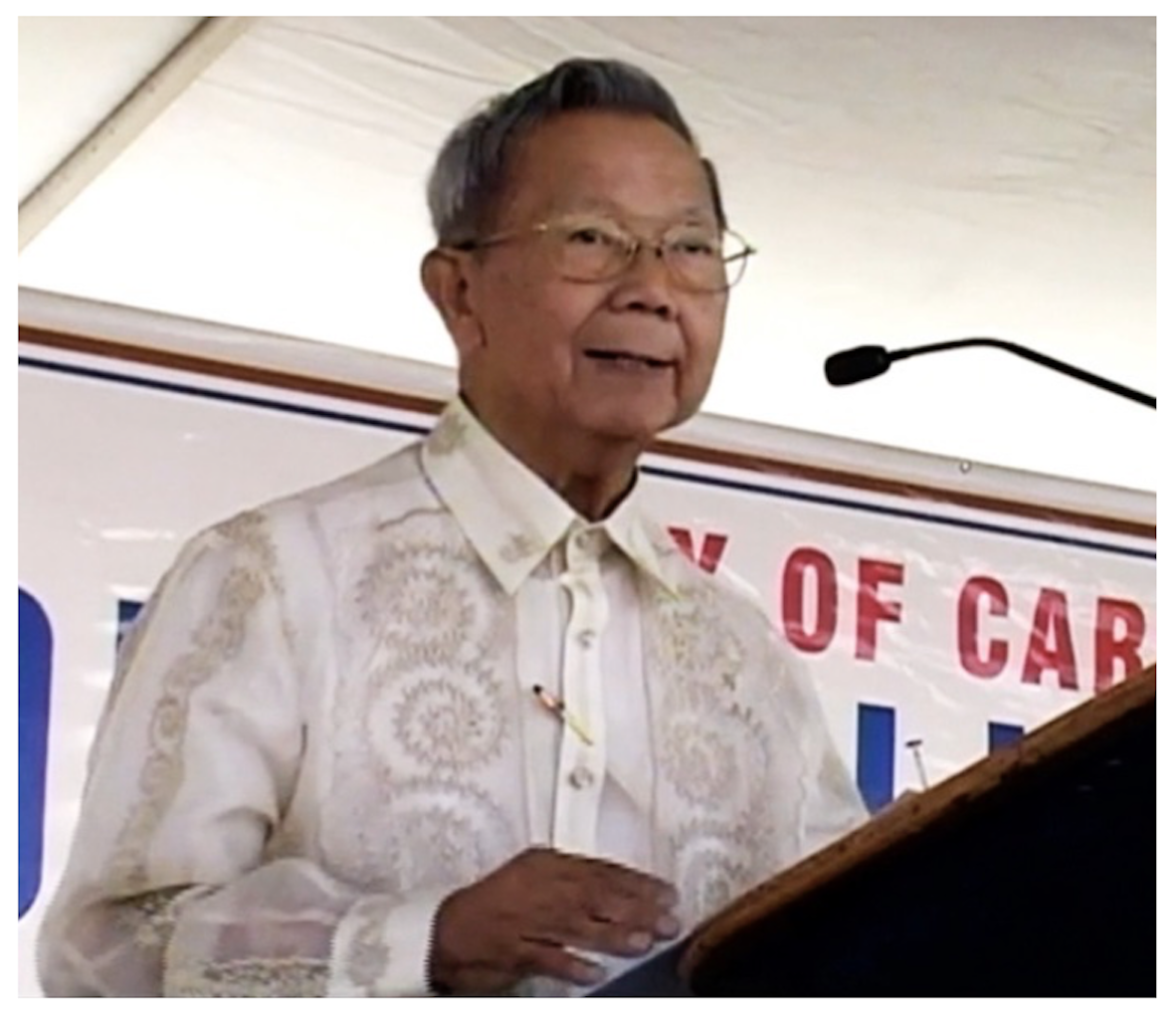






Larry Itliong during the 1965 Delano Grape Strike in California. (Courtesy of the Filipino American National Historical Society)
Before César Chávez became the face of America’s farmworker movement, Filipino organizer Larry Itliong had already led hundreds to strike for dignity in California’s grape fields. Decades later, from Delano to Pangasinan, his family and community are ensuring his story is finally told.
DELANO, Calif – In the fertile heart of California’s Central Valley, the story of America’s farmworker movement is usually told through one name. Most remember César Chávez, the soft-spoken crusader who marched through Delano’s vineyards for justice. But long before the movement became a national symbol, another leader had already lit the fuse of solidarity: a Filipino organizer named Larry Itliong, whose call for fairness helped change the landscape of American labor.
Born Modesto Dulay Itliong on October 25, 1913, in San Nicolás, Pangasinan, when the Philippines was still under U.S. rule, he arrived in America at 15, chasing the promise of education and opportunity. What he found instead were the harsh realities of hard labor in asparagus fields, salmon canneries, and railroad camps across the West. Those years forged a creed that never left him: no one’s work should come at the expense of their dignity.
By the 1930s, Itliong had become a fixture in the labor scene, helping organize Filipino cannery workers who later formed ILWU Local 37, one of the first predominantly Asian-Pacific unions in the country. Gruff, sharp-witted, and unafraid to speak truth to power, he once said, “Because in that Constitution, it said that everybody has equal rights and justice. You’ve got to make that come about.”

The Delano turning point
In May 1965, as head of the Agricultural Workers Organizing Committee (AWOC), Itliong led Filipino grape pickers in the Coachella Valley to strike for fair pay. On September 8, 1965, more than 800 Filipino farmworkers in Delanowalked off the fields, demanding an end to poverty wages.
Itliong knew the strike could not last without allies. He turned to César Chávez and Dolores Huerta of the National Farm Workers Association (NFWA), urging them to join. On September 16, after days of debate, the NFWA voted unanimously to stand with their Filipino counterparts, creating one of the first major interracial labor alliances in U.S. history.
By 1966, the two groups merged to form the United Farm Workers (UFW), with Itliong as assistant director. Their five-year boycott of California grapes drew support from churches, students, and consumers across the country. By 1970, the strike had won landmark contracts guaranteeing higher wages, rest breaks, and health benefits, victories that redefined the rights of agricultural laborers nationwide.
The fight beyond the fields
For Itliong, justice went beyond wages. Many of his Filipino peers, known as the manong generation, were aging bachelors who had spent decades living in crowded labor camps, isolated by immigration laws and racial barriers. Itliong fought to give them dignity in their later years. His vision led to the creation of Agbayani Village, a retirement community built by volunteers on UFW land in Delano’s Forty Acres. The village still stands today, quiet among the vineyards, as a living monument to solidarity.

Yet within the UFW, Itliong grew disillusioned. He believed Filipino workers were losing influence in the union they helped create. In 1971, he resigned but continued his advocacy until his death in February 1977 from ALS, at age 63.
The missing chapter
In the decades that followed, Itliong’s name faded from the mainstream narrative. Textbooks celebrated Chávez and Huerta but rarely mentioned the Filipino men who first walked off the fields. Scholars later described it as a failure of movement memory, a simplification of complex coalitions into single heroic figures.
For Filipino Americans, reclaiming Itliong’s story became an act of justice.
A legacy reclaimed
That reclamation began to take shape in 2015, when Governor Jerry Brown signed Assembly Bill 7, declaring October 25 as Larry Itliong Day in California. Every year since, state leaders, including Lt. Gov. Eleni Kounalakis and Gov. Gavin Newsom, have reaffirmed the observance and urged schools to include Filipino farmworkers in labor history curricula.
The City of Carson became the first to hold a local celebration, featuring student contests, cultural showcases, and lectures by Johnny Itliong, Larry’s son. Other communities, including Los Angeles, Delano, Stockton, and San José, soon followed with their own tributes.
In San José, Filipino American organizers have been campaigning to rename a downtown walkway “Larry Itliong Way”and to install a large mural at San José State University, expanding the geography of remembrance.
Painting history back into view
Public art has helped keep Itliong’s image alive. In Los Angeles’s Historic Filipinotown, artist Eliseo Art Silva’s mural Gintong Kasaysayan, Gintong Pamaná (A Glorious History, A Golden Legacy) has, since 1995, depicted Filipino heroes, Itliong among them, across 150 feet of vivid color at Unidad Park. Now one of the largest Filipino American murals in the United States, it serves as both monument and classroom.
In 2021, Silva carried that vision home. At the request of Itliong’s youngest daughter, Patty Itliong Serda, he painted a new mural on the library wall of Morningside Elementary School in Delano, where she works as librarian. Students joined in, transforming their campus into a living tribute to the labor leader who once walked their town’s dusty roads.
From California to Pangasinan
Nearly half a century after his death, Itliong’s hometown has taken up his memory. On October 25, 2024, San Nicolás, Pangasinan, where he was born, held its first Larry Itliong Day in the Philippines following a municipal ordinance passed the previous year.
The celebration was organized by The Filipino School, operating as The Filipino Story Studio, which raised tax-deductible funds for student programs, including a speech contest themed after Itliong’s 1965 rallying cry: “Di Ka Pasisiil” or “Never Give Up.”
Following its success, organizers scheduled the celebration to return on October 24–25, 2025, positioning Larry Itliong Day Philippines as an annual hometown tradition that connects the youth of Pangasinan with Filipino Americans abroad and brings the movement’s spirit full circle from California’s vineyards back to the soil where Itliong was born.

Family and future
While murals preserve his image, Johnny Itliong carries his father’s words across campuses and community halls, reminding audiences that the Delano movement was built not by one man but by many hands across cultures. His advocacy, along with the children’s book Journey for Justice: The Life of Larry Itliong and the work of the Filipino American National Historical Society, has restored his father’s place in America’s labor story.
A lasting lesson
Larry Itliong’s story endures as both lesson and testament. Progress, he proved, is never the work of a single figure. It is the sum of countless quiet acts of courage. He believed that solidarity across race and language was not idealism but survival, and that equality, once promised, must be defended in every generation.
As grapes ripen again in the San Joaquin Valley and murals in Los Angeles and Delano glow under the sun, his presence lingers not as a relic of the past but as a reminder that the struggle for dignity is a harvest still being gathered.