





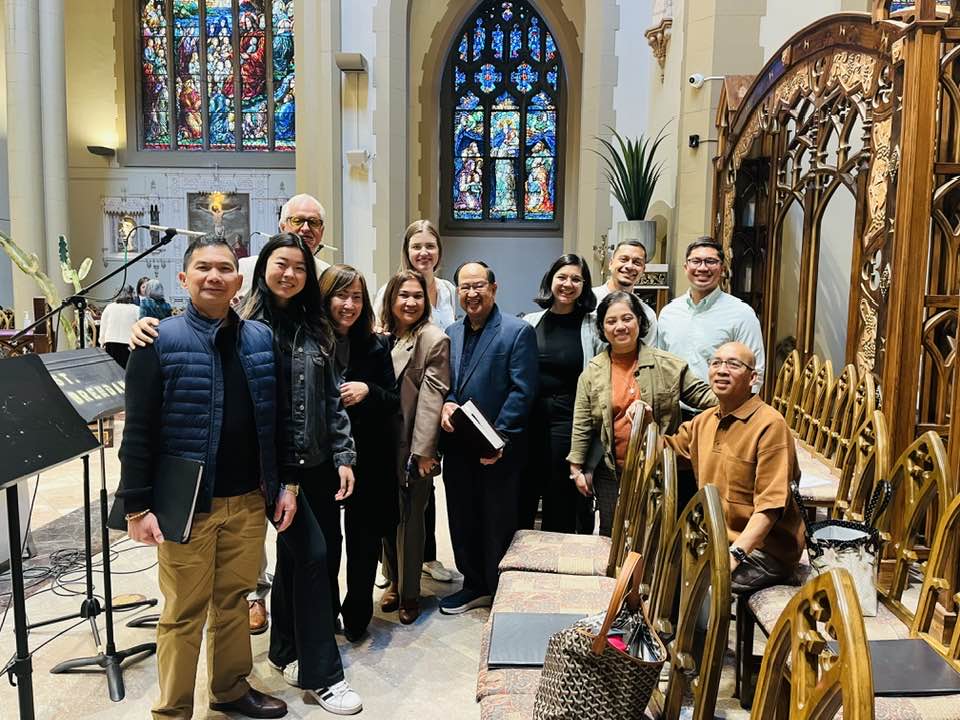
Fil-Am community during Holy Week celebration at St. Brendan Parish Church
MANILA — As Holy Week unfolds across the Philippines and Filipino communities worldwide, its modern expressions – livestreamed liturgies, full-capacity tourist hubs, and diaspora-led devotions – remain anchored in a tradition that spans two millennia. The evolution of Filipino Holy Week reflects continuity as much as change, shaped by faith, history, and shifting social realities.

Biblical origins and early foundations
Holy Week traces its origins to the Passion, death, and Resurrection of Jesus Christ, as recounted in the Gospel of Matthew, Gospel of Mark, Gospel of Luke, and Gospel of John.
By the 4th century, early Christians in Jerusalem were already marking these events through processions and liturgies tied to specific sites. The Council of Nicaea helped standardize the date of Easter, providing a structure that continues to guide Christian observance worldwide.
From colonial transmission to Filipino tradition
Holy Week was introduced to the Philippines in the 16th century through Spanish missionary activity. Over time, Catholic rites merged with local customs, producing a distinctly Filipino expression of devotion.
Practices such as the Pabasa, a continuous chanting of the Passion, draw from oral traditions, while the Senákulo, a dramatization of Christ’s suffering, reflects both European influence and local theatrical culture. Visita Iglesia, the visitation of multiple churches, mirrors pilgrimage traditions but has become a widespread communal practice across Philippine provinces.
These forms established Holy Week as both a religious observance and a cultural institution.
A nation once defined by stillness
For decades, Holy Week in the Philippines was marked by a near-total slowdown. Broadcast networks limited programming, businesses closed, and public transportation was reduced.
Good Friday, particularly from noon to 3 p.m., was widely observed as a period of silence and reflection. Communities gathered for the Pabasa, reinforcing a shared participation in the Passion narrative. This collective pause defined the traditional experience for much of the late 20th century.
Continuity in a digital era
In recent years, observance has expanded into digital spaces without displacing traditional practices.
Churches now livestream liturgies, allowing participation beyond physical boundaries. Online Stations of the Cross and prayer services have become common, particularly following the pandemic-era shift toward virtual access.
The Catholic Bishops’ Conference of the Philippines (CBCP) has encouraged moderation in digital media use during Lent, framing restraint as a contemporary form of reflection. These efforts reflect an ongoing adaptation to changing patterns of communication.
Mobility and economic realities
Holy Week today intersects with the demands of a modern economy.
The Department of Labor and Employment (DOLE) classifies Maundy Thursday and Good Friday as regular holidays. At the same time, the Department of Tourism (DOT) reports sustained travel demand during the Lenten period, with major destinations such as Boracay, Palawan, and Cebu experiencing high occupancy. For many Filipinos, the observance now includes both religious and leisure activities.
A global observance
For millions of Filipinos overseas, Holy Week has become a transnational practice.
Philippine diplomatic posts and Filipino communities organize religious services abroad, while traditions such as Pabasaand Visita Iglesia are adapted to local contexts. The Department of Foreign Affairs (DFA) advises Filipinos in certain regions to observe local regulations, leading to more discreet forms of worship where necessary.
Digital platforms further connect diaspora communities, enabling real-time participation in services from the Philippines.
Tradition and public health
Some forms of devotion remain physically demanding. In parts of Pampanga, penitential practices such as self-flagellation and voluntary crucifixion continue among a small number of devotees. While not endorsed by the Catholic Church, these practices persist as localized expressions of faith.
The Department of Health (DOH) regularly issues advisories on heat, dehydration, and safety risks during Holy Week, particularly as large crowds gather.
An enduring observance
Holy Week in 2026 reflects a layered tradition – rooted in early Christianity, shaped by colonial history, and adapted to contemporary life.