






By Janet Susan R. Nepales
We arrived at the Geffen Playhouse’s Audrey Skirball Kenis Theater without any expectations.
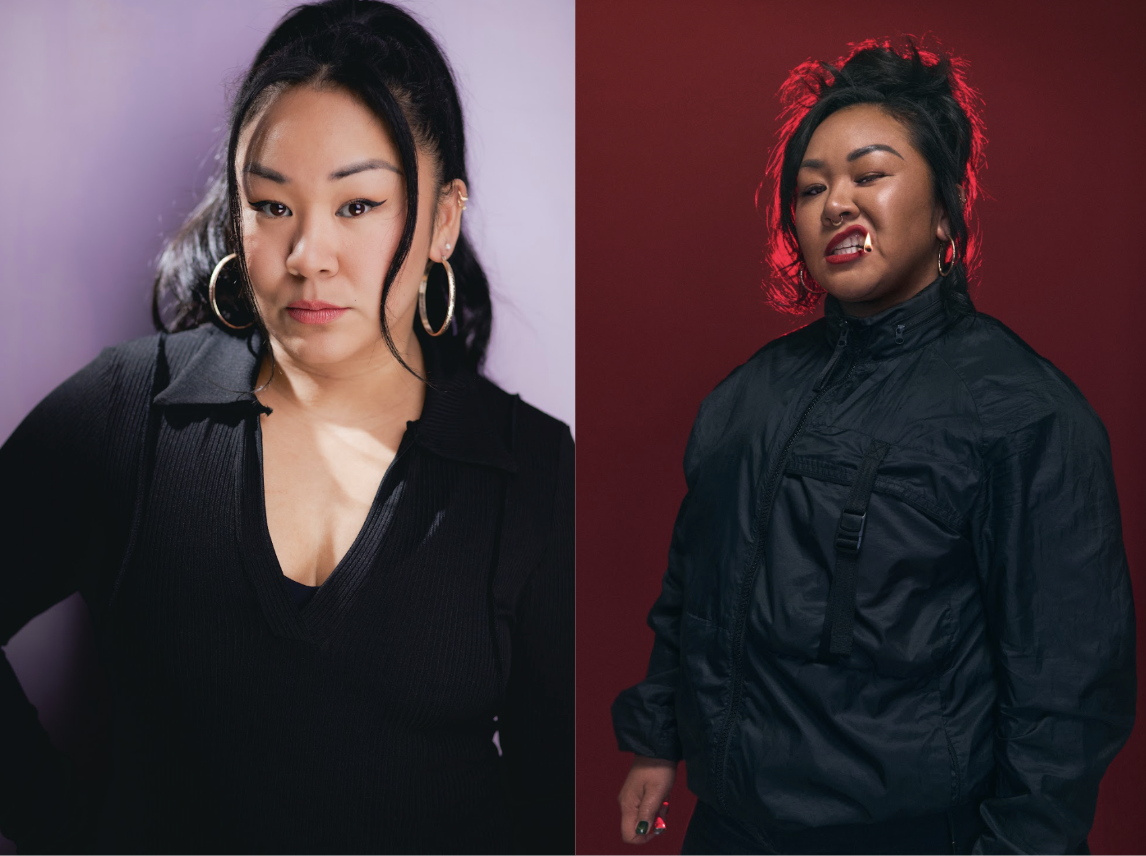
Until actress Sara Porkalob arrived onstage to do her almost two-hour, one-woman show in “Dragon Mama” and blew us away.
Aside from being the creator, writer, and actress of her play “Dragon Mama,” she portrayed 28 characters. Who does that?
I have seen actors do two characters in a play or a movie, but 28? It is simply a superhuman feat to be able to do that.
What was impressive with Porkalob is that she can shift from one character to another—from a little boy to a grandmother, or a mother to a child—in a split second without even losing her beat, and with great emotional characterization for each. You can immediately feel the emotions of each character and see the changes in her portrayal.
Then she also breaks into song, and she is once again perfect as a singer.
This super-talented powerhouse, who has a knack for verbal and physical comedy in split seconds, will truly surprise you.
Asked how she was able to do 28 characters in her almost two-hour show, Porkalob explained to us in an exclusive virtual interview, “Just practice. A lot of young people give up so easily. You can’t blame them. Everybody wants to be good at something automatically. But I knew that if I was going to do this all by myself, I had to practice.
“I saw the women in my life fail and get back up, start all over again. They never gave up. Nobody in my family has ever given up. So I was like, why would I give up just because I’m not good the first time? The fact that I look so good up there and I make it look so easy is because I’ve worked so hard. I have put more than 10,000 hours of work into my style of performance, solo performance.
“I don’t even really know anybody in my industry who does it like me. Some people can play a handful of characters. We’re even seeing it in movies where people are playing two characters at the same time. But I don’t know anybody else who can play 28 characters the way that I do.”
“Dragon Mama” is actually the second part of the trilogy “The Dragon Cycle,” which Porkalob created about her Filipino American gangster family, with one play for each generation built around a central female protagonist.
The award-winning artist, activist, and creator relives and narrates her painful family story with the trilogy, which honors her family—from her grandmother Maria Sr. in “Dragon Lady” to her mother in “Dragon Mama,” and herself in “Dragon Baby”—three generations of Filipinas who, despite the challenges they encountered, have survived, thrived, and loved. You will laugh; you will cry; you will be moved.
In an exclusive interview, Porkalob revealed to us how she started the trilogy.
“It really started in my senior year of undergrad in 2012,” Porkalob narrated. “I was attending a predominantly white private liberal arts college, getting my BFA, and I was terrified and angry at the prospect of graduating into the real world of theater.
“Feeling like there wasn’t much representation—not only out there in the world for musical theater majors, for Filipinos like myself, and queer Americans like myself—but also feeling mad at the last four years of my education, like my teachers hadn’t really set me up for success the way that a lot of my white peers had been set up for success. And really, to reclaim my power, I decided to write my own stuff.
“I grew up in a family of storytellers. Everybody in my family sings. Everybody’s creative. So it made sense that, as a young 22-year-old, I would write about what I knew, and what I knew was my family. So that’s where it started.”
The talented and charming Porkalob described her grandmother, her inspiration for “Dragon Lady.”
“My grandmother is a firecracker,” she began. “She was so glamorous growing up. Some of my earliest memories were watching her get ready for work and watching her do her hair, put on her matching outfits with her heels and her nails. And she was just so powerful. She was maybe only five feet one, but whatever room she walked into, she commanded it.
“And my earliest memories were of her encouraging me to do whatever I wanted. She used to tell me, ‘You’re going to win Star Search one day and pay for my retirement.’ She would have me sit on her lap while she sang karaoke. So I grew up singing old songs with her. She would take me to work when she worked at the bingo hall, when there was nobody to babysit me, and I would watch her work.
“She would charm everybody, be so social. But at the same time, she was very volatile. One minute she could be sweet, and the next minute she could be angry, as I’ve seen her. I have seen her take six-foot-tall men to the ground. They would sexually harass her at the bingo hall, grabbing her as she walked by.
“And one of my memories was her taking a beer bottle and breaking it over a guy’s head—not even wrestling. She practiced karate or something. So she was able to get him on the floor in a split second, and she was stepping on his neck. She was pointing the broken bottle at him and saying, ‘If you ever touch me again, I’m going to cut you.’ She was a complicated woman.”
“Dragon Lady,” which premiered in 2017 at the Intiman Theatre in Seattle, Washington, had its Los Angeles premiere at the Gil Cates Theater of the Geffen Playhouse in 2024.
It was about Maria Porkalob Sr., Porkalob’s grandmother, who passed away in 2023. A former lounge singer who escaped a gangster-controlled nightclub in Manila to become a free-range mother of five in the United States, Maria Sr. is a matriarch not to be trifled with.
In “Dragon Mama,” which is showing now at the Geffen Playhouse’s Audrey Skirball Kenis Theater until April 12, Porkalob dramatizes her mother Maria Jr.’s struggles as the eldest daughter of an immigrant mother, an absent father, and a society that fails immigrant families—forced to grow up too soon and act as a surrogate mother to her four siblings while trying to balance her intersectional identity: poor, queer, brown, and an immigrant. She longs for a more open, more diverse life than Bremerton, Washington, can offer her and must decide whether to leave her debt-ridden mother, four siblings, and newborn daughter for the unknown of Alaska, or stay close to home.
As for her mother Maria Jr., her inspiration for “Dragon Mama,” Porkalob described, “My mother was complicated in a different way, but also in a similar one. My mother had that powerful streak in her, too. I remember growing up and going to kindergarten in Alaska. I came home one day because a little boy had beaten me up on the playground—he wanted the swing or something. I came home crying, and I told my mom what happened. She sat me down and said, ‘Tomorrow, when you go back to school, if he bothers you again, I want you to hit him so hard he never bothers you again.’
“And I was like, what? She said, ‘I don’t ever want you to come home from a fight as the loser. Do you hear me?’
“But my mother was really social. She loved working with children. I always had a cool mom. Whenever there were field trips, everybody wanted to be in her group. She was just so kind to every single child she encountered. Everybody wanted her to be their mom. So she was powerful, charming, and sociable in a different way than my grandmother.
“She was never violent toward me. She never spanked me or anything like that, except for that one time that shows up in the show, which I don’t even remember. I grew up, and then Tina, my other mom (her partner), I grew up raised by three very strong, intelligent, hilarious, charming, and beautiful women.”
In “Dragon Baby,” which is currently in development, the three-act genre tells more of Porkalob’s own story. The first in her family to attend college, Porkalob is faced with her parents’ ugly breakup and midlife crisis and devotes her time and energy into writing the next Great American Musical and being a playwright and actress.
Picking up where “Dragon Mama” left off, we will follow Porkalob’s journey from the queer communal house of her childhood in Anchorage, Alaska to her teens in her conservative hometown of Bremerton, Washington to the hallowed halls of a Seattle liberal arts college as she deconstructs her white supremacist education, juggles five jobs including but not limited to a phone sex operator, a drug dealer, and a pizza call center aide, and ultimately her purpose in the universe.
It must be challenging to write about herself and her experiences for the last part of this trilogy, we asked this Cornish College of the Arts at Seattle University alumna.
She admitted, “Yes, it is so hard. I’m not even done. I’m in the middle. So, you’re finding me in the middle of figuring this out. It’s harder than writing about my mother. Harder than writing about my grandma. It’s vulnerable in a different way because with my grandma, I have some distance. Even with my mother, I have some distance. But to then put my story out there, in a lot of ways, the biggest challenge is thinking that I don’t have a story that’s as compelling or as interesting as theirs.
“So, then I’m like, what do I have to like? So what? I had a hard time in college. Everybody experiences racism. So what? Who cares? That’s not new. But I just have to believe that the story I have to offer, and especially my audience, they really want to see how I came to do this work, and how I came to do this work is actually part of my life story. So, I just got to believe in that.”
Growing up, did any comediennes or stand-up comedians influenced her?
“Growing up, I loved watching Whoopi Goldberg and Carol Burnett,” she revealed. “I also grew up watching those sketch comedy shows ‘In Living Color’ and ‘Mad’ TV. Funnily enough, my family didn’t watch SNL.
“Comedy was a huge part of my upbringing. I grew up watching a lot of movies. I actually didn’t start seeing that many plays until I was in college because plays are expensive. So, I feel like even the way that I write my plays is more influenced by movies and TV that I grew up watching and music that I listen to, rather than other musicals and other stage plays.
When I first watched it, I was ten years old. So, in 1999, it was the first movie that my parents saw on a date together that had a huge influence on me. I grew up reading Amy Tan. Also, Toni Morrison had a huge influence on me. Jane Austen, I read all of her books. I know all of her books, like ‘Front to Back,’ ‘Anne of Green Gables,’ obviously.
“My grandmother was a character in her own right. So, I would say all of my idols growing up were either in literature or film. Funnily enough, I didn’t even know who Lea Salonga was until I was in high school.”
Asked how she prepares and psyches herself before each performance, or her usual preparation routine, Porkalob told us, “So I’ve been a weightlifter, serious weightlifter for five years now. I train about three or four times a week. Hydration is key. I drink so much water every day. I do a physical warm-up and a vocal warm-up, probably about half an hour of warm-up before my show. And then, I review my lines, but I pretty much know them.
“I review my notes from my director (Andrew Russell), the first week of previews. Then I usually do like the first ten minutes of the play in my dressing room, just saying all the lines and doing all the blocking and stuff just to get ready for the show.”
So how did she discover her director, Andrew Russell, and how did she collaborate with him all these years?
Porkalob answered, “Andrew Russell and I met in 2017 in Seattle. Now I knew who he was and he knew who I was, but we hadn’t worked together until 2017. At that time, he was the artistic director of a theater there called Intiman Theatre, and Intiman Theatre was workshopping a new leadership model, and 2017 was their second year of workshopping this new leadership model called the Co-Curator Model, where they would bring in somebody from the community to help them plan the season, sit on the board, and then they would let the co-curator and their area of expertise influence the kind of the programming for a year.
“So, they asked me to be the co-curator in 2017. I’d been making my name in Seattle, not only as a solo performer, but as a director, as an educator, and as an activist. I was writing a lot of theatrical critique from a feminist POC lens, and they wanted basically a young person in their early career to help them plan the season.
“So, Andrew and I met and he saw a production of ‘Dragon Lady,’ which included four courses of Filipino food at this theatre called Cafe Nordo. And he was like, we need to program that at our theater. You need to have a regional theater debut. I was like, okay. Then we workshopped the play for two weeks, and that’s when the idea of a trilogy emerged. We’ve been working together ever since.”
We complimented Porkalob on her singing a Whitney Houston song in “Dragon Mama” and asked her why she chose that song and if she was going to do more singing in “Dragon Baby.”
“Whitney Houston is an icon,” she pointed out. “Anybody who sings or calls them a singer can’t deny her excellence and her repertoire. I grew up listening to Whitney Houston, and when my mother actually met my other mother, Tina, at the only gay bar in Anchorage, Alaska, Tina was actually on stage singing a Whitney Houston song. So, it made sense that if I was going to write their love story and how they first met, that of course Tina would be singing a Whitney Houston song.
“It’s also thematically, that song ‘I Have Nothing’ is really about being in love with somebody who’s your whole world. My mother, up until that point in her life, hadn’t ever had a romantic relationship. That was like fulfilling on both sides. That was equal.
“Tina would end up being the great love of her life and a huge positive influence on me. Of course, in ‘Dragon Baby,’ I will have more music for sure. More music than ‘Dragon Mama.’ Maybe as much music as ‘Dragon Lady’ had. So, we’ll see.”
As for her plan to do a TV adaptation of her “Dragon Cycle,” Porkalob explained, “Well, honestly, that’s all that it is right now. It’s just hopes and dreams. I’m working on my pilot. I’ve never made TV before, so the biggest challenge is I’ve never made it before.
“And you know, TV and film are a different industry than theater. I have a feeling that just like in the theater world, where I had to independently produce my plays for five years before people started to notice, I have a feeling that’s what’s going to happen in the TV world.
“A lot of people who are seeing the work are so supportive, and they want to connect me with other people. But one thing that’s really important to me and so consistent in my journey is how my team and I preserve creative integrity. It’s a little nerve-racking to consider that a TV producer with a lot of money might come over here and be like, your story is amazing. Now I want you to change all these things.
“I need a team that is ready to support the story as it is and can envision it in a TV adaptation in an empowering way, rather than trying to sanitize it or make it consumable for wider audiences. So right now, it’s hopes and dreams. I’m just being patient.
“TV and film are very fickle. You could work with one producer at a company one day, and the next month, they’re laid off. That’s just how it is. So, I don’t want to pin my hopes and dreams all in one basket. I know at the end of the day, I can do it on my own with like-minded people who are aligned with the work, but I’m not in a rush to find those people.”
So why does she think “Dragon Mama” is relevant now?
“’Dragon Mama,’ at its heart, is a coming-of-age story. Everybody’s young once upon a time. Everybody gets old if we’re lucky. I have never seen a young Filipina lesbian coming-of-age story that is empowering and hopeful and not tragic. So, it’s relevant because it showcases to other queer, lesbian, and gay people that their stories matter, that their identity as a queer, lesbian, or gay person isn’t only valuable to our industry when it’s wrapped up in tragedy. Because then, what does that tell other people who aren’t gay or lesbian or queer? It tells them that gay, lesbian and queer people have only tragic stories.
“That’s not true. It’s also important because my mother, as a young woman, became a mother before she even really got to be free as a young adult. I can’t imagine having a baby at 19. I’m 37. That means that if I had a kid, they would be 17 right now.
“I cannot imagine a 17-year-old in my house. So, it’s important to showcase that, like becoming a parent at a young age. That’s the reality for so many Americans. It’s not the end of the road for those people.
“Young people are so resilient that they have the grit and the determination to change their lives. As we get older, we forget to look at young people for inspiration. So many times, we become jaded, and we’re like, well, they don’t know. They didn’t go through what I went through. We just have to remember that children, young people, are very smart emotionally and otherwise, and they can envision a more hopeful future than those of us who are old and jaded can oftentimes.”
***
Janet Susan R. Nepales is an award-winning journalist and the first Filipina voting member and Associate of the Golden Globe Awards. She has been a member since 2008 and is the first Filipina to be elected to the Advisory Board. She is the author of the coffee table book “FASHION. Filipino. Hollywood. The World” and the co-author of the first FWN book “DISRUPT: Filipina Women: Proud. Loud. Leading Without A Doubt.” A graduate of UST (AB Journalism, cum laude), she is based in Los Angeles and is a Hollywood entertainment journalist and TV correspondent.