
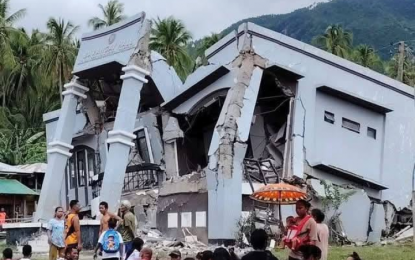
The collapsed Malalan Barangay Hall in Jose Abad Santos, Davao Occidental, shows the force of the magnitude 7.8 earthquake that struck off Sarangani on Monday morning, June 8, 2026. House Speaker Faustino “Bojie” Dy III urged vigilance, unity and swift action as officials assessed damage and coordinated response efforts in affected Mindanao communities. (Photo by Jurel Bayang – Philippine News Agency)
The offshore Sarangani earthquake struck as public schools reopened, prompting tsunami warnings, emergency inspections and a wide government response across southern Mindanao.
MANILA — A magnitude 7.8 earthquake struck off Sarangani on Monday morning, June 8, damaging schools, roads, bridges, hospitals and commercial buildings across parts of Mindanao as authorities worked to verify casualties, inspect weakened structures and account for displaced families.
The Philippine Institute of Volcanology and Seismology said the quake struck at 7:37 a.m. offshore of Sarangani, near Maasim town, at a depth of about 33 kilometers. PHIVOLCS classified it as a major offshore earthquake and warned that damage and aftershocks were expected.
The tremor was felt across a wide area of Mindanao and beyond the southern Philippines. Strong aftershocks followed through Monday, including one measured at magnitude 6.7, according to official monitoring reports.
President Ferdinand Marcos Jr. ordered national agencies to coordinate with local governments, prepare relief supplies, open evacuation centers where needed and support rescue and damage-assessment operations.
“The national government is moving and we will not leave Mindanao behind,” Marcos said in a statement.
The earthquake struck as public schools reopened nationwide for School Year 2026-2027, compounding the disruption for students, teachers and local governments. The Department of Education said more than 6,000 schools were affected, a figure that includes class suspensions, safety inspections, reported damage and other operational interruptions.
Education officials were assessing which campuses could safely resume classes and which would require repairs, temporary learning spaces or alternative arrangements.
In General Santos City, one of the communities closest to the epicentral area, authorities reported damaged structures and ordered inspections of public buildings, roads, bridges and commercial establishments. A hospital was evacuated after cracks were found on upper floors, according to initial field reports. A building at Notre Dame of Dadiangas University also collapsed, with authorities reporting that no one was inside at the time.
Damage was reported beyond General Santos. In South Cotabato, a portion of a highway was reported to have collapsed after the strong shaking, raising concerns about whether key routes remained safe for rescue teams, ambulances, relief trucks and evacuees. Authorities advised motorists to avoid damaged road sections while engineers inspected affected routes.
Officials also reported deaths and injuries in South Cotabato, Davao Occidental and Balut Island, with initial assessments attributing casualties to falling debris, a damaged mosque and a landslide. In Malita, Davao Occidental, a canopy roof at Mahayahay Elementary School collapsed as students reacted during the quake. Disaster officials said students in parts of Mindanao suffered bruises or fainted in panic during morning school activities.
The quake triggered tsunami warnings in the southern Philippines and nearby areas. Tsunami waves were monitored in parts of Sarangani and Sultan Kudarat, including a wave of about 1.4 meters recorded in Kiamba, Sarangani. Authorities later said the wider tsunami threat had largely passed, though coastal residents were advised to continue following local safety guidance.
The Department of Energy said it was coordinating with electric cooperatives, distribution utilities and fuel-industry stakeholders to assess power lines, substations, fuel depots and retail stations in Sarangani and nearby areas. Transmission disruptions were also reported in parts of Mindanao. The department said it was consolidating reports on energy facilities and monitoring the supply of electricity and petroleum products in affected communities.
he Office of Civil Defense said it was receiving reports of major infrastructure damage while local governments continued to verify casualties, structural damage and displacement. The Department of Social Welfare and Development ordered field offices to prepare aid for affected communities.
Casualty figures remained provisional Monday as local governments, police and disaster agencies reconciled reports from the ground. Officials reported deaths and injuries in several affected areas but cautioned that totals could change as inspections and search operations continued.
The Philippines lies along the Pacific Ring of Fire, where earthquakes and volcanic activity are frequent. Across Mindanao, authorities continued inspecting schools, hospitals, bridges, ports, roads, power facilities and public buildings while warning residents to stay away from damaged structures as aftershocks persisted.