






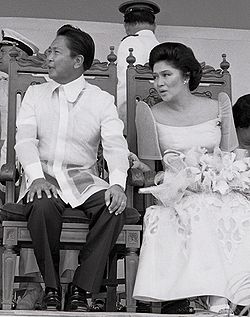
Former Philippine President Ferdinand E. Marcos and First Lady Imelda R. Marcos are shown at a public event during the Marcos administration. The Sandiganbayan recently dismissed the remaining unresolved claims in Civil Case No. 0141, a long-running government forfeiture case filed in 1991, while earlier court-ordered recoveries involving Swiss deposits, Arelma assets, jewelry and other properties remain in effect. (Photo: Public domain/Wikimedia Commons)
MANILA — A Philippine anti-graft court has dismissed the remaining unresolved claims in one of the government’s largest and longest-running efforts to recover assets allegedly amassed by the family of former President Ferdinand E. Marcos, bringing to a close a forfeiture case that began more than three decades ago.
In a resolution promulgated on June 2, the Sandiganbayan’s Second Division dismissed the remaining portions of Civil Case No. 0141, a forfeiture action filed by the government in 1991 through the Presidential Commission on Good Government (PCGG). The court said the dismissal applied only to properties not already covered by previous judgments and forfeiture orders.
The ruling does not affect earlier court decisions that transferred substantial assets to the Philippine government, including Swiss bank deposits, assets held through Arelma Inc., the Malacañang jewelry collection and proceeds from artworks that courts previously determined were subject to forfeiture.
Civil Case No. 0141 was filed on Dec. 17, 1991, as part of the government’s post-1986 campaign to recover alleged ill-gotten wealth linked to the Marcos family and their associates. According to court records, the petition covered a broad range of assets, including corporations, bank accounts, real estate holdings, jewelry, paintings and other properties. The complaint placed the value of the assets involved at roughly $5 billion, excluding properties already covered by separate cases.
Over the years, portions of the case were resolved through separate rulings.
The most prominent involved approximately $658 million in Swiss deposits that the Supreme Court ultimately ordered forfeited in favor of the state. Other rulings upheld the forfeiture of assets associated with Arelma Inc., a corporation found by the courts to have held funds linked to the Marcoses, as well as the Malacañang jewelry collection and other identified properties.
The remaining claims stayed pending for years as the litigation continued.
Court records show that in recent hearings, the Sandiganbayan repeatedly asked government lawyers whether they intended to continue presenting evidence on properties still listed in the original petition but not covered by earlier judgments. In May, the court questioned state lawyers about delays in presenting evidence and witnesses related to the unresolved assets.
The government subsequently informed the court that it would no longer present additional evidence regarding the remaining properties. According to the Sandiganbayan resolution, the position was based on advice from the PCGG that most of the assets identified in the petition had already been recovered through various proceedings and judgments.
With no further evidence to be presented on the unresolved properties, the court dismissed the remaining claims.
The resolution leaves intact all prior forfeiture judgments obtained by the government under Civil Case No. 0141 and related proceedings. It closes only the unresolved portion of the 1991 petition that remained pending before the anti-graft court.
The PCGG, created in the aftermath of the 1986 People Power uprising, has reported recovering hundreds of billions of pesos in cash, shares, real estate and other assets from the Marcoses and their associates through settlements, forfeiture proceedings and court judgments. Civil Case No. 0141 was among the most significant cases filed as part of that recovery effort.