






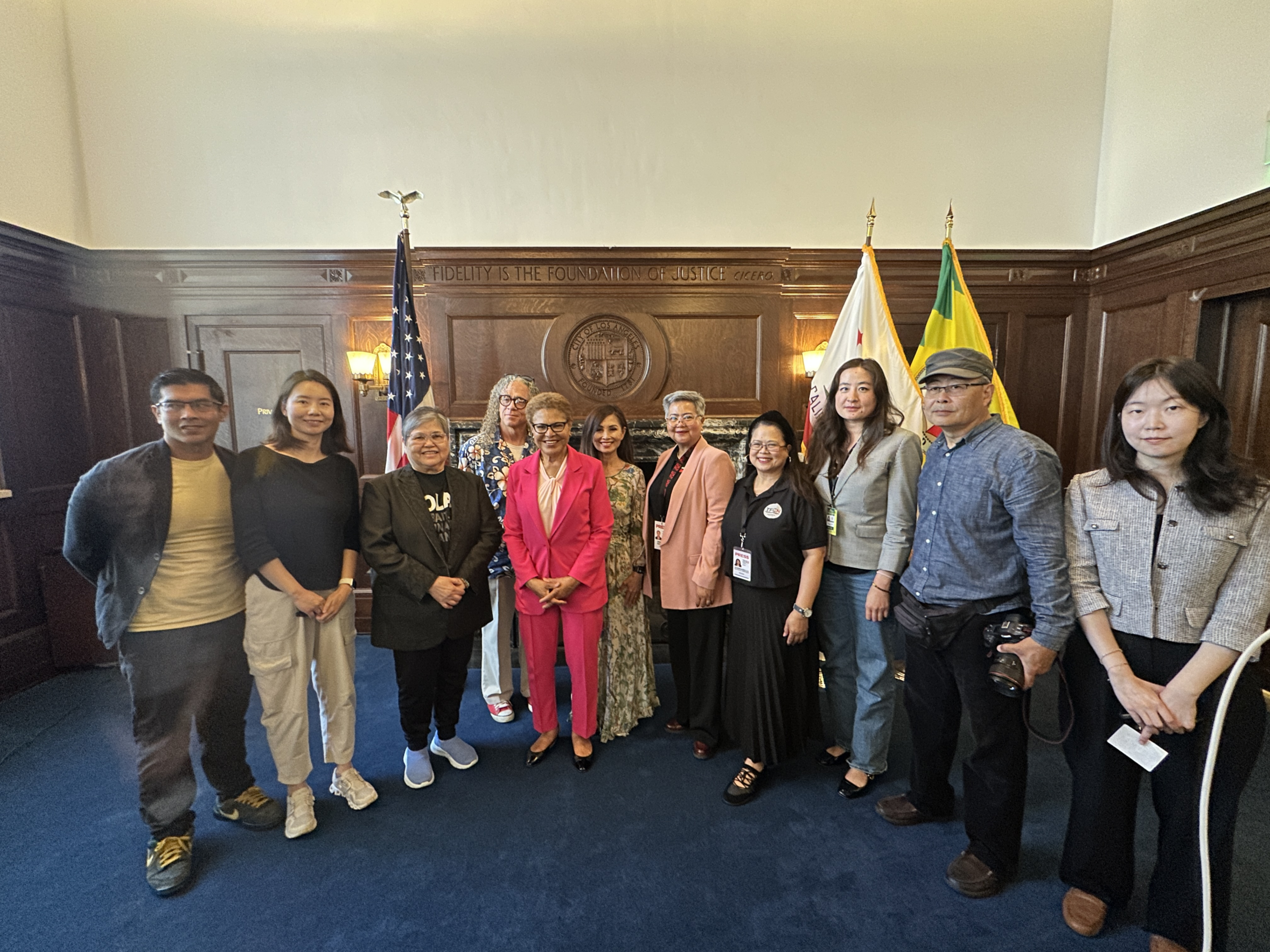
Mayor Karen Bass enthusiastically greeted 17 media folks representing Asian Journal, Rafu Shimpo, Philippine Post, Bilyonaryo News Channel, The Filipino Correspondent Network, World Journal, Chinapress, UNE News Express, Yonhap News, JTBC, Chosun Daily LA, The Local, Korea Times, Korea Daily, The Filipino Channel and SoCal Filipinos, who arrived promptly, and said: “It has been an amazing honor and privilege to serve as mayor for 3 ½ years, and I look forward to taking it to another level for the world events.” She thanked us for coming to LA City Hall, despite the commute challenges. We gathered promptly at 1 p.m. on May 23, 2026, warmly welcomed by Jieun Kim, deputy director of Korean Language Communications, and Eduardo Soriano-Hewitt, senior policy director of the Office of Mayor Karen Bass.
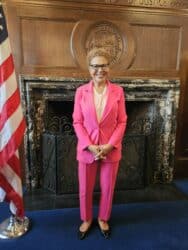
She heads a city with about 3.8 million residents and one of the most linguistically diverse populations in the country. “I want you all to have access to us,” Bass emphasized. Given the organized themes of this briefing: housing and homelessness, public safety, economic development, small business, immigrant and language access initiatives and city services and infrastructure, it appears that this hands-on mayor has her pulse, her heart and her mind on what this city needs.
She described that her focus is revitalizing key neighborhoods that used to be tourism magnets: Chinatown and El Pueblo. She hailed Little Tokyo as the standard for a revitalized community, bustling on weekends, attracting tourists and out-of-town visitors, visiting the Shohei mural and the Dodgers shop, and showing how the Dodgers have become Los Angeles in enthusiastic energies.
Unfolding of world events and business development
Mayor Bass shared the unfolding of world events in this city: Golf FORE Her for girls from June 4 to 7 across 10 city-owned golf courses; the staging and viewing of World Cup games during the 2026 tournament period, all throughout our city; and, in two years, the 2028 Olympics.
The groundwork has already begun, illustrating her proactive strategies to help small businesses. She convened a summit attended by more than a thousand businesses on how to do business with the City of Los Angeles through www.procurela.com. Through that initiative, according to the mayor’s office, participating businesses have gotten contract awards of more than $45 million and supported 23 contract bids, including the creation of businessconcierge@lacity.
Linkages to BusinessSource Centers like New Economics for Women, Pacific Asian Consortium in Employment, Coalition for Responsible Community Development, Managed Career Solutions and Initiating Change in the Neighborhoods are aimed at “accelerating entrepreneurial journeys.”


If you recall, even while serving as speaker of the State Assembly, Bass created the very first film and television tax incentive program, and these financial subsidies have now anchored her business strategy to preserve jobs in the entertainment field. So when we see the huge “Hollywood” sign on the hills, it reminds us that more films and television shows are being made and should be made in Hollywood in the City of LA. She has called for eliminating the $750 million annual cap on California’s Film and Television Tax Credit Program to directly compete with Georgia’s uncapped production markets.
Her sustained support of this major industry has earned her key endorsements from the International Alliance of Theatrical Stage Employees, given her ongoing efforts to reduce filming costs with reduced parking rates and her efforts to keep production jobs locally. She has also earned endorsements from Teamsters Local 399, composed of location managers and casting directors, as well as AFM Local 47, which represents musicians working in television, film and live venues.
By understanding that this critical industry is crucial to keeping jobs in LA City, she has also worked on improving the ecosystem surrounding the local storefront businesses, the sporting goods stores, the bakeries, the restaurants and filming on the streets, thus her concerted efforts on reducing homelessness and increasing public safety.
Improving the ecosystem of public squares in LA City
Two years ago, I had a one-on-one interview with Mayor Karen Bass. In that interview, she emphasized her policies and focused efforts on reducing homelessness, including the structural barriers in housing faced by veterans.
She has consistently focused the city’s efforts. The Los Angeles Homeless Services Authority reported in 2025 that unsheltered homelessness in the City of Los Angeles declined by 7.9% from the previous year and was 17.5% lower than two years earlier. The city’s Inside Safe initiative has also moved unhoused Angelenos indoors and connected them to services and longer-term housing. It means more people are living with dignity than ever.
Added to that are more than 40,000 units of affordable housing that have seen red tape reduced and been accelerated through the pipeline, according to the mayor’s office.
In fact, it was this issue that motivated her to run for mayor. From the time she was installed, she issued Executive Order No. 1, declaring an emergency in the City of LA. Shortly thereafter, she announced collaborative efforts with LA County, the State of California and even the federal government. Through the Inside Safe initiative, more than 120 operations have been conducted, bringing unhoused Angelenos indoors and connecting them to interim and permanent housing.
A team composed of outreach workers with lived experience in foster homes and homelessness approaches encampments, understanding that each encampment has become a community. For two to three days, they talk to them, and on the fourth day, a bus comes to take them to motels, where community-based agencies take over to manage, supervise, secure services and provide food. In addition, there is continued engagement with the Korean American Federation of LA, Thai CDC, Little Tokyo Service Center and Chinatown Service Center to support prevention outreach.
Vacant office spaces are being developed to become affordable housing units under the adaptive reuse and affordability strategy. Also, the first update to the Rent Stabilization Ordinance in 40 years includes homelessness prevention strategies aimed at keeping residents housed and reducing their inflow into homelessness.
It is a multi-pronged collaborative systems approach linking the power of learned experiences of the outreach team members, as well as working with developers in delivering affordable units while linking LA City with community-based organizations for prevention outreach and strong collaboration with the state, the county and federal government agencies to coordinate funds. With that singular focus on keeping folks safe inside, it has led to increased public safety by increasing access to city services and infrastructure.
City services, infrastructure plans and increasing police force
Mayor Bass spoke of access by calling 311 or (213) 473-3231, or visiting lacity.gov/myla311 or the MyLA311 app. There is increased language accessibility, as 311 services are available in many languages in the city.
Personally, I have used 311 to report two incidents of missed green trash pickup, and within a day or two, they were addressed. I have called about street lights obscured by untrimmed magnolia trees on our residential street. They were attended to as well. When a tree fell on my car, LA City street services came in 20 minutes, mobilized by then-city official Susana Reyes, who waited to make sure the job of cutting the tree and disposing of it was done. Storefront businesses could not believe how fast the services were completed.
When you see graffiti removal, pothole repair and roads resurfaced, I pointed that out to the mayor during the briefing, saying that the renewed Wilshire Boulevard gave me a feeling that LA City’s infrastructure is working.
Mayor Bass also described plans for solar-powered street lights. The switch to solar, though expensive, would help address the theft of copper, and she joked that sunlight cannot be stolen. It illustrates how she cares about keeping immigrant communities safer when streets are lighted. In fact, street lights were the campaign platform that Councilperson Ysabel Jurado ran on. She described that 60% of street lights are obscured, with missing parts in her district.
For a city of 3.8 million residents, Mayor Bass wants to increase the police force. In terms of increasing it, she is pausing for the moment to focus on retaining officers. LA City needs 510 more officers just to keep the LAPD from shrinking.
She encouraged us to write more about the need for Asian officers in the LAPD and pointed out LAPD interim chief Dominic Choi. Now the LAPD is headed by Jim McDonnell, who was sworn into office in November 2024.
As to ICE and Executive Directive 17, Mayor Bass signed a policy setting boundaries on the use of city government facilities for federal immigration enforcement. Under the directive, city property is not to be used by federal immigration agents as staging areas, processing sites or operational bases. More than 450 ICE signs have been installed across city properties, parks, parking lots, libraries, the LA Zoo and more. The city has also expanded services for immigrant families to access legal, financial and emergency assistance.
“Every cultural house of countries represented here should be in the city,” Bass said. She cited the Korean festival, where the festival showcased investments in Korea, kind of like a trade show, where different foods were showcased as well as businesses in LA City. She also cited Little Tokyo as the standard for revitalization. Her focus is on Chinatown and El Pueblo.
I, too, have observed that the community leaders in Little Tokyo actively planned for the development and gave support to small businesses, such as Suehiro, with Little Tokyo Service Center working closely with LA City. Several housing developments, as well as Terasaki Budokan, a recreation center in Little Tokyo, have also been accomplished.
* * *
The opinions, beliefs and viewpoints expressed by the author do not necessarily reflect the opinions, beliefs and viewpoints of the Asian Journal, its management, editorial board and staff.
* * *
Prosy Abarquez-Delacruz, J.D. writes a weekly column for Asian Journal, called “Rhizomes.” She has been writing for AJ Press for 18 years. She also contributes to Balikbayan Magazine. Her training and experiences are in science, food technology, law and community volunteerism for 4decades.She holds a B.S. degree from the University of the Philippines, a law degree from Whittier College School of Law in California and a certificate on21st Century Leadership from Harvard’s Kennedy School of Government. She has been a participating NVM Writing Workshops taught by Prof. Peter Bacho for 4 years and Prof. Russell Leong. She has travelled to France, Holland, Belgium, Spain, Portugal, Japan, Costa Rica, Mexico and over 22national parks in the U.S., in her pursuit of love for nature and the arts.
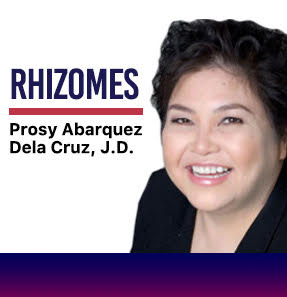
Prosy Abarquez-Delacruz, J.D. writes a weekly column for Asian Journal, called “Rhizomes.” She has been writing for AJ Press for 18 years. She also contributes to Balikbayan Magazine. Her training and experiences are in science, food technology, law and community volunteerism for 4 decades. She holds a B.S. degree from the University of the Philippines, a law degree from Whittier College School of Law in California and a certificate on 21st Century Leadership from Harvard’s Kennedy School of Government. She has been a participant in NVM Writing Workshops taught by Prof. Peter Bacho for 4 years and Prof. Russell Leong. She has travelled to France, Holland, Belgium, Japan, Costa Rica, Mexico and over 22 national parks in the US, in her pursuit of love for nature and the arts.