




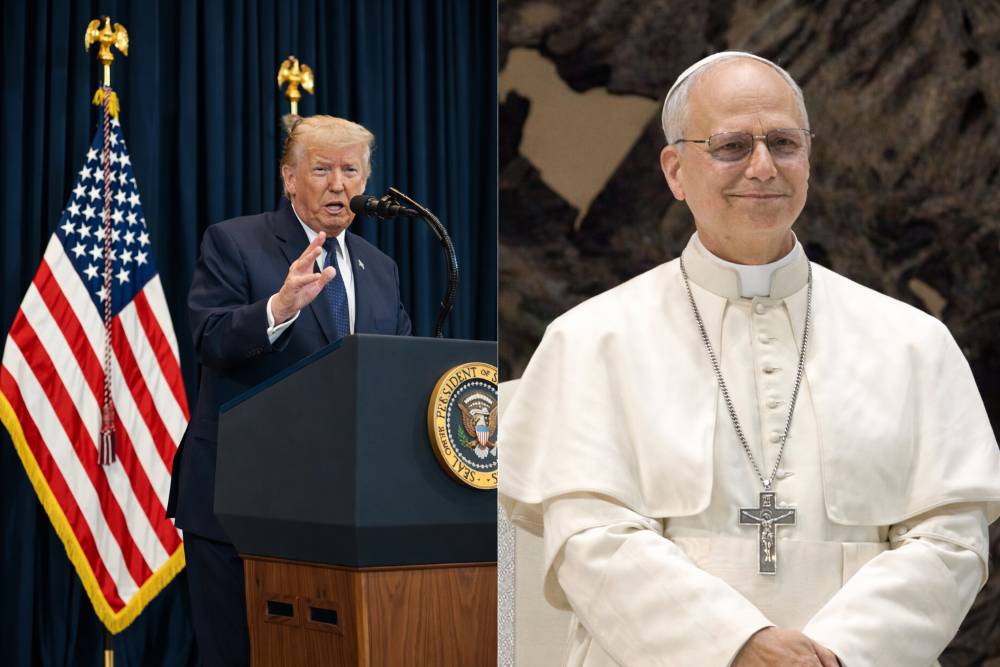
Left: Donald Trump speaks at a podium bearing the Presidential Seal, with U.S. flags behind him. (Official White House photo)
Right: Pope Leo XIV in papal attire during an official appearance at the Vatican. (Image licensed under CC BY-SA 4.0)
In 2026, one of the more consequential dynamics shaping global discourse is a visible divergence between two American figures operating at the highest levels of influence: Donald Trump and Pope Leo XIV.
The immediate backdrop is a widening public clash over war, peace, and the language of moral authority. In recent days, Pope Leo XIV has used major public appearances to call for dialogue, restraint, and the rejection of decisions driven by rearmament. President Trump, in turn, responded with a direct public rebuke, describing the pope as “WEAK on Crime” and “terrible for Foreign Policy.” The exchange has brought into sharper focus a relationship that is often managed quietly through diplomacy, not public confrontation.
One governs through the machinery of the state, including military, economic, and diplomatic power. The other leads a global church grounded in moral teaching, with no army and no electorate, but with a voice that reaches across borders. Their roles are not designed to align. Increasingly, they do not.
Yet the distinction is not only institutional. It is also formative. Pope Leo XIV (Robert Francis Prevost), born in Chicago, emerges from a distinctly American Catholic tradition shaped by immigration, pluralism, and engagement within a secular democracy. Formed within the Order of Saint Augustine, his intellectual and pastoral framework emphasizes conscience, community, and moral reasoning. At the same time, his ministry has been global in scope, reflecting a Church that operates beyond national identity. His voice, while American in origin, is not bound to the priorities of any single nation.
The friction between them is not theoretical. It is now explicit, articulated in public language rather than implied through policy differences. It is a rare moment when disagreement between political authority and religious leadership is not filtered, but stated outright.
Pope Leo XIV has articulated a consistent emphasis on peace, restraint, and human dignity. In recent addresses, he has urged leaders to choose dialogue over escalation and to consider the human cost of decisions shaped by force. His framing does not engage policy line by line. It operates at the level of principle, asking what power is for and how it ought to be exercised.
President Trump’s approach, by contrast, is often expressed in terms of outcomes that can be measured, including security, enforcement, deterrence, and leverage. It is a framework grounded in the obligations of governance, protecting borders, managing threats, and asserting national interest in an increasingly unstable global environment.
This is where the divide becomes most apparent. One operates in terms of moral responsibility that extends beyond borders. The other is driven by obligations to voters and the exercise of state power. They are not arguing from the same place, and they are not trying to achieve the same ends. The friction between them is not incidental. It is built into the roles they occupy.
That difference is not only about method. It points to different end states. One envisions a world held together by sovereign strength, where stability is maintained through control, deterrence, and the clear assertion of national interest. The other points toward a world shaped by restraint, where stability depends on dialogue, shared responsibility, and limits on the use of force.
If fully realized, neither vision fully resolves the risks the other is trying to contain. A world defined by strength may secure order, but at the cost of rigidity and escalation. A world defined by restraint may elevate human dignity, but struggles with enforcement when confronted by actors who do not share those limits.
Some observers have reached for the language of rupture to describe this moment, suggesting that the distance between these two centers of authority is widening into something more permanent, separating not just positions, but the very terms by which authority is understood. That framing, however, runs ahead of the facts.
There is no institutional break, no severed diplomatic channel, and no formal conflict between the United States and the Holy See. What exists instead is a sharpening contrast, two vocabularies of power unfolding in parallel.
That contrast is not new. Political authority and moral authority have long operated in tension. What distinguishes this moment is the extent to which these differences are now out in the open. Both men speak directly, both command global attention, and both are increasingly explicit in how they define strength.
For President Trump, strength is often expressed through control, including borders, threats, and outcomes. For Pope Leo XIV, strength is expressed through restraint, the discipline to temper power with conscience and to measure decisions not only by their effectiveness, but by their human cost.
The fact that both voices are American does not bring them closer. It sharpens the contrast. One answers to U.S. voters and national priorities. The other speaks from a position that is not bound to any nation, including the United States.