



By Prosy Abarquez-Delacruz, J.D.
What does Filipino Catholicism contribute to the American Church beyond growing congregations, devotional traditions and an increasing Filipino presence in parish life?
That question emerged at the August 8 interdiocesan consultation on Filipino Catholics: Gifts to the Church and the World, where three Filipino priests approached the subject not simply through demographics or pastoral experience, but through theology, history and culture.
I found a ride to Claremont on that hot, humid August Saturday and arrived as an enthusiastic participant.
I was certain it would be a fruitful discussion, supported by well-prepared slides. These three priests are gifted homilists, conscientious servants of God and continuous learners with administrative and leadership skills.
What I heard that day made me look differently at the Filipino American story.
I learned that Filipino contributions, now part of the larger American collective story, are theological and generative.
Our story began in the 16th century with shrimp farmers in Louisiana and continued through the experience of our ancestors being exhibited as cultural artifacts at the St. Louis World’s Fair in 1904, dressed in bahags even though we already had one of the oldest universities in existence.
In 1965, Larry Itliong persuaded Cesar Chavez to join the Delano grape strike to increase farmworkers’ wages to 25 cents a crate, helping spark international support, including the attendance of Robert Kennedy.
Yet Filipinos continued to face strong exclusionary treatment.
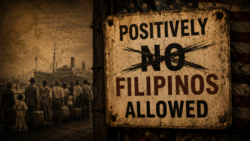
In 1930, a hotel in Stockton displayed a sign reading, “Positively No Filipinos Allowed,” documenting the intense discrimination faced by Filipino immigrants during the early part of the 20th century.
Fr. Michael Montoya offered another way of looking at that painful history.
A modern interpretation might read, “Positively Filipinos Allowed,” with an X drawn over the word “No.”
Dignity defies erasure, and exclusionary discrimination does not have the final say, as Fr. Michael emphasized.
It is about erasing the “No” and using our imagination to forge ahead in our participation, involvement and empowerment to build institutions and churches.
Three practical theologians
The three priests brought substantial academic and pastoral experience to the discussion.
Fr. John Ernesto Cordero was a former superior general, while Fr. Rodel Balagtas was a former faculty member and vice dean of St. John’s Seminary.
Fr. Michael founded a border church in Texas that became engaged in a dialogue with then-Pope Francis.
All three wrote and defended dissertations and authored books.
Fr. Michael has two upcoming books: As the Bamboo Breaks: Toward a Filipino Theological Anthropology in a Broken World and Filipino Catholics in the American Church: Beyond “No Filipinos Allowed.”
My excitement could not be contained.
I shared slides with my husband, who was at home babysitting our two grandchildren.
I realized that I was experiencing a full-circle moment in my life, one that brought together wholesomeness, humanity, spirituality, the Filipino American experience and the work of building communities.
Kapwa and a shared humanity
The seminar introduced the concept of kapwa.
It is a concept popularized by Dr. Katrin de Guia after being mentored by Virgilio Enriquez, Ph.D. It recognizes a shared humanity: I am in you, and you are in me.
It is similar to the South African concept of Ubuntu, which recognizes compassion and humanity in another person.
This resonated deeply with participants.
It is also a value we teach our children through pakikipagkapwa: getting along with another person by bringing forward one’s best self.
It led to the conclusion that the Filipino is a good seed, grown in good soil, rather than the dregs of society or a people to be dehumanized as “bottom-barrel.”
In asserting who we are, we should not limit our vision to accepting the status quo.
We are more than preservers. We can be transformative agents.
We also limit our vision when we are unable to share our story credibly, thereby sustaining our own invisibility as 2 million Filipino Catholics out of 3 million Asian Pacifics.
What untapped potential that represents.
More than a demographic presence
I return to the prophetic insight shared by Fr. Michael and echoed by the other two priests:
“We cannot claim universality [of the Catholic Church] while suppressing particularity. We cannot preach community while overlooking individual communities [ethnicities]. And we cannot celebrate diversity while treating Filipino faith as mere decoration rather than as a genuine theological contribution.”
That, to me, was one of the most important messages of the gathering.
The Filipino Catholic story cannot be reduced to the number of Filipinos sitting in church pews, the number of Filipino priests serving parishes or even the visible devotional practices that Filipino Catholics have brought with them.
Presence matters, but presence alone is not the point.
It is about saying yes: beyond being regarded merely as a treasured presence or as a contributing factor to the browning of the pews.
In our Christian faith, we need to become more deeply immersed in interculturality and in understanding that each culture carries its own distinctive wisdom.
We need more pastoral initiatives that encourage involvement, a yes to helping others, and a yes to becoming empowered people with a personal recognition of the full measure of our dignity.
The Filipino experience itself — its history of exclusion and perseverance, its spirituality, communal consciousness and instinct toward kapwa — can become part of the theological conversation.
It need not remain at the margins.
“If we are light-bearing and maternal,” then contributing our talents and untapped potential in service of a higher purpose becomes a natural response.
It is much like what I call this trio of highly educated, deeply involved and highly participatory “energizer” Filipino priests.
“The fruit of the Spirit is love, joy, peace, patience, kindness, generosity.” — Gal. 5:22.
And as Rev. Jude Winkler writes in Daily Meditations with the Holy Spirit:
“True love is a willingness to live and even die for one another. It is not a feeling or an emotion. True love is a choice that ultimately brings one to the Cross. None of us has the strength to do this on our own. It is the Spirit who gives us the grace we need.”
Prosy Abarquez-Delacruz, J.D. writes a weekly column for Asian Journal, called “Rhizomes.” She has been writing for AJ Press for 18 years. She also contributes to Balikbayan Magazine. Her training and experiences are in science, food technology, law and community volunteerism for 4 decades. She holds a B.S. degree from the University of the Philippines, a law degree from Whittier College School of Law in California and a certificate on 21st Century Leadership from Harvard’s Kennedy School of Government. She has been a participant in NVM Writing Workshops taught by Prof. Peter Bacho for 4 years and Prof. Russell Leong. She has travelled to France, Holland, Belgium, Japan, Costa Rica, Mexico and over 22 national parks in the US, in her pursuit of love for nature and the arts.