




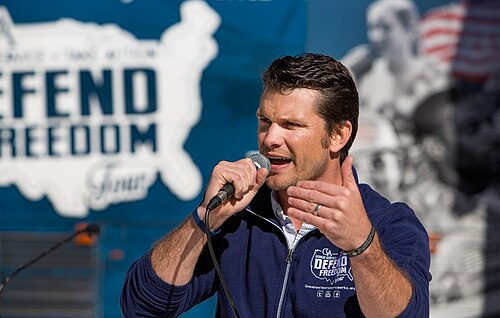
U.S. Defense Secretary Pete Hegseth, shown at a “Defend Freedom” event file photo, cited the Philippines at the Shangri-La Dialogue in Singapore as an example of allied defense burden sharing, saying Manila’s shift toward external defense reflects Washington’s push for partners to assume greater responsibility for regional security. – Photo from Wikimedia Commons
Hegseth says Manila’s defense shift reflects Washington’s push for allies to assume greater regional security responsibility
SINGAPORE — U.S. Defense Secretary Pete Hegseth cited the Philippines as an example of the kind of ally Washington wants in the Indo-Pacific: a treaty partner investing more in defense, improving coordination with American forces and preparing for a security environment increasingly shaped by competition with China.
Speaking at the Shangri-La Dialogue in Singapore, Hegseth said the United States is moving away from alliances built on dependency and toward partnerships defined by shared responsibility. He said Washington wants “partners, not protectorates,” arguing that security in the Pacific can no longer rest disproportionately on American military power.
The remarks placed Manila inside a broader U.S. push for allies to assume more of the financial and operational burden of regional defense. Hegseth said a favorable balance of power requires partners with military strength, industrial capacity and political resolve, and he urged countries in the region to increase defense spending.
Hegseth singled out the Philippines after discussing other U.S. partners in Asia. He said Manila is shifting its focus toward external defense, enhancing interoperability with American forces and investing in the modernization of its military and coast guard. He also cited this year’s Balikatan exercises, which U.S. officials described as the largest iteration of the annual drills, as an example of joint training involving advanced American capabilities.
Philippine and U.S. officials have increasingly framed the alliance around deterrence, maritime security and territorial defense. The shift comes amid repeated confrontations between Chinese and Philippine vessels in the South China Sea, including waters Manila refers to as the West Philippine Sea. Beijing claims much of the South China Sea, despite a 2016 arbitral ruling that rejected the legal basis of its sweeping claims. China does not recognize the ruling.
Under President Ferdinand Marcos Jr., the Philippines has expanded security cooperation with the United States while deepening defense ties with Japan, Australia and other partners. In February, Manila and Washington reaffirmed the 1951 Mutual Defense Treaty and said it applies to armed attacks on either country’s armed forces, aircraft and public vessels, including coast guard vessels, anywhere in the South China Sea.
The alliance also rests on the Visiting Forces Agreement and the Enhanced Defense Cooperation Agreement, which allow rotational access, joint training and expanded military cooperation. U.S. and Philippine officials have identified those frameworks as central to improving interoperability and supporting a more modern Philippine defense posture.
Hegseth said Marcos had approved a budget that included a 12% increase in defense spending. Philippine budget materials for 2026 list P423.7 billion for national defense, an allocation the Department of Budget and Management has linked to sovereignty protection amid evolving geopolitical conditions.
Hegseth’s comments on China were direct but calibrated. He cited Beijing’s military buildup as a source of concern, while also saying the United States seeks a stable relationship with China and more regular military-to-military communication to reduce the risk of miscalculation.
The significance of Hegseth’s remarks was not that Manila has completed its defense transition, but that Washington sees the Philippines moving in the direction it now expects of key allies: higher defense investment, closer operational coordination and a larger role in sustaining deterrence in the Indo-Pacific.