







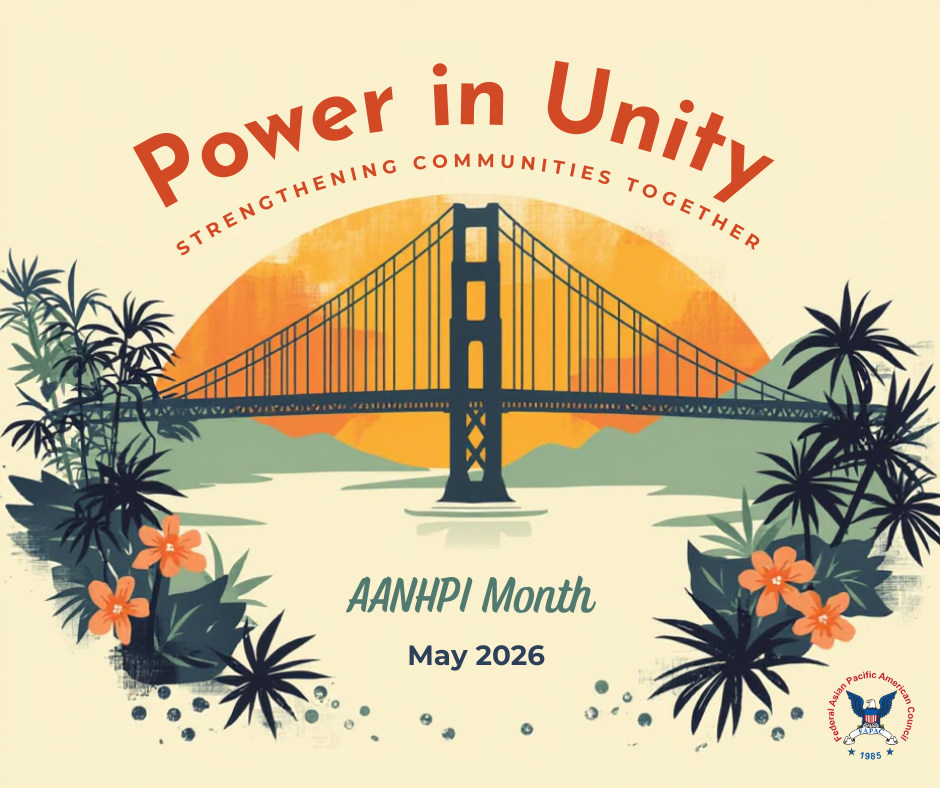
This year’s theme, established by the Federal Asian Pacific American Council (FAPAC), highlights the importance of collective power, storytelling, and bridge-building within AAPI communities. It emphasizes the strength that comes from collaborating, sharing lived experiences, and fostering connection and resilience across different groups.
LOS ANGELES — Each May, the United States observes Asian American, Native Hawaiian, and Pacific Islander (AANHPI) Heritage Month, a federally recognized commemoration that reflects a population now firmly embedded in the country’s demographic, economic, and civic structure.
The observance traces its roots to congressional action in 1978, when a weeklong recognition was first established and later expanded into a month by 1992. May was selected to mark two historical reference points: the arrival of early Japanese immigrants to the United States in 1843 and the completion of the transcontinental railroad in 1869, built with the decisive labor of Chinese workers. They are foundational chapters in the formation of the modern United States.
Federal cultural institutions, including the Library of Congress and the Smithsonian Institution, now coordinate national programming that situates the observance within a broader historical and educational framework. The federal designation itself has evolved to explicitly include Native Hawaiian and Pacific Islander communities, reflecting a more precise and inclusive standard.
Yet the pace of demographic and economic change has moved faster than public understanding.
Data from the U.S. Census Bureau identifies Asian Americans as one of the fastest-growing population groups in the country. In states such as California, they represent a significant share of residents, shaping labor markets, education systems, housing demand, and electoral dynamics.
Economic indicators reinforce that presence. Market research places Asian American purchasing power in the trillion-dollar range, supported by high levels of entrepreneurship and strong representation in sectors such as healthcare, technology, and finance. Educational attainment levels are among the highest nationally, particularly in science, engineering, and medical professions.
But aggregate strength conceals uneven outcomes within the broader category.
Research from the Pew Research Center and academic institutions shows wide variation across communities. While some groups report high median incomes and advanced degrees, others, particularly among Southeast Asian and Pacific Islander populations, continue to face challenges in income stability, access to education, and healthcare equity. The category itself encompasses multiple migration histories and socioeconomic realities that do not converge into a single experience.
Representation reflects similar asymmetry. Asian Americans, Native Hawaiians, and Pacific Islanders have expanded their presence in public office and civic institutions, and voter participation has increased in recent election cycles. Still, proportional representation remains incomplete, particularly in senior policymaking and executive leadership roles.
This imbalance reflects a longer historical pattern shaped by cycles of labor demand, legal exclusion, and later reintegration. From 19th-century migration to early 20th-century restrictions and post-1965 immigration reforms, AANHPI history has been defined by shifts in access, status, and recognition.
Educational coverage has yet to fully close that gap. Standard curricula often emphasize a limited set of historical episodes, leaving broader contributions underrepresented. Efforts to expand ethnic studies programs in states such as California aim to address that imbalance, though implementation remains uneven.
In recent years, AANHPI Heritage Month has taken on expanded meaning. It now serves not only as a cultural commemoration but also as a platform for examining current issues, including representation, civil rights, and public safety.
Policy analysts, including those at the Brookings Institution, increasingly frame AANHPI communities as integral to the nation’s economic competitiveness and long-term workforce. Their influence extends beyond demographic growth into structural roles across industries and institutions.
Recognition, however, is only a starting point.
Asian American, Native Hawaiian, and Pacific Islander Heritage Month acknowledges contributions that have long been part of the American foundation. The measure of its relevance lies in whether public understanding, institutional inclusion, and policy frameworks evolve at the same pace as the communities themselves.
The American narrative continues to expand. The question is whether it expands with sufficient precision to reflect those who are shaping it.