




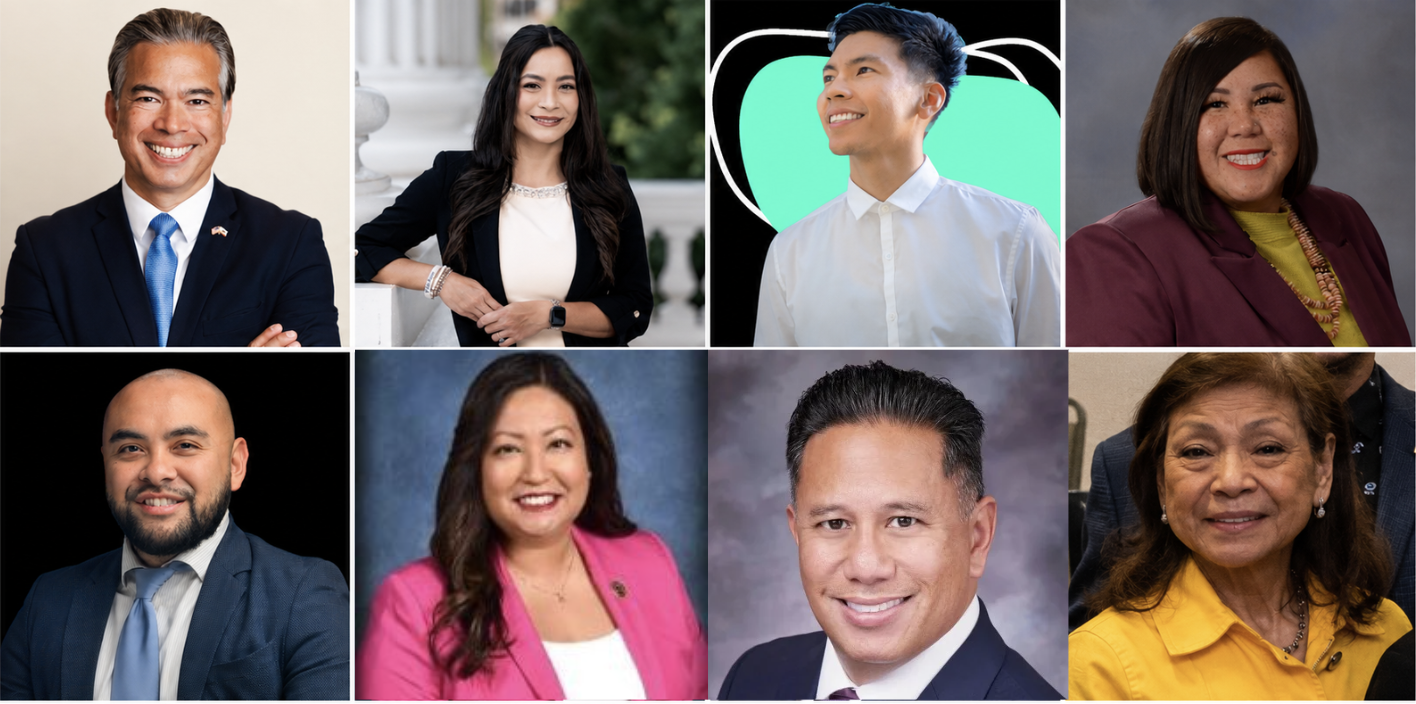
Filipino American candidates and public officials featured in the 2026 election landscape include California Attorney General Rob Bonta, Assemblymember Jessica Caloza, Los Angeles City Controller Kenneth Mejia, Nevada Assemblymember Erica Mosca, New York Assemblymember Steven Raga, Artesia City Councilmember Melissa Ramoso, Cerritos City Councilmember Mark Pulido and former Hawaii State Representative Rosebella L. Ellazar-Martinez.
Across federal, statewide and local races, candidates of Filipino descent are entering the 2026 cycle as Filipino American political representation moves beyond familiar strongholds into a broader national map.
LOS ANGELES — Filipino American candidates are entering the 2026 election cycle across a widening range of federal, state and local offices, underscoring the community’s growing visibility in contests that shape law enforcement, public spending, education, housing, health care and local services.
The roster is selective, not exhaustive. It highlights candidates of Filipino descent who are incumbents, current or former elected officials, or candidates with verified public-service records and visible campaign activity. It does not attempt to list every person who filed for office, particularly in crowded races where some candidacies may have limited public campaign infrastructure.
The political stakes are practical as much as symbolic. An estimated 4.6 million people in the United States identified as Filipino in 2023, making Filipino Americans the third-largest Asian-origin group in the country, according to Pew Research Center’s analysis of U.S. Census Bureau data. Pew also estimates that about 1.6 million Filipinos live in California, with Hawaii, Texas, Florida and Nevada among other states with large Filipino populations.
In California, Attorney General Rob Bonta, a Democrat and the first Filipino American to serve as the state’s top law enforcement officer, is seeking reelection. The California Secretary of State’s certified candidate list for the June 2, 2026 primary identifies Bonta as the incumbent Democratic candidate for attorney general. Bonta was appointed attorney general in 2021 and elected to a full term in 2022. The office carries statewide authority over criminal justice policy, consumer protection, civil rights enforcement, housing litigation and legal challenges involving state law.
In Los Angeles County, Assemblymember Jessica Caloza is seeking reelection in California’s 52nd Assembly District. California’s certified candidate list identifies Caloza as the incumbent Democratic candidate for the seat, and her official Assembly biography says she was sworn into office in December 2024 and represents the 52nd District. She is the first Filipina elected to the California Legislature.
Another California legislative race with Filipino American visibility is in Assembly District 67, where Mark Pulido, a Cerritos city councilmember and former mayor, is running for a seat covering parts of southeast Los Angeles County and northern Orange County. The official state candidate list identifies Pulido as a Democratic candidate for the district. Cerritos’ city biography says Pulido first served on the City Council beginning in 2011, later returned to the council in 2025 and previously served as mayor and mayor pro tem.
In Los Angeles city government, City Controller Kenneth Mejia is seeking a second term. Mejia, a certified public accountant, was elected in 2022 and became the first Filipino American elected official in the City of Los Angeles and the first Asian American elected to citywide office there. The controller’s office audits city departments, monitors public spending and issues financial reports, making the race less about ceremonial representation than the mechanics of accountability at City Hall.
In Artesia, Melissa Ramoso, a city councilmember and former mayor, is seeking reelection to the City Council in November after more than two decades in government and public service. Artesia’s official biography identifies Ramoso as mayor pro tem and says she has more than 22 years of experience in government and public service. It also notes her work as district director for California Assemblymember Al Muratsuchi and her previous service as senior adviser to U.S. Rep. Ted Lieu.
First elected to the Artesia City Council in 2018, Ramoso became the city’s first Filipina American mayor in 2021. Her candidacy adds a local-government dimension to the 2026 landscape, where city councils often decide issues closer to daily life than statewide campaigns: land use, public safety, local budgets, parks, streets, business policy and community services.
In Nevada, Erica Mosca, a Democrat representing Assembly District 14 in Clark County, is listed by the Nevada Legislature as assistant majority floor leader. Her official legislative page identifies her as the District 14 assemblymember. She is the first Filipina to serve in the Nevada Legislature.
In another Nevada race, Maria Teresa Hank is running in the Democratic primary for Assembly District 9, an open Las Vegas-area seat. Nevada political coverage has described the race as competitive. Hank, a Southwest flight attendant and Transport Workers Union shop steward, identifies in her campaign biography as Filipina/Hawaiian and has drawn support from labor and progressive groups.
The national map extends beyond California and Nevada. In New York, Assemblymember Steven Raga is running for State Senate District 12 in Queens while continuing to represent Assembly District 30. Raga is the first Filipino American elected to the New York State Legislature.
In Hawaii, Rosebella L. Ellazar-Martinez, a former state representative, is listed in state 2026 candidate records as a Democratic candidate for State Representative, District 40.
At the school board level, Stephanie Loredo, president of the Culver City Unified School District Governing Board, is seeking reelection in 2026. The district identifies her term as running through Nov. 30, 2026, and local coverage identifies her as the first woman of Filipino descent elected to citywide office on the Westside of Los Angeles.
Other Filipino American incumbents, though not all are on the 2026 ballot, provide context for the broader landscape. They include federal and state officials in Virginia, Arizona, Wisconsin, Tennessee, Alaska and North Carolina; county and state officials in California; and local leaders serving in cities, towns, school districts and municipal governments across the country where Filipino American communities have become an increasingly visible part of civic life.
The offices vary widely, from state attorney general and Congress to state legislature, city controller, city council and school board. But they share one feature: each carries authority over decisions that affect everyday life, including public safety, education, housing, infrastructure, health services and government spending.
The 2026 cycle is more than a count of Filipino American names on the ballot. It is a measure of whether a large and increasingly visible community can turn presence into political capacity. That capacity is built over time through consistent voter participation, credible candidate pipelines, fundraising networks, policy expertise, coalition-building and accountability after Election Day.
The roster remains fluid. Candidate lists can change as filing deadlines close, primaries advance and state election offices complete ballot certification. The names in this story should therefore be read as a verified snapshot of a developing election cycle, not a complete national inventory.
Even with that caveat, the direction is clear. Filipino American participation is moving beyond historic firsts and symbolic breakthroughs into institutions where power is exercised day by day: city halls, school boards, county commissions, state legislatures and congressional races. The larger test in 2026 is whether representation becomes more than visibility, developing the organization, governing skill and public trust needed to influence policy once candidates take office.