



Memorial Day, while distinctly an American holiday, is a day of remembrance that Filipinos rightfully participate in. It is a day to remember and honor those who have made the ultimate sacrifice.
During World War II, members of the Philippine Scouts and the Philippine Commonwealth Army served under the United States Army Forces in the Far East, or USAFFE, a U.S. military command created in 1941 under Gen. Douglas MacArthur to defend U.S. interests in the Asia-Pacific region. Filipinos fought and died during World War II under the command of an American general.
The presence of American military bases in the Philippines was also a principal reason for the Japanese invasion of the Philippines. Japan’s imperial army wanted to neutralize American forces that could hinder Imperial Japan’s ambitions in Southeast Asia.
Several hours after the attack on Pearl Harbor on Dec. 8, 1941, Japanese forces began bombing U.S. forces in the Philippines, especially Clark Field, an American air base north of Manila. The Japanese invasion followed shortly after.
In the face of an overwhelming force, MacArthur ordered USAFFE units in Luzon to retreat to the Bataan Peninsula to form a defensive perimeter before he was ordered to Australia. Japanese imperial forces laid siege to Bataan.
On April 9, USAFFE forces in Bataan under Gen. Edward King surrendered. Roughly 12,000 American and 64,000 Filipino troops surrendered, making this one of the largest surrenders of U.S. and allied forces in wartime history. Weeks later, Gen. Jonathan Wainwright was forced to surrender all U.S. and Filipino forces in the Philippines to save them from annihilation.
Immediately following their surrender in Bataan, exhausted Filipino and American troops, now prisoners of war, were forced on a brutal 65-mile march toward Camp O’Donnell in Capas, Tarlac. Denied basic food and water under the scorching Philippine summer sun, thousands perished from exhaustion, disease or execution after being unable to continue. This forced march became known as the Bataan Death March.
My father, who was an Army lieutenant in USAFFE, was lucky to survive the death march. Like many who suffer traumatic experiences, he would provide only vague details of this march, not willing perhaps to relive its horrors.
The one story Prosy, my spouse, remembers is of him counting the dead as they were forced to march along and leave the bodies behind.
“I had to count, for they were human beings,” he said. “Daily, they were in the hundreds.”
The horrors and brutality illustrated by these stories are part of the wartime record that helped shape the postwar strengthening of international rules on the treatment of prisoners of war, including the 1949 Geneva Conventions.
As we honor those who made the ultimate sacrifice in war, our community needs to say a special prayer for those who perished during the Bataan Death March.
Shortly after World War II, to help U.S. servicemen and servicewomen who served during the war readjust and return to society, Congress passed the GI Bill, which provided four primary benefits: education and training, unemployment pay, business and farm loans, and home mortgages. Millions of veterans used these benefits to pursue interrupted education, restart businesses, start families and purchase homes.
As I contemplate the sacrifices of Filipino World War II veterans who fought as USAFFE soldiers, I am outraged by an effort to erase these sacrifices.
In 1946, Congress passed a law known as the Rescission Act of 1946, which decreed that certain service in the Philippine Scouts and Philippine Commonwealth Army “shall not be deemed to have been active military, naval or air service.” The law made many Filipino veterans who served during World War II ineligible for full veterans’ benefits.
It took a concerted campaign of more than two decades by Filipino veterans and the Filipino American community to correct this egregious injustice. Congress has yet to repeal the Rescission Act of 1946. Instead, through piecemeal legislation, it has sought to restore partial benefits.
In 1990, it granted Filipino veterans the right to become naturalized U.S. citizens. In 2009, it passed a law modifying the exclusions of the Rescission Act by creating the Filipino Veterans Equity Compensation Fund, which provided one-time, lump-sum payments to eligible veterans.
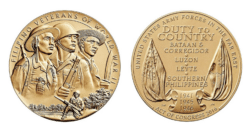
Finally, in 2016, as if to say, “We are recognizing and honoring the service of Filipino veterans of World War II under USAFFE,” Congress enacted the Filipino Veterans of World War II Congressional Gold Medal Act of 2015, bestowing the Congressional Gold Medal on Filipino World War II veterans in honor of their service.
The Congressional Gold Medal is an award bestowed by Congress and is among the highest civilian honors in the United States. The decoration is awarded to an individual or unit that performs an outstanding deed or act of service to the security, prosperity and national interest of the United States.
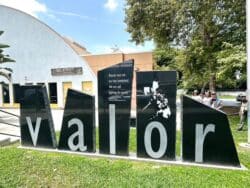
Aside from the Congressional Gold Medal, one of the most prominent public memorials in the United States honoring Filipino veterans of World War II is in Los Angeles. The Valor Memorial was unveiled in 2006 at Lake Street Park, 227 N. Lake St., Los Angeles, in Historic Filipinotown.
In light of the efforts to erase Filipino World War II veterans’ sacrifices and contributions, these two forms of recognition, the Valor Memorial in Historic Filipinotown and the Congressional Gold Medal, need to be made a focus of the stories we tell.
On Memorial Day and Veterans Day, stories about the Bataan Death March and Filipino valor during World War II need to be part of the stories told in school classrooms and college Filipino Experience classes.
The opinions, beliefs and viewpoints expressed by the author do not necessarily reflect the opinions, beliefs and viewpoints of the Asian Journal, its management, editorial board and staff.
* * *
Enrique de la Cruz is Professor Emeritus of Asian American Studies at California State University, Northridge. He currently serves as a Commissioner for Human Relations with the City of Los Angeles.

***
Enrique B. dela Cruz, Ph.D. is Professor Emeritus at the California State University-Northridge. He received his Ph.D. in Philosophy (Mathematical Logic) from UCLA and has written on Asian Americans, Filipino-Americans and Philippine-U.S. relations. You can e-mail him at enrique.dela.cruz@csun.edu