







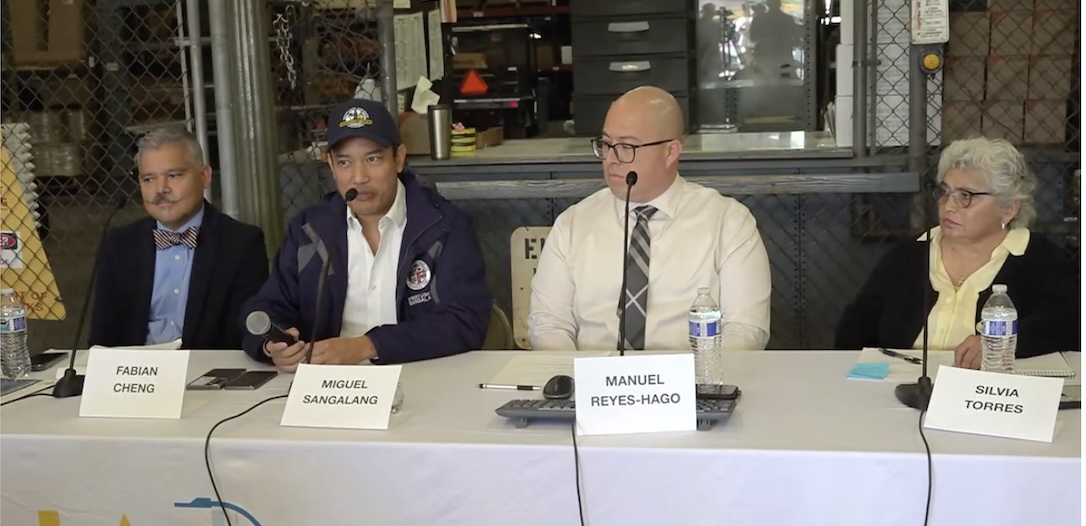
LEADERSHIP BRIEFING: Los Angeles Bureau of Street Lighting (BSL) officials (from left) Fabian Cheng, Assistant Director and Chief Engineer; Miguel Sangalang, Executive Director and General Manager; Manuel Reyes-Hago, Street Lighting Construction and Maintenance Superintendent; and Silvia Torres, Street Lighting Superintendent II, conduct a press event at the BSL Yard on April 8, 2026. The team detailed the upcoming Proposition 218 ballot measure to fund critical repairs and combat the city’s copper wire theft crisis.
Property owners will weigh a Proposition 218 assessment increase aimed at modernizing Los Angeles’ aging streetlight system, as officials cite widespread outages, copper theft, and decades-old funding levels driving the need for upgrades.
LOS ANGELES — Property owners across the City of Los Angeles are set to receive assessment ballots beginning April 17 in a consequential vote that will determine whether the city can modernize its street lighting system, reduce repair delays, and respond to a surge in copper wire theft that has left tens of thousands of streetlights in need of repair or replacement.
The ballot process, conducted under California’s Proposition 218, would mark the first broad update to most individual street lighting assessments since 1996, an aging funding structure that city officials say no longer reflects the scale or demands of the system. More than 95% of the bureau’s funding is derived from property assessments that have remained largely unchanged for nearly three decades.
Leadership outlines stakes at ACoM briefing
At an April 8 briefing presented by American Community Media at the Bureau of Street Lighting Field Operations Yard, Executive Director and General Manager Miguel Sangalang appeared with senior leadership including Silvia Torres, Street Lighting Superintendent II of Field Operations; Fabian E. Cheng, Assistant Director and Chief Engineer; and Manuel Reyes Hago, Street Lighting Construction and Maintenance Superintendent.
“We are currently operating with roughly 45% of the resources required for a system of this scale,” Sangalang said.
He added that the bureau is responsible for maintaining more than 220,000 streetlights across Los Angeles.
A system under strain
The Los Angeles Bureau of Street Lighting maintains more than 220,000 streetlights across Los Angeles, covering roughly two-thirds of the city and nearly 4,500 miles of streets.
The system is supported by an extensive underground network of approximately 9,000 miles of conduit and 27,000 miles of copper wire, an engineering footprint that underscores both its scale and vulnerability.
Much of the infrastructure dates back decades, with many fixtures more than 50 years old and some approaching a century in service.
Officials say the system is currently managing more than 32,000 service requests, while on a typical night more than 25,000 streetlights may be non-operational.
Copper theft drives shift in strategy
“This is not just wear and tear—it is repeated, targeted damage,” officials said of copper wire theft, which has become a central strain on maintenance operations.
Because the system relies on underground copper wiring, theft incidents often require full circuit restoration rather than simple fixture repair, significantly increasing costs and prolonging outages.
In response, the city is advancing a transition toward solar-powered streetlights, which eliminate underground copper wiring and reduce vulnerability to theft. Installations have begun in areas including Lincoln Heights and Cypress Park as part of an initial rollout.
The broader plan also includes expanding field repair capacity to address the existing backlog and improve response times.
Proposition 218 voting structure
Because street lighting is classified as a “special benefit,” it is funded through property assessments rather than the city’s general fund. Under Proposition 218, any increase must be approved through a property owner ballot process.
Ballots are tabulated based on the assessment assigned to each parcel. The proposal will be rejected only if a majority of returned assessment-weighted ballots are cast in opposition. Ballots that are not returned are not counted.
For the 2026–27 fiscal year, the proposed maximum rate is $58.83 per benefit point, with final assessments varying based on land use and parcel characteristics.
Oversight and cost considerations
“The proposed increase would include a three-year auditing mechanism,” Sangalang said, emphasizing accountability in how funds would be used.
The proposed increase comes as property owners continue to face broader cost pressures, placing added scrutiny on the city’s ability to deliver measurable improvements in system reliability and public safety.
Officials say maintaining consistent street lighting is directly tied to public safety, with improved visibility associated with reduced crime risk and fewer traffic-related incidents.
Timeline
Ballots must be completed and returned by June 2, 2026, with final tabulation expected following a public hearing.
The outcome will determine whether Los Angeles proceeds with a systemwide modernization effort or continues operating under funding levels established nearly three decades ago, as infrastructure demands and public safety risks continue to intensify.