






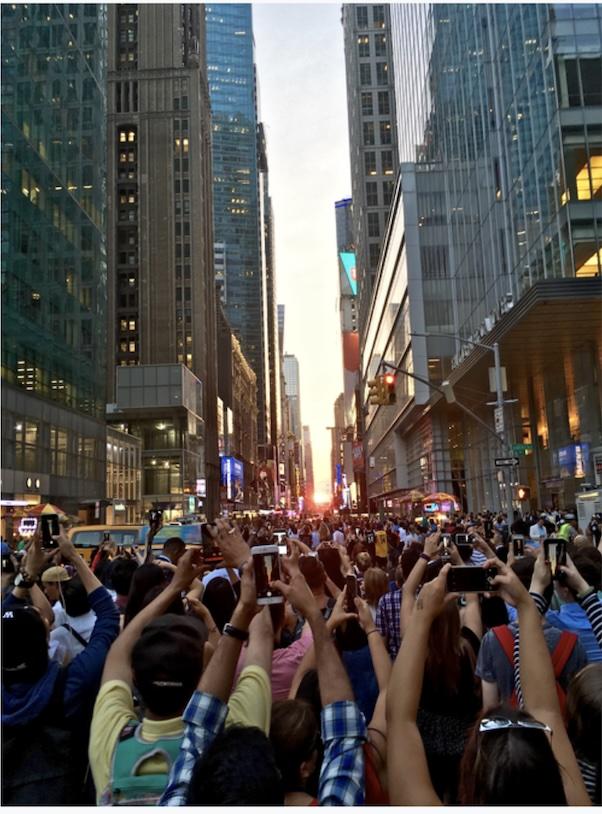
Tourists gather on 42nd Street in Midtown Manhattan to capture the rare spectacle of Manhattanhenge, when the setting sun aligns precisely with the city’s grid, creating a canyon of light between skyscrapers. (Photo: Wikimedia Commons / CC BY-SA 4.0)
From the ancient stones of Stonehenge to the modern streets of Manhattan, both the summer solstice sunrise and Manhattanhenge sunset reflect a striking parallelism—moments when the sun aligns with human design, bridging millennia of celestial wonder and cultural connection. This year’s Manhattanhenge offered more than a stunning sunset—it echoed Stonehenge’s sacred geometry, reminding us that both ancient rituals and modern cities continue to honor the enduring path of the sun.
NEW YORK – As the sun sank low over Manhattan on July 11, 2025, its golden orb aligned with surgical precision between the city’s towering buildings, casting a corridor of radiant light along 42nd Street. Onlookers gathered shoulder-to-shoulder, phones raised and eyes wide, to witness a phenomenon that has become one of New York City’s most beloved urban rituals: Manhattanhenge.
But while the setting seemed uniquely modern, the impulse behind the moment reaches far into humanity’s past. This solar alignment, now an Instagram staple, shares a spiritual and scientific lineage with Stonehenge, the ancient stone monument on England’s Salisbury Plain. Though separated by thousands of years and continents, both serve as silent witnesses to humankind’s enduring fascination with the sun.
A MODERN NAME WITH AN ANCIENT ROOT

The name “Manhattanhenge” was coined in 2002 by astrophysicist Neil deGrasse Tyson, inspired by his teenage visit to Stonehenge. Tyson, director of the Hayden Planetarium at the American Museum of Natural History, saw a parallel between the Neolithic stone circle and Manhattan’s urban grid. Both, he noted, align with the sun during specific days of the year—turning structured spaces into cosmic observatories.
Unlike Stonehenge, which was built deliberately to track the solar calendar, Manhattanhenge is a happy accident of geometry. The 1811 Commissioners’ Plan angled Manhattan’s streets approximately 29 degrees off true east–west, allowing the setting sun to align perfectly with cross streets on two pairs of days each year—usually in late May and mid-July.
STONEHENGE: WHERE THE SKY MET SPIRIT

Built between 3000 and 2000 BCE, Stonehenge is more than just a circle of stones. Archaeological evidence suggests it served as a ritual burial ground, a sacred gathering place, and a solar calendar. On the summer solstice, the sun rises directly above the Heel Stone, illuminating the monument’s central passage. On the winter solstice, it sets in near-perfect alignment with the structure’s axis.
These celestial alignments were not merely scientific markers—they were spiritual events. For ancient people, the sun’s journey through the sky was deeply tied to the cycles of life, death, and renewal. The stones embodied humanity’s effort to give meaning to the heavens.
Even today, modern-day Druids, Pagans, and spiritual seekers return to Stonehenge during solstices to celebrate the sun and nature’s rhythms.
MANHATTANHENGE: A CITY’S UNINTENDED SOLSTICE
Though designed for commerce, not cosmology, Manhattan’s street grid transforms twice each year into a cathedral of light. Known popularly as the “Manhattan solstice,” Manhattanhenge occurs when the setting sun aligns precisely with the city’s east–west avenues. In 2025, the phenomenon reached peak visibility on May 28 (half sun), May 29 (full sun), July 11 (full sun), and July 12 (half sun).
On the “full sun” days, such as July 11, the entire solar disk was visible hovering just above the horizon, creating a glowing tunnel of sunlight through the city. Prime viewing locations included 14th, 23rd, 34th, 42nd, and 57th Streets, as well as the Tudor City Overpass and Hunter’s Point South Park in Queens.
In contrast to the ancient stillness of Stonehenge, the Manhattan version unfolds amid taxi horns, towering billboards, and pedestrian chatter. And yet, the pause it inspires—the hush of the crowd, the gaze toward the west—is oddly familiar.
WHERE CITY AND STONE CONVERGE
While Stonehenge was shaped by sacred intent and Manhattan by urban logic, the effect is remarkably similar. Both sites:
- Align with the sun at key times of year
- Create moments of awe and gathering
- Offer a shared experience of time, space, and light
- Remind observers of humanity’s connection to something larger
In each case, the sun becomes more than a celestial body—it becomes a symbol of rhythm, purpose, and continuity.
A SHARED SPIRIT ACROSS TIME AND CULTURE
For readers across the Filipino diaspora—from Manila to Los Angeles to Toronto—the resonance of solar alignment is not foreign. Filipino traditions, too, are rich with symbolic celebrations of light, from parol lanterns during Christmasto sunrise masses and harvest feasts. The desire to honor the cycles of nature transcends geography.
Manhattanhenge, like Stonehenge, is a reminder that amid technology and traffic, humans still yearn for connection with the cosmos—and find it in the path of the sun.
LOOKING FORWARD
Those who missed this year’s summer alignment can anticipate reverse Manhattanhenge, which occurs during winter sunrises in early January and early December. While less photographed, these quiet mornings offer the same profound geometry—just turned east.
A MOMENT OF SHARED WONDER
Stonehenge and Manhattanhenge stand at opposite ends of history, yet both capture the same human truth: the search for meaning in the skies above. Whether carved from ancient stones or etched into a city grid, both monuments frame the sun’s journey—and reflect our own.
For a moment, the city becomes sacred. And the sunset, like in the days of old, becomes something to celebrate.