






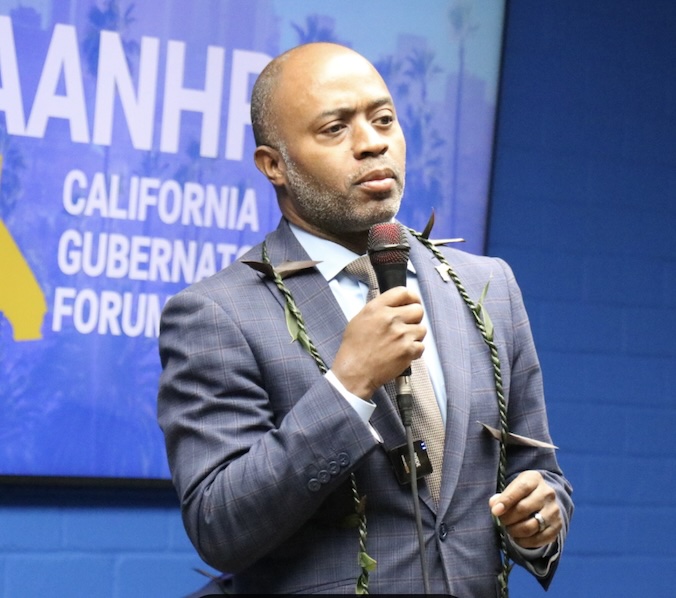
California Superintendent of Public Instruction Tony Thurmond during the AANHPI California Gubernatorial Candidates Forum in Los Angeles. (Photo by Eric Moon)
California schools chief presents proposals on affordability, public systems, and economic relief as race remains wide open with no clear front-runner
LOS ANGELES — California Superintendent of Public Instruction Tony Thurmond used a policy briefing with American Community Media to lay out a campaign agenda centered on housing expansion, healthcare access, immigration reform, and economic relief, offering detailed responses to questions from ethnic and community media.
The session, part of a broader series connecting candidates with local and ethnic press, provided a direct account of Thurmond’s positions as he competes in a crowded 2026 gubernatorial race that remains unsettled, with polling showing no dominant candidate and a large share of undecided voters.
Personal history and governing lens
Thurmond began by situating his policy views in his upbringing, describing early economic hardship and family disruption.
“I’m a California native… my mom was an immigrant from Panama… while my dad was off in Vietnam, my mom was raising four kids by herself,” he said.
He described the impact of his mother’s death when he was six.
“My mom lost her battle to cancer and her four kids got split up.”
He said those experiences inform his approach to governance.
“I believe that a better California is possible and that we have to build it together.”
Housing supply constraints and structural affordability
Housing costs were a central focus of the discussion. Thurmond identified limited supply as a key factor.
“We are experiencing a crisis of supply and demand. The state has not invested in affordable housing in over a decade.”
He said his platform includes a plan to build two million housing units by 2030.
“One of the signature components of my platform is a plan to build 2 million housing units by the year 2030.”
The proposal includes use of public land and potential bond financing. He also acknowledged limits to direct price control.
“The governor and the state can’t just make prices go down, but we can create conditions that ultimately will support bringing costs down.”
Housing has emerged as a central issue across the field, with multiple candidates advancing competing proposals as affordability pressures continue to dominate voter concerns statewide.
Fiscal policy and redistribution framework
Thurmond said he supports taxing high-wealth individuals to fund relief for lower- and middle-income households.
“I plan to tax billionaires and to take the proceeds… to provide a tax credit to working and middle-class Californians,” he said.
He said such policies would need broader coordination to avoid capital movement.
“If California does pass a wealth tax, it should also be in conjunction with the national wealth tax.”
Wealth taxation and cost-of-living relief have become recurring themes in the race, reflecting broader debates among candidates over how to address inequality and rising household expenses.
Immigration posture and federal constraints
On immigration, Thurmond reiterated his call to abolish U.S. Immigration and Customs Enforcement, a proposal that would require federal action.
“I was the first candidate to call for abolishing ICE,” he said.
He questioned the agency’s function.
“ICE was supposed to be a way to keep us safe… But who are they keeping us safe from?”
He said current enforcement affects workers in several sectors.
“Look at who’s being deported. People who work as child care workers and farm workers.”
He said he would pursue state-level measures affecting detention facilities and work with Congress on broader reforms.
The issue remains politically contested, with immigration enforcement and federal-state coordination continuing to divide candidates and policymakers.
Healthcare access and system design
Thurmond linked his healthcare position to a personal experience involving his brother.
“I had a brother who lost his job and lost his insurance right at the time that he developed a very rare liver disorder,” he said.
He said the lack of insurance limited access to care.
“Because he didn’t have insurance, he couldn’t see a doctor and his condition worsened to the point that he lost his life.”
“He was only 35 years old.”
He said the experience informs his support for broader coverage.
“No person should lose their life simply because they don’t have health insurance.”
He reiterated support for a single-payer system, a proposal that would require legislative approval and coordination with federal healthcare programs.
Education pathways and workforce alignment
Thurmond said economic mobility should include both higher education and vocational pathways.
“It’s not just about getting a college education… we have to support those who want to work in an apprenticeship training program.”
He proposed a tuition deferral model.
“When they graduate and they get a job, they start to pay back… This becomes the pool of dollars for the next group of students.”
The proposal reflects broader discussions in the state about workforce development and alternative career pathways.
Small business environment and regulatory approach
Asked about business conditions, Thurmond emphasized support for small enterprises.
He said he would pursue regulatory changes and expand access to financing and state contracts.
Business climate concerns, including regulatory burdens and capital movement, have been raised by multiple candidates as part of the broader economic debate.
Electoral posture and campaign viability
Thurmond said polling does not determine election outcomes.
“I just don’t think that polls elect anyone. People do,” he said.
He said he intends to continue his campaign.
“My name is on the ballot. I’m in it to the end. And I’m running to win.”
Recent polling indicates a fragmented field with no clear front-runner and a significant share of undecided voters, creating an environment in which late shifts in support could influence the outcome of the primary.
Policy scope and institutional limits
The briefing provided a direct account of Thurmond’s policy positions as he seeks to gain traction in the gubernatorial race. Several proposals he outlined, including changes to immigration enforcement, healthcare systems, and tax policy, would require action beyond the governor’s office, including legislative approval or federal involvement.
The event is part of a continuing series of candidate briefings, with additional coverage expected as other candidates present their platforms.