






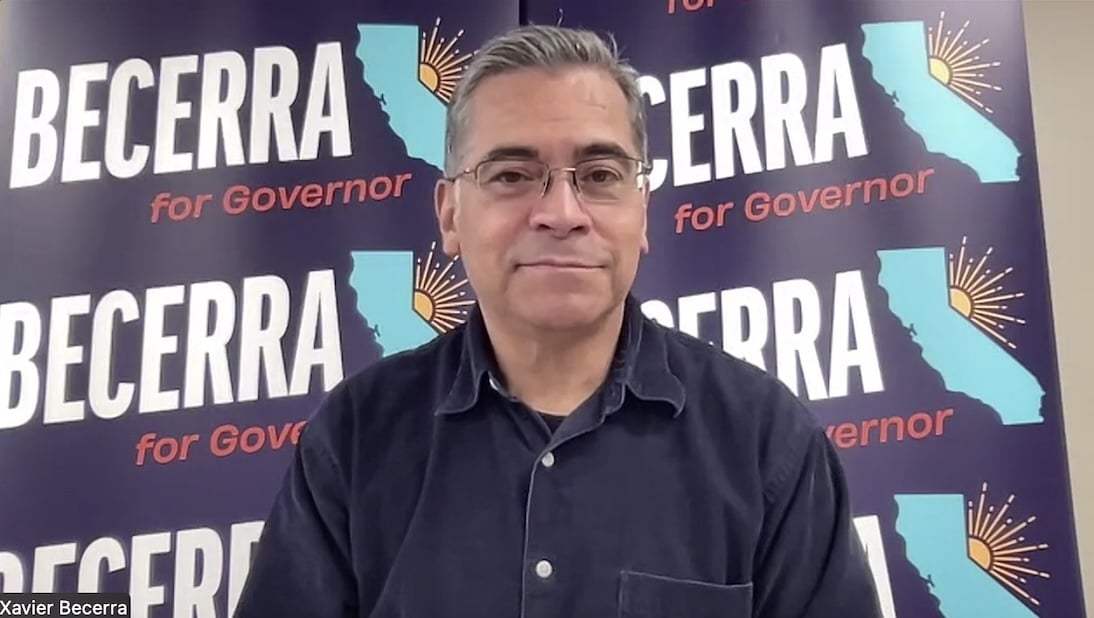
In an interview with ethnic and community media, the former U.S. health secretary and California attorney general said his first priority would be a housing emergency, while arguing that California needs a governor ready to confront Washington and restore faith in the state’s promise.
As California voters prepare for the June 2 primary, Democratic gubernatorial candidate Xavier Becerra is making health care, housing and immigrant protections the center of his closing argument, presenting himself as a former federal Cabinet secretary and state attorney general prepared to manage California through high costs, federal conflict and voter uncertainty.
Becerra, who served as U.S. secretary of Health and Human Services and previously as California attorney general and a longtime Los Angeles-area member of Congress, told ethnic and community media that California is “hungry for a governor who can reignite a sense of possibility.” His campaign, he said, rests on “one conviction: that working hard should be enough to help you build something that lasts.”
The June 2 election will narrow the governor’s race to two candidates under California’s top-two primary system, in which all candidates appear on the same ballot and the two highest vote-getters advance to November regardless of party. June 2 is the last day to vote in person or return a ballot by 8 p.m.; polls are open from 7 a.m. to 8 p.m.; and vote-by-mail ballots must be postmarked no later than June 2, according to the California Secretary of State. Eligible citizens who missed the May 18 registration deadline may still use same-day voter registration through Election Day.
The race has drawn a crowded field to succeed Gov. Gavin Newsom, who is term-limited. The California Secretary of State’s certified candidate list shows dozens of candidates running for governor in the June 2 primary. Public election materials and voter guides identify the major candidates as including Becerra; Republican Riverside County Sheriff Chad Bianco; Republican Steve Hilton; Democratic San Jose Mayor Matt Mahan; Democratic former Rep. Katie Porter; Democratic environmental advocate Tom Steyer; Democratic state schools chief Tony Thurmond; and former Los Angeles Mayor Antonio Villaraigosa.
A May 13 Emerson College Polling survey of likely primary voters found Becerra leading with 19%, followed by Hilton and Steyer at 17% each, Porter at 10% and Mahan at 8%, with 12% undecided. The survey was conducted May 9 to 10 among 1,000 likely primary voters, with a credibility interval similar to a margin of error of plus or minus 3 percentage points.
In the interview, Becerra described his campaign as powered by small donors and labor-aligned support, contrasting that with wealthy self-funded candidates. He said the average donation to his campaign was “about $59” and described his supporters as “teachers and nurses and union workers.” He also cited support from “working families,” firefighters, Planned Parenthood and nurses. Becerra offered the remarks as part of his broader campaign argument, describing the coalition he says is powering his run.
First order of business: housing
Asked what his first executive order would be if elected, Becerra said he would declare a state of emergency or urgent state action on housing and move quickly to speed construction.
“I will declare a state of urgent or emergency in the state when it comes to housing,” Becerra said. He said he would “move to try to put in practice actions that will let us begin building more housing as quickly as possible.”
Becerra said California has “about 40,000 housing units that are shovel ready,” but that the projects lack financing. He said he would “immediately work with the Legislature” to find resources to move those projects forward, saying Californians need “a true sense of faith that we will actually build the housing units that we need.”
He also tied the housing emergency to utility and insurance costs, saying he would seek to “freeze utility rates and home insurance casualty insurance premiums.” Becerra said many families “cannot make sense of the spiraling prices of utilities and home insurance premiums” and deserve to know “what they’re paying for” and why some are “losing their policies without sufficient notice.”
The proposal places Becerra’s campaign within the state’s central affordability debate. In the May 13 Emerson College Polling survey, 42% of Californians surveyed named the economy as the top issue facing the state, followed by 21% who cited housing affordability.
Health care as a governing record
Health care formed one of Becerra’s strongest themes. When asked whether he had moved away from support for single-payer health care, he rejected the premise.
“I never backed away,” Becerra said. “I’ve been consistent throughout my career in public service.” He said that in 1993 he was “a principal co-sponsor” of Medicare for All legislation and described Medicare as “a form of single-payer.”
Becerra said he believes “the most efficient way to deliver care is to remove as many of the middlemen” and “unnecessary moving parts” from the health care system. He said his work on the Affordable Care Act, the defense of that law as California attorney general and his tenure at HHS all moved the country closer to wider coverage.
“I helped draft and pass the Affordable Care Act,” he said. “When I defended it in the Supreme Court as attorney general and as secretary, I built the Affordable Care Act to the most successful program it’s been.”
Becerra also cited federal efforts to lower prescription drug costs, including work “to help cap the price of medicines like insulin to $35” and “to negotiate better drug prices for Medicare for the first time in history.” Federal health officials have said those changes stem from the Inflation Reduction Act, which capped covered insulin costs for Medicare patients and authorized Medicare to negotiate selected drug prices.
Asked about Medi-Cal access for undocumented immigrants and low-income Californians, Becerra said his health care policy would be guided by access for people who work in California.
“If you work hard in California, it makes no difference to me where you come from, how long you’ve been here,” he said. “If you’re working hard, you deserve to have access to the health care that you need.”
Becerra argued that removing coverage would not eliminate medical need but would shift costs elsewhere. “They don’t stop using health care if they need a doctor or a hospital,” he said. Without insurance, he said, patients are more likely to use emergency rooms, “the most expensive place to get health care,” with costs ultimately borne by California taxpayers, hospitals, doctors and community health centers.
For immigrant families and many California households, the issue is practical: Medi-Cal access, hospital bills, elder care, prescription drugs and community clinics affect residents already balancing rent, utilities, insurance and caregiving costs.
Drawing the line on immigration enforcement
Becerra repeatedly framed the governor’s office as a defensive post against the Trump administration. Asked how California should respond to renewed federal immigration crackdowns, he said he would use the tools he had as attorney general and work with California Attorney General Rob Bonta to protect immigrant families.
“I certainly will make sure that I use all the tools that I had at my disposal when I was attorney general the first time Donald Trump was president,” Becerra said. He said he would work “to protect the interests of our families, immigrant families.”
Becerra said federal immigration agencies must comply with constitutional limits and state law when operating in California. “ICE, while it’s a federal agency, still must obey the Constitution,” he said. “It still must respect state laws when it goes beyond its jurisdiction.”
Asked about a reported federal policy change affecting green-card applicants seeking adjustment of status, Becerra said he was “absolutely against it.” He said such applicants are “people who are on the verge of getting a green card” and “qualifying to be here,” and he argued that families should not have their lives disrupted while they are moving through lawful immigration processes.
“No family should have their livelihood and their family relationships disrupted simply because a guy doesn’t like who you are,” Becerra said. “It’s not the way you do business. It’s un-American.”
On federal funding, Becerra said California should partner with Washington where possible but fight when necessary.
“We will fight where we must to stand up for the rights of California,” he said. “We will not take a knee to anyone.”
Becerra said California taxpayers send “more money to the federal treasury than any other state in the nation” and deserve a fair return. He cited his time as attorney general, saying California challenged the Trump administration after it attempted to withhold law enforcement funding over the state’s refusal to participate in certain immigration enforcement actions.
“We took them on in court and we got our $57 million back,” he said. “We will partner with them where we must, but we will fight when it’s necessary.”
His message was directed partly at audiences served by ethnic and community media. At the start of the interview, Becerra thanked those outlets for reaching communities that he said often “don’t have access to all sources of media” and “don’t often get approached by general or mainstream media.”
The money question
The interview also brought out one of the race’s sharpest contrasts: campaign money and political independence.
Asked about criticism from Steyer over corporate interests and independent expenditure committees, Becerra said he has no relationship, knowledge or coordination with independent committees supporting him.
“I am totally independent of them because I have no sight, no relationship to those independent committees,” Becerra said. “I have no knowledge of what those independent committees are doing. I have no coordination with them.”
Under campaign finance rules, independent expenditure committees may raise and spend money to support or oppose candidates but cannot coordinate with the campaigns they affect. State campaign finance disclosures and advertising-tracking data cited in public campaign coverage show major spending by outside committees and candidate-controlled campaigns, including more than $195 million spent or reserved by Steyer in broadcast, cable and radio advertising. The scale of that spending has made money and independence a defining issue in the final stretch.
Becerra used the interview to draw a contrast with Steyer, saying his own record should be judged by his work as attorney general and HHS secretary. “My record speaks for itself,” he said. He cited litigation involving fossil fuel interests, clean-car standards, the Clean Air Act, the Clean Water Act and the Endangered Species Act.
“It is easy for a billionaire to distort the truth about another candidate,” Becerra said. “What he cannot distort is the truth of his own record.” He criticized Steyer’s past investments in coal, oil and other industries, saying it was “very rich, to say the least” for Steyer to criticize him over money Becerra said he has “nothing to do with.”
Steyer has faced scrutiny over the scale of his spending and his past investments, while presenting his campaign as an effort to challenge corporate power and lower costs. The contest has become, in part, a contrast between Becerra’s government experience and Steyer’s self-funded outsider campaign.
Accountability on homelessness and detention
On homelessness, Becerra said California must demand clearer results from programs funded by state dollars. He said cities and counties should expand shelter, health care and job-training services, but programs should be measured by whether they help people leave the streets.
“It must have clear outcomes, documented outcomes of helping people leave the streets,” Becerra said. “If they don’t show clear outcomes, then I will demand that those programs be closed and those programs that are successful…we scale up.”
He placed particular emphasis on prevention. “What I will focus on as governor, because this I will have direct jurisdiction over, is helping ensure that people do not become homeless,” Becerra said. He argued that helping a family stay housed after a medical emergency, job loss or income shock is less costly than trying to help someone after they have become homeless.
Asked about private immigration detention facilities, Becerra said California should move away from privately owned detention centers and enforce state standards where possible, while acknowledging limits on state authority when the federal government controls detention operations.
“We would take every action we can to move away from having any facilities that are privately owned detention facilities located in California,” he said. “We only have so much authority on that because the federal government can force its will on us.”
On arts funding, Becerra said he had not reviewed the specific figures cited by a reporter but supports restoring investments in arts, culture, music and science programs, especially for children from disadvantaged families.
“One of the things that lets our children grow and be successful and be tremendous assets to our country is when we let their brains flourish,” he said. “The way you can do that most is to expand their mind at the earliest stages of life.”
A résumé as his final argument
Becerra closed the interview by returning to biography. He described himself as “the son of immigrants,” the son of a father who “didn’t get past the sixth grade” and a mother who came to California with “$12 in her pocket.” He said he knows what it means to come from “a working-class home where a father was a union member” and to be the first in a family to attend college.
“I am going to make full use of every lever of government as governor to protect the families that were just like my parents,” Becerra said. He said California must restore the belief that people can work hard, own a home, send their children to college or the military and retire in California rather than leave for another state.
“You won’t get that from someone who’s never taken the tough votes, who’s never had to run an agency, a government agency as large as the budget of the state of California,” he said. “I am ready. I will not need training wheels when I become governor.”