





As a patriarchal society, we have the tendency to highlight a single individual, especially males, and enshrine them into places of honor, our pantheon of heroes, naming streets, schools, and public places in their honor, and even designating a day of commemoration. For California, Cesar Chavez is one such person. A years-long investigation by the New York Times into Cesar Chavez, an icon of the farmworker movement, reported allegations that he was a very flawed individual who sexually abused girls, and even Dolores Huerta. Chavez and Huerta co-founded the National Farm Workers Association (NFWA), a precursor to the United Farm Workers (UFW), which came about through a merger of NFWA, which was predominantly Mexican in membership, and AWOC (Agricultural Workers Organizing Committee), a predominantly Filipino organization. This exposé has led some cities, especially in California, to cancel Cesar Chavez Day celebrations, and in some cases to cover up monuments as resolutions for their removal are being debated. The reported allegations are shocking and deplorable. But merely removing him from our pantheon of heroes does not resolve the underlying conditions that enabled such behavior, so to speak.
Despite being sexually assaulted, Huerta decided to remain silent at that time. From the interview she gave NPR after the exposé, one of the reasons she cites is that no one might believe her. During the period in question, the mid-1960s to the 1970s, the burden of proof on accusations of sexual assault or rape usually fell on women, if they could withstand the public scrutiny and negative innuendo that follow such accusations. Many women have chosen to just remain silent, coming out years later when they “felt safe.” Maria Hinojosa shared her story to empathize with Dolores Huerta during their interview, saying, “we are both survivors of rape.” This derision and skepticism when women make accusations of sexual assault against men is gender inequality, part of an invisible knapsack of advantages and privileges that men carry and take for granted. We are probably in a better place today, thanks to the feminist movement, and more recently, the “me too” movement. But much work still needs to be done, for this requires a cultural change where men, too, consider such behavior as “unthinkable.”
The broader context which constrained Huerta was the task of building a farm worker movement that challenged growers for higher wages and better working conditions, and at the same time, undertaking a political campaign for legislation for farm worker civil rights. Chavez had become the face of the movement, which still was in its infancy. To build this movement required farmworkers, hundreds of volunteers, and support from political leaders. It also required a leadership that was beyond reproach. Had Huerta accused Chavez of misconduct during that period, support from volunteers and politicians could have collapsed. Farmworkers, too, would feel hesitant to join and pay dues to a union led by someone morally compromised. Hers was a personal hurt, while the farmworker movement involved a large constituency of farmworkers, volunteers, and political leaders. She said it was her cross to bear.
It is important to understand why the farm worker movement in California, spearheaded by the UFW, was a civil rights movement, not just a movement to unionize farm labor.
The National Labor Relations Act of 1935 gave urban workers, e.g., autoworkers, nurses, teachers, truck drivers, etc., the right to organize and bargain collectively. Urban workers have since taken this act for granted, organizing workplaces whenever they felt a need for better wages and working conditions. But farm workers were explicitly exempted from these protections by this law. And in California, agribusiness corporations took advantage of this exclusion to exploit farmworkers. Without bargaining agreement rights, it often took great organized effort among farmworkers to get growers to agree to higher wages. Even then, such agreements were often seasonal and regional. Philip Vera Cruz, the Filipino Vice President of the UFW, tells how growers would agree to somewhat higher wages during the Coachella Valley harvest early in the season, but would rescind those agreements later when the harvest moved up to the Delano area.
There was a group of farm workers that was able to successfully strike and negotiate for better wages. These were the Filipino migrant farmworkers; they had clout in their numbers, being able to quickly organize along ethnic lines as the Agricultural Workers Organizing Committee (AWOC), and even get sponsorship from a national labor union, the AFL-CIO. In the meantime, Dolores Huerta, a community social worker, and Cesar Chavez, a community activist, met and decided to start organizing Mexican farmworkers under the National Farm Worker Association (NFWA). This organization was just three years old when its path would intersect with AWOC. AWOC decided to strike the table grape growers in Delano, California, and invited NFWA to join. In the beginning, Chavez and Huerta were hesitant, but a week later were prevailed upon to join. This new strength in numbers enabled them to picket more farms and prevented growers from hiring one group against the other. A year into the Delano grape strike, both AWOC and NFWA merged to form the United Farm Workers of America, now simply known as the UFW. This larger entity would mount the farmworker civil rights campaign that included marches to Sacramento to lobby for legislation, and grape boycotts at supermarkets where volunteers passed out leaflets urging people not to buy non-union grapes. These led to the passage of the California Agricultural Labor Relations Act (CALRA) of 1975, which granted farmworkers the right to organize and bargain collectively. CALRA 1975 was the first of its kind, nationwide, to give collective bargaining rights to farm workers.
The New York Times’ reporting that the icon of the farm worker civil rights movement faced serious allegations is sad and tragic. It is especially so for everyone who supported this movement: the farmworkers, the volunteers who gave hours of their time during the grape boycott and the marches to Sacramento, and the political leaders like the Kennedys who identified with his crusade. The late Senator Robert Kennedy thanked Chavez and the farmworkers for their support in winning California’s presidential primary. Tragically, he was assassinated that same night. Ethel Kennedy celebrated communion with Chavez as he ended his 36-day fast in 1988. I remember spending a couple of weekends at 40 Acres, hammering nails into the wood frame of a building that would become Agbayani Village, the retirement home of aging Filipino farm workers.
* * *
The opinions, beliefs and viewpoints expressed by the author do not necessarily reflect the opinions, beliefs and viewpoints of the Asian Journal, its management, editorial board and staff.
* * *
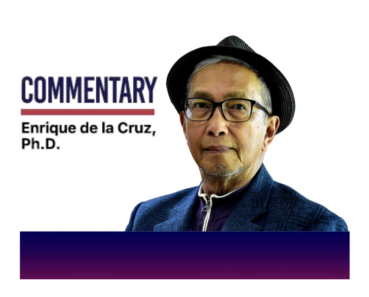
Enrique de la Cruz is Professor Emeritus of Asian American Studies at California State University, Northridge. He currently serves as a Commissioner for Human Relations with the City of Los Angeles.

***
Enrique B. dela Cruz, Ph.D. is Professor Emeritus at the California State University-Northridge. He received his Ph.D. in Philosophy (Mathematical Logic) from UCLA and has written on Asian Americans, Filipino-Americans and Philippine-U.S. relations. You can e-mail him at enrique.dela.cruz@csun.edu