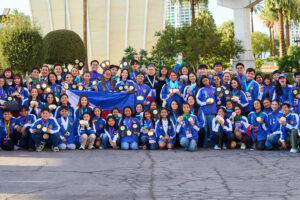

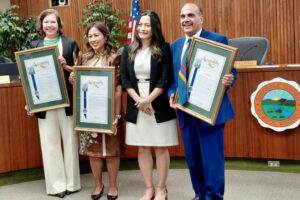

Cardinal Pablo Virgilio “Ambo” David, president of the Catholic Bishops’ Conference of the Philippines, during his visit to Los Angeles. The event was organized by the Filipino Ministry of the Archdiocese of Los Angeles and hosted at Incarnation Church in Glendale by Father Rodel Balagtas, pastor.
In his Los Angeles visit, the Philippines’ 10th cardinal shares a life shaped by faith, courage, and compassion and urges Filipinos to turn hope into action against corruption and indifference
Editor’s Note: This is Part 2 of the Asian Journal’s special report on Cardinal Pablo Virgilio “Ambo” David’s recent visit to Los Angeles. While Part 1 (which appeared in the October 4, 2025 issue of the Asian Journal) presented excerpts from his keynote address to the Filipino Ministry of the Archdiocese of Los Angeles, this second installment offers a closer look at his life, convictions, and the enduring significance of his message to Filipinos both at home and abroad.
“Embodied Communion is the Church made concrete, tangible, in the way we walk with one another, support one another, and lift one another. It is not wishful thinking but Christian hope — the kind of hope that does not disappoint.”
— Cardinal Pablo (Ambo) Virgilio David
A man of conviction
I recently accepted an invitation to attend the historic visit to Los Angeles of Cardinal Pablo Virgilio David, the 10th Cardinal from the Philippines. I had limited knowledge of Cardinal David, other than that he is a human rights activist — and that grabbed my interest. I listened to his keynote address, where he talked about three main challenges facing Filipinos in the homeland and abroad.The man who would become the 10th Filipino Cardinal is a man who truly cares — not just in words but through his actions — for people who live on the margins of society. He is a man who is open to working with people who may or may not share his religious or political beliefs, and he is a man who is not afraid to look at and expose the injustices faced by his countrymen, even when his own life is threatened. He speaks with deep knowledge and compassion — a quality admired by many as he guides them into action.


Cardinal Pablo David is a humble man with a strong conviction about what the Church stands for. He prefers to be called Cardinal Ambo, or even Bishop Ambo (he stipulated that technically, he is still the Bishop of the Caloocan Diocese), but he draws the line at the common title given to cardinals — “His Eminence” — a title he hopes will one day be abolished.
In previous interviews, Cardinal David had this to say about the title instituted by Pope Urban VIII in 1630: “I mean, I’m honestly scandalized by that. It’s one of the things I wish mawala sa Simbahan [would be gone from the Church].
Pablo Virgilio David was born in Betis, Guagua, Pampanga, on March 2, 1959. He is the 10th child of Pedro David and Bienvenida Siongco. He knew at an early age that he wanted to become a priest and attended the Mother of Good Counsel Minor Seminary when he was 10. He earned his bachelor’s degree in pre-divinity studies in 1978 from Ateneo de Manila University and was ordained a priest of the Archdiocese of San Fernando in 1983, where he served until 1986.
From 1986 to 1991, he left the country to further his studies abroad, where he received his licentiate and doctorate in Sacred Theology. He returned to the Philippines, where he taught at the Theology Department of the Mother of Good Counsel Seminary.
He is the head of the Federation of Asian Bishops’ Conferences (FABC) Commission for Synodality and is currently serving his second term as president of the Catholic Bishops’ Conference of the Philippines (CBCP).
A man of the people
Cardinal David’s rise to prominence in the Church began in 2006, when Pope Benedict XVI appointed him auxiliary bishop of San Fernando. This was followed by Pope Francis appointing him Bishop of Caloocan in 2016 and Cardinal in 2024.
Shortly after being appointed Cardinal, he admitted going through a period of self-doubt. When he had an opportunity to speak with Pope Francis, he confronted him about not giving advance notice: “Holy Father, you changed my life again without even an advance notice.”
Pope Francis looked at him and replied: “Don’t make a big deal of it. Learn to take things with a grain of divine humor. Don’t be very dogmatic in interpreting doctrine.”
Cardinal David said the exchange calmed him and gave him inner peace (Interview with ANC 24/7, Jan. 26, 2025).
The conclave
With the death of Pope Francis last April, cardinals gathered to elect a new pope. Cardinal David was one of three Filipino cardinals who entered the Sistine Chapel on May 7 to vote for the successor to Pope Francis.
He recalled meeting many cardinals from different countries and dioceses. He tells the story of a cardinal who sat next to him and started a conversation in Italian. When asked if he was Filipino, Cardinal Ambo replied, “Yes.” He asked the other cardinal where he was from, and the reply was, “Peru.”
They continued chatting until the other cardinal shifted to English, surprising Cardinal Ambo. “You speak English very well,” he told him. The cardinal replied, “I was born in Chicago, but I now live and work in Peru.”
It turned out Cardinal Ambo had been speaking with Cardinal Robert Prevost, who holds dual U.S.-Peruvian nationality — and who, in a few days, would become Pope Leo XIV.
Human rights and the challenges faced by Filipinos at home
Cardinal Ambo has long spoken out against injustices faced by his countrymen, even when his own life is threatened. This recalls the time when clergy in the Philippines, inspired by Latin America’s Liberation Theology, risked arrest under Ferdinand Marcos for siding with the poor and political prisoners. Their efforts culminated in the People Power uprising of 1986, when nuns stood in front of tanks to defend protesters calling for democracy’s restoration.
While he protested against Marcos as a student, David’s leadership on human rights became more pronounced during Rodrigo Duterte’s presidency. Then as Bishop of Caloocan, he condemned extrajudicial killings in his diocese under Duterte’s drug war. Today, he continues to fight for the basic rights of the poor in a society where corruption has been normalized and where its harshest impacts fall on the marginalized.


In Los Angeles, he told the story of Dion Angelo “Gelo” de la Rosa, a 20-year-old student who died of leptospirosis after wading through floodwaters in search of his father. For many, it was simply a tragedy of poverty. But David drew attention to deeper structural factors — corruption, gambling, urban migration — that trap families like Gelo’s in cycles of vulnerability.
“When all these factors are examined,” he explained, “it becomes clear what the poor are up against. Poverty, and the government’s role in exacerbating it, drive families from the countryside to the cities. Then the poor are blamed for selling their votes to corrupt candidates, clinging to patronage politics because they are constantly in survival mode.”
Just weeks ago, on the 53rd anniversary of martial law, David joined large-scale protests dubbed the Trillion Peso March, where thousands demanded accountability for multi-billion-peso corruption scandals in flood-control projects.
“We seek true and deep renewal, but peacefully,” he told protesters. “This is not political, but a moral affirmation of our unified faith in the fight against the culture of corruption.”
Cardinal Ambo and Filipinos in the U.S.
At his Los Angeles keynote, David also spoke about the U.S. context. Post-election data from 2024 showed that 44% of Filipino Americans voted for Donald Trump — the highest support among Asian American subgroups. Many cited his promises on economic growth, inflation, border security, and traditional family values.
Cardinal Ambo, however, warned of America’s contradictions: “… Today, America is facing contradictions: inequality is widening; oligarchs and billionaires benefit from tax systems that leave many impoverished. Racism and white supremacist ideologies are emerging. Migrants that once symbolized American strength are now scapegoated.”
While firmly critical of the administration’s anti-immigrant policies, he encouraged Filipinos to reflect on their own journeys :“You bring bayanihan, your faith, your joy to the community of nations that make up America.”
Embodied Communion
As a key advocate of synodality in the Catholic Church, Cardinal David believes it fosters inclusivity and empowers the laity.
He urged Filipinos: “Use the education we have been blessed with, the social media platforms within our reach, and every bit of influence we hold to expose the nakedness of patronage politics and to help dismantle the systemic corruption that traps the poor in an endless cycle of ayuda culture. We must stop treating the poor as mere ‘beneficiaries’ of our charity. Instead, let us listen to them, walk with them, and empower them to take part in solving the deep ills of our nation.”
And in his own words, he defined Embodied Communion as: “It is the Church made concrete, tangible, in the way we walk with one another, support one another, and lift one another. It is not wishful thinking but Christian hope — the kind of hope that does not disappoint.”