







Desirae Krawczyk and Britain’s Neal Skupski celebrate their mixed doubles victory at the 2022 Wimbledon Championships, successfully defending the title after winning the tournament together in 2021. – Photo from Instagram/@ des_krawczyk11
With four Grand Slam mixed doubles titles, including a rare three-major sweep in 2021, Desirae Krawczyk stands among the sport’s elite doubles specialists, her career shaped by precision on court and heritage at home.
INDIAN WELLS, California — In professional tennis, the sport’s brightest spotlight often follows the solitary drama of singles champions. Yet within the intricate architecture of doubles play – where anticipation, trust and tactical intelligence define success – Desirae Krawczyk has quietly assembled one of the most impressive championship résumés of her generation.
The Coachella Valley native is a four-time Grand Slam mixed doubles champion, a distinction built on a remarkable sequence of victories that reshaped her place in the sport. Her titles include the 2021 French Open, Wimbledon, and US Open, followed by another Wimbledon championship in 2022, a record that underscores both her adaptability and her instinctive mastery of doubles tennis.
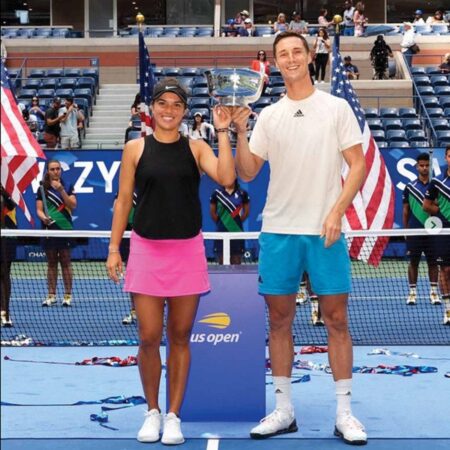
Her breakthrough year came in 2021, when Krawczyk achieved one of the rarest accomplishments in the modern game, winning three Grand Slam mixed doubles titles in a single season.
At Roland Garros, she partnered with Britain’s Joe Salisbury to capture the French Open mixed doubles title, defeating Elena Vesnina and Aslan Karatsev in the final.
Weeks later, on the grass courts of the All England Club, she teamed with Neal Skupski to win the Wimbledon mixed doubles championship, overcoming Samantha Stosur and Matthew Ebden.
The run continued at the US Open, where Krawczyk reunited with Salisbury to defeat Giuliana Olmos and Marcelo Arévalo, completing what observers widely described as a modern mixed doubles “Triple Crown.”
In the Open Era, only a handful of players have managed to win three mixed doubles majors in the same year, placing Krawczyk among an elite group in the history of the discipline.
Her success at Wimbledon did not end there. In 2022, she returned to the All England Club and successfully defended the mixed doubles title, again partnering with Neal Skupski and once more defeating Samantha Stosur and Matthew Ebden in the final.
The sequence cemented her reputation as one of the most reliable tactical partners in professional tennis.
Today, Krawczyk’s career prize earnings exceed $3.2 million, and she continues to compete among the sport’s leading doubles specialists.
Yet for all the trophies and rankings, Krawczyk’s story begins far from the grandeur of Grand Slam stadiums.
Born in Rancho Mirage and raised in Palm Desert, she grew up in the tennis-rich communities of the Coachella Valley, within sight of the Indian Wells Tennis Garden that now hosts one of the sport’s most prestigious tournaments.
Her father, Teddy Krawczyk, first discovered tennis while working as a massage therapist in Palm Springs. Curious about the game played by many of his clients, he began teaching himself before eventually introducing it to his daughter when she was just two years old.
Her mother, Maria Krawczyk, brought a different influence to the household. A nurse originally from Cagayan in the Philippines, she infused the family home with the traditions of Filipino culture — hospitality, resilience and strong family ties.
If Teddy introduced the sport, Maria shaped the spirit with which Krawczyk would pursue it.
During her collegiate years at Arizona State University, Krawczyk emerged as one of the program’s standout players. But the transition from college tennis to the professional tour required a critical decision.
Rather than pursue the intensely crowded singles circuit, she recognized that her natural instincts – quick reactions at the net, strategic court awareness and a powerful left-handed serve – were ideally suited to doubles competition.
It proved to be a defining choice.
Doubles tennis is often described as a game of geometry and timing, where players must anticipate not only the ball but also the movements of three other competitors. Krawczyk’s instinct for these rhythms allowed her to flourish in a discipline that rewards both athleticism and intelligence.
Over the past decade, she has become a fixture on the international tour, frequently partnering with some of the sport’s most accomplished doubles players.
The cultural foundation of her life has remained just as influential as her technical mastery of the game. That connection surfaced in a particularly revealing way earlier this season during an appearance on “The Player’s Box” podcast, a player-driven program that offers a candid window into life on the professional tour.
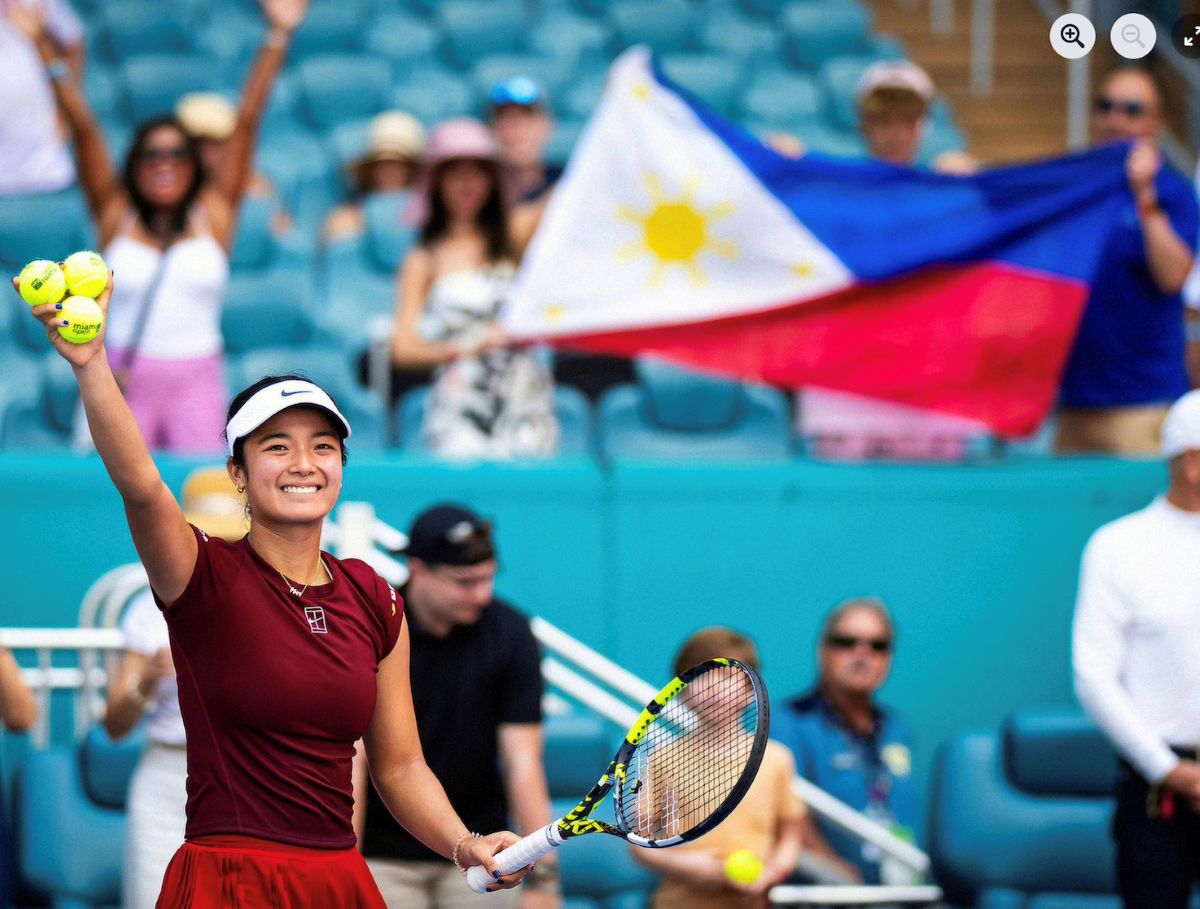
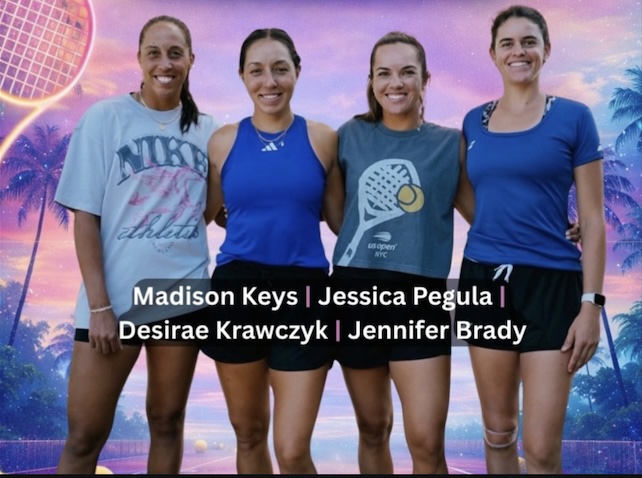
The episode featured Jessica Pegula, Madison Keys, Jennifer Brady, and Desirae Krawczyk, a group of American players whose conversation moved easily between competition, travel, and the everyday realities of life on the circuit. In that relaxed setting, the discussion eventually turned to Alexandra Eala, the young Filipina tennis star whose rise has energized fans across the Philippines and the global Filipino diaspora.
It was then that Krawczyk shared the now widely circulated story about her mother.
“My mom’s Filipino,” she said with a laugh. “She was like, ‘I want to go watch Alex Eala play.’ She’s crazy about Alex.”
When Krawczyk reminded her mother that she herself also had a match scheduled that day, Maria reportedly paused before replying with affectionate realization.
“Oh yes,” she said. “You too. I’ll watch you too.”
Maria had even planned to prepare pancit and lumpia, beloved Filipino dishes, as a welcoming gesture for the young Filipina player.
The moment, shared casually on the podcast, quickly resonated among Filipino tennis fans online. What began as a lighthearted family story became a small cultural moment, a reminder that behind Krawczyk’s Grand Slam résumé lies a heritage that has quietly accompanied her throughout her career.

As of March 2026, she is ranked No. 33 in the WTA doubles standings and sits No. 10 in the season race to the WTA Finals alongside partner Lyudmyla Kichenok. The pair opened the year strongly with a run to the Adelaide final, positioning themselves among the teams pursuing qualification for the prestigious year-end championship.
Their campaign at Indian Wells ended in the second round against the experienced duo of Anna Danilina and Aleksandra Krunić, a reminder of the razor-thin margins that often define doubles competition.
For Krawczyk, however, a career is measured not by a single tournament but by sustained excellence across seasons.
Each spring, when the BNP Paribas Open returns to the desert, the tournament becomes something more than another stop on the professional circuit for Krawczyk. For her, it is a return to the landscape where the journey first took shape.
The stadium courts that now welcome her as a Grand Slam champion once existed only in the imagination of a young girl growing up in nearby Palm Desert, watching the world’s best players compete beneath the same desert sun.
Today she walks those same grounds as a veteran of the international tour, a player whose championship record spans multiple Grand Slam tournaments and whose career reflects both the precision of doubles mastery and the cultural foundations of her Filipino heritage.