




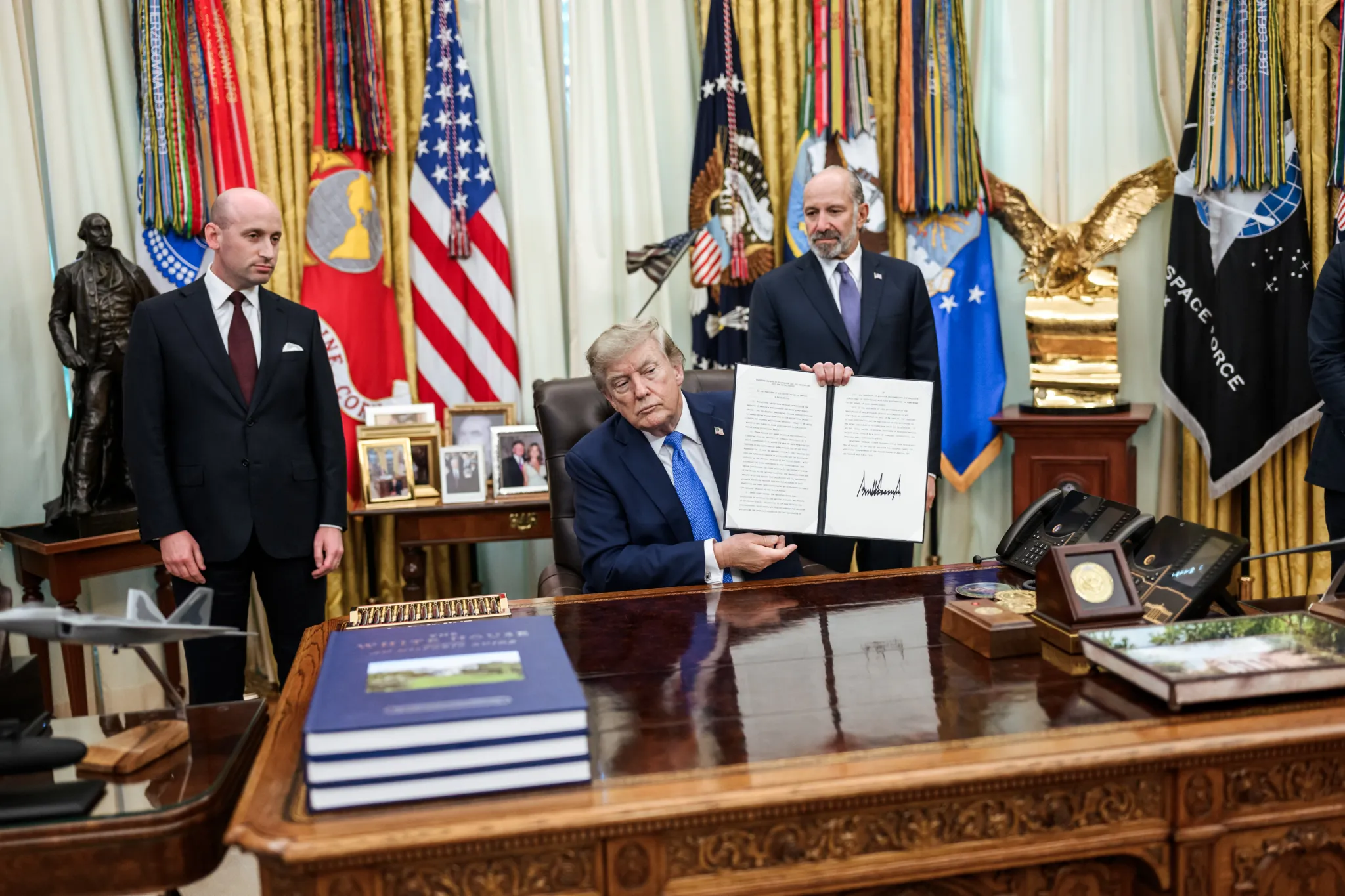
President Donald J. Trump signs Executive Orders (The White House)
New directives target specified categories of noncitizens and give federal agencies 30 days to issue implementation guidance
WASHINGTON — President Donald Trump signed two executive orders Thursday, Aug. 6, seeking new restrictions on birthright citizenship and directing federal agencies to intensify enforcement against what the administration calls “birth tourism,” little more than a month after the Supreme Court rejected his broader attempt to deny citizenship to children born in the United States to undocumented immigrants and temporary visitors.
The new citizenship order is narrower than the executive order Trump issued after returning to office in January 2025. It does not seek generally to deny citizenship to U.S.-born children simply because their parents are undocumented or temporarily in the country.
Instead, the order directs federal agencies not to recognize citizenship when neither parent is a U.S. citizen and at least one of several additional conditions applies. The categories include certain people designated as “alien enemies,” specified foreign-government and international-organization employees, and parents the administration says used fraud or certain commercial arrangements to obtain birthright citizenship.
The order also addresses some arrangements involving a mother or surrogate giving birth in the United States. Whether all of the categories identified by the administration fall outside the Constitution’s citizenship guarantee has not been resolved by the Supreme Court, leaving parts of the order open to further legal challenge.
The legal backdrop is the Supreme Court’s June 30 ruling in Trump v. Barbara. The court rejected Trump’s earlier citizenship order by a 6-3 judgment.
A five-justice majority, led by Chief Justice John Roberts, concluded that children born in the United States to parents who are unlawfully or temporarily present are subject to U.S. jurisdiction and therefore citizens at birth under the 14th Amendment.
Justice Brett Kavanaugh supplied the sixth vote against the earlier order on separate statutory grounds, concluding that it conflicted with federal citizenship law.
Trump’s new order seeks to build on narrower exceptions the administration says remain permissible. Historically recognized exceptions have included children of accredited foreign diplomats and children born to enemy forces during hostile occupation.
The president directed the departments of State, Justice and Homeland Security, along with the Social Security Administration and other federal agencies, to align their policies with the new order and issue implementation guidance within 30 days.
A second executive order, titled “Ending Birth Tourism,” focuses on foreign nationals entering the United States on nonimmigrant visas primarily to give birth and on people or organizations that facilitate such travel.
The order authorizes the State and Homeland Security departments to strengthen enforcement under existing immigration law. Measures may include denying or revoking visas or travel authorizations, refusing admission, pursuing removal and, where legally authorized, restricting future entry. Humanitarian and national-interest exceptions are permitted.
The order does not itself create a new criminal offense.
Federal restrictions on birth tourism are not new. Since 2020, State Department regulations have directed consular officers to deny visitor visas when they have reason to believe an applicant’s primary purpose is traveling to the United States to give birth so the child can obtain U.S. citizenship.
Pregnancy alone, however, does not make an applicant ineligible for a visitor visa. State Department guidance also allows legitimate travel for medical treatment and instructs consular officers not to routinely ask female applicants whether they are pregnant.
Federal prosecutors have previously brought criminal cases against organized birth-tourism businesses when the conduct involved offenses such as visa fraud, conspiracy or money laundering.
For Philippine nationals and other foreign visitors, the new orders do not establish nationality-specific restrictions. Their practical impact will depend on the implementation rules issued by federal agencies.
The central legal issue remains unsettled: the Supreme Court has already rejected a broad effort to deny citizenship to U.S.-born children based solely on their parents’ unlawful or temporary immigration status. The new orders now test how far the executive branch may go in defining narrower exceptions.