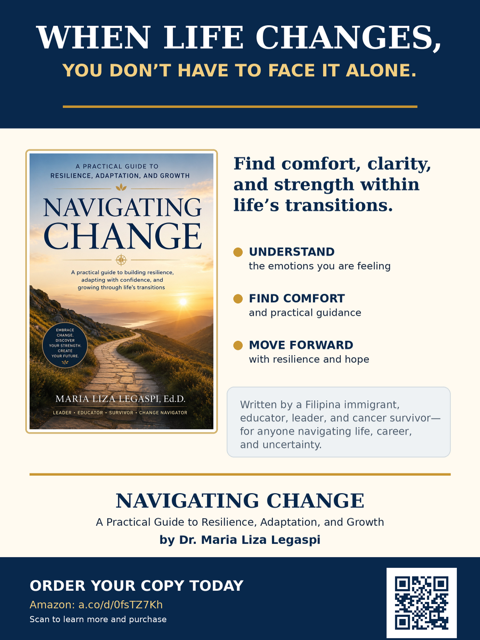






Change can arrive without warning—a career setback, a health crisis, the loss of something familiar, or an unexpected turn that leaves us questioning what comes next. For Filipina author, educator, and leadership professional Dr. Maria Liza Legaspi, change has been more than a subject of study. It has been a defining part of her life.
Her book, Navigating Change: A Practical Guide to Resilience, Adaptation, and Growth, was written for anyone facing uncertainty and searching for understanding, comfort, and the courage to move forward.
More than 26 years ago, Legaspi immigrated to the United States with what she describes as “a suitcase, a dream, and courage.” Like many Filipino immigrants, she worked to build a new life while adapting to a different culture, establishing a career, and pursuing greater opportunities. Her journey eventually led her to earn an MBA and a Doctor of Education in Organizational Leadership—both with a 4.0 GPA—and build a career spanning marketing, education, behavioral science, leadership, and organizational change.
But professional accomplishments did not protect her from life’s most difficult transitions.
At age 47, Legaspi was diagnosed with cancer. She underwent multiple surgeries, chemotherapy, and hair loss. The experience tested her physically, emotionally, and spiritually. It also transformed her understanding of resilience.
“Resilience does not mean that we never feel afraid, discouraged, or overwhelmed,” Legaspi explains through the message of her book. “It means learning how to acknowledge what we are feeling, seek support, adapt to what has changed, and continue moving forward.”
That belief became the heart of Navigating Change.
The book combines personal stories, behavioral science, leadership insights, research, practical strategies, and guided reflection exercises. It helps readers understand why people often resist change, recognize the emotions that accompany uncertainty, strengthen their ability to adapt, and discover opportunities for growth even during painful circumstances.
Readers are encouraged to reflect on their own experiences rather than simply being told to “stay positive.” Legaspi recognizes that change can involve grief, fear, anger, confusion, and the loss of identity or control. By explaining these emotions in relatable language, she hopes readers will feel understood and realize they do not have to navigate difficult seasons alone.
The book is especially meaningful for immigrants, professionals experiencing career transitions, individuals rebuilding after adversity, educators, students, leaders guiding others through uncertainty, and anyone confronting a major life change.
For Legaspi, writing the book was also a way to honor the people and experiences that shaped her. She credits her family, mentors, medical professionals, students, colleagues, and community for helping her throughout her journey. Her faith remains central to her life and her message of hope.
Her story reflects a value deeply familiar to the Filipino community: the determination to rise after hardship while remaining grounded in faith, family, gratitude, and service to others.
Today, Legaspi continues to serve as an educator, mentor, speaker, wellness instructor, and advocate for resilience. Through her teaching and community involvement, she encourages others to recognize their strengths and believe that difficult chapters do not have to become the final chapter of their story.
“Change may redirect your path,” she says, “but it can also reveal strengths you never knew you had.”
Navigating Change: A Practical Guide to Resilience, Adaptation, and Growth is available in paperback and Kindle formats on Amazon.
To learn more or order a copy, visit:
https://a.co/d/0fsTZ7Kh