




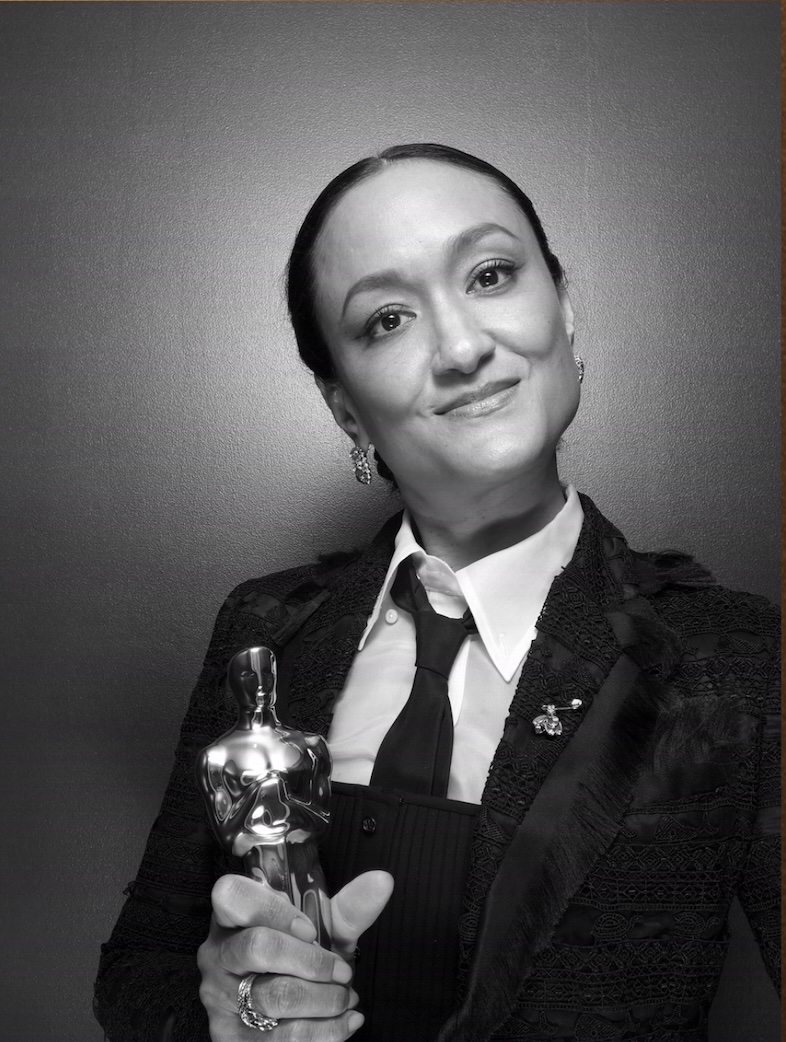
Autumn Durald Arkapaw poses with her Oscar following her Best Cinematography win for Sinners, a milestone recognized by the Academy as the first by a woman in the category. – Photo Courtesy: Academy of Motion Picture Arts and Sciences / @theacademy / addp
Her rise to the top of cinematography reflects both inherited resilience and a redefinition of access in Hollywood’s technical disciplines
HOLLYWOOD — Cinematographer Autumn Durald Arkapaw made history at the 98th Academy Awards, becoming the first woman to win Best Cinematography, according to Academy records dating back to 1929. Her win, for the film Sinners, marks a milestone in a category long defined by limited access and entrenched professional pathways.
In her acceptance remarks, she emphasized the collective nature of the milestone, stating: “I’m so honored to be here and I really want all the women in the room to stand up,” she said, “because I feel like I don’t get here without you guys. I really, really, truly mean that.”
Her recognition reflects a broader shift within the Academy of Motion Picture Arts and Sciences, which in recent years has expanded its membership and faced sustained scrutiny over representation across both creative and technical disciplines.
Directed by Ryan Coogler, Sinners emerged as one of the year’s most technically ambitious productions, employing large-format cinematography that required precise coordination across camera, lighting, and production teams. Its visual language – defined by controlled contrast, atmospheric lighting, and a measured sense of scale – was central to its critical reception.
Coogler also received the Academy Award for Best Original Screenplay for Sinners, contributing to the film’s multiple wins of the night.
The film’s broader cultural resonance also extends to its cast and creative circle. Among those connected to the project is actor Hailee Steinfeld, who is of Filipino descent through her maternal lineage, reflecting a wider presence of Filipino-American talent within contemporary Hollywood.
The Foundation: Education and Early Grit
Arkapaw’s ascent to the Dolby stage was built on a foundation of elite technical training. A native of the San Francisco Bay Area, she first honed her visual eye at Loyola Marymount University before attending the prestigious AFI Conservatory (American Film Institute). It was at AFI where she earned her Master of Fine Arts in Cinematography, a pivotal moment that placed her in the same creative lineage as many of Hollywood’s greatest visual storytellers.
Before she was capturing the sprawling landscapes of the Mississippi Delta in 15-perf IMAX, Arkapaw spent years in the “trenches” of the industry. She built her reputation through a diverse range of past experiences, from high-concept music videos for artists like Solange Knowles and Janelle Monáe to gritty independent features like Palo Alto. Each project served as a chapter in her “picaresque journey,” proving she could deliver a high-fashion aesthetic with technical precision long before the major studios came calling.
The Mother-Daughter Foundation and Honoring Her Roots
Arkapaw’s path follows a trail blazed by Filipino American cinematographer Matthew Libatique, ASC. While the full extent of his individual influence remains behind the scenes, Libatique stands as a foundational figure who forced the industry to look past its own biases. For years, major studios were hesitant to hand over the visual responsibility of their largest projects to those outside the traditional circle because they “did not know” what a Fil-Am vision could achieve.
Through three Academy Award nominations for Black Swan, A Star Is Born, and Maestro, Libatique proved his worth so undeniably that the industry eventually had to hand him the keys to its most prestigious sets. His success created the atmospheric shift that allowed Arkapaw’s own signature “steez”, her blend of technical ease and razor-sharp style, to be recognized at the highest level.
Leadership on Both Sides of the Lens
The night was a double victory for the Filipino-American community. Alongside Arkapaw, Zinzi Coogler made history as the first person of Filipino descent to be nominated for Best Picture as a lead producer. Between Coogler managing the production and Arkapaw directing the camera, Sinners proved that the “Gold Standard” of filmmaking is now being set by a new generation of diverse leaders.