






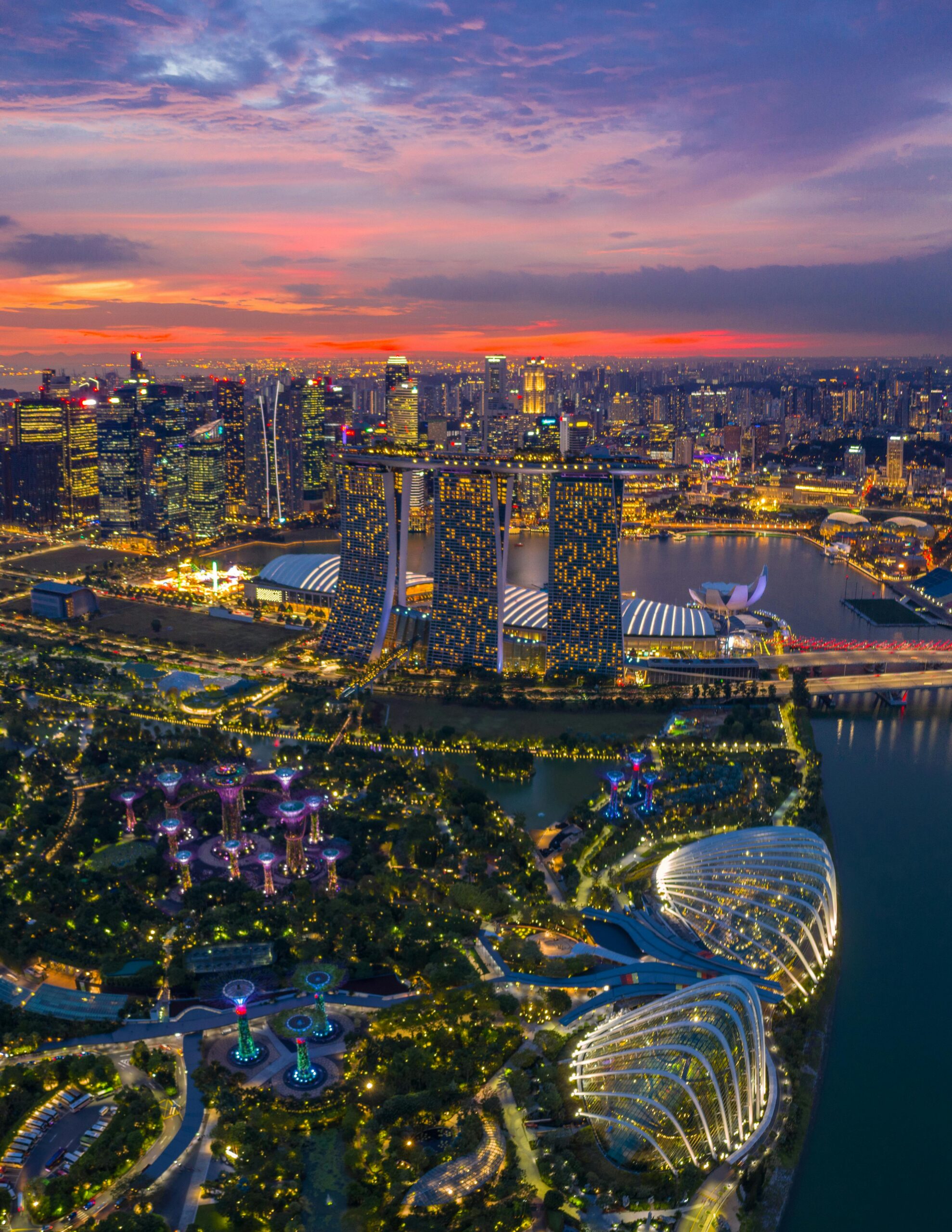
Singapore’s Marina Bay skyline at dusk. The city-state’s small physical footprint has not limited its financial reach. Singapore has become one of Southeast Asia’s most concentrated centers of private capital, driven by banking, investment management, family offices, corporate headquarters and cross-border financial services.
Forbes-derived May 2026 figures show how Southeast Asia’s largest private fortunes are clustered around finance, corporate networks and cross-border capital, not simply land or population.
SINGAPORE — Singapore is small enough to appear as a dot on many maps of Southeast Asia. In the region’s billionaire economy, however, it occupies far larger space.
Forbes-derived figures for May 2026 placed Singapore first among six major ASEAN markets in combined billionaire wealth, with an estimated $152.9 billion. The city-state led a table that also included Indonesia, Thailand, Malaysia, Vietnam and the Philippines, giving Singapore the largest country-level share of the six-market total.
The figures do not measure national wealth, government resources or household prosperity. They track the estimated net worth of Forbes-listed billionaires, a narrow but revealing measure of where the region’s largest private fortunes are clustered.
On that measure, Singapore stands apart.
The six markets shown accounted for about $551.7 billion in combined billionaire wealth in May 2026. Singapore alone represented nearly 28% of that total. Indonesia followed with $140.8 billion, Thailand with $88.5 billion, Malaysia with $79.5 billion, Vietnam with $50.7 billion and the Philippines with $39.3 billion.
The concentration is striking because Singapore’s advantage is not physical scale. Official Singapore data put the country’s total land area at about 744.3 square kilometers as of end-2025, making it one of the smallest states in the region by territory. Its economic weight comes instead from density: capital markets, private banking, family offices, corporate headquarters, logistics, real estate, legal infrastructure and access to global finance.
That structure has made Singapore a command center for regional capital. It is a place where money is incorporated, invested, managed, protected and moved across borders. For many wealthy families and businesses in Southeast Asia, Singapore functions less as a domestic market than as a financial base.
The May snapshot also shows why billionaire wealth should be read carefully. The rankings can move quickly. Singapore’s billionaire wealth declined 1.8% month over month, while Malaysia rose 4.7%, the Philippines gained 4.2%, Thailand increased 1.6%, Vietnam declined 2.7% and Indonesia fell 18.5%. Such changes may reflect stock prices, exchange rates, public-company holdings, private valuations and other market-sensitive factors.
Across ASEAN, fortunes are built from different engines. Some are tied to old conglomerates in banking, property, retail, ports, power and infrastructure. Others reflect newer sources of capital in manufacturing, logistics, technology, consumer brands and cross-border investment. The region itself remains vast: ASEANStats reported 684.1 million people in 2024, with $230.8 billion in foreign direct investment and $3.84 trillion in goods trade.
For the Philippines, the May figure placed the country sixth among the six markets shown, but its 4.2% monthly gain was one of the stronger positive moves in the table. Philippine billionaire wealth remains closely associated with banking, real estate, retail, ports, infrastructure, food, power and family-led conglomerates. The increase suggests an improvement in paper wealth among some of the country’s richest individuals, not a broad measure of national prosperity.
The larger regional lesson is that billionaire wealth follows infrastructure of a different kind. It follows legal systems, financial institutions, capital access, global investor confidence, corporate networks and the ability to serve as a base for cross-border enterprise.
That is why Singapore’s small physical footprint does not limit its billionaire footprint. In ASEAN’s wealth map, the island operates less like a small country on the edge of the region and more like a vault, exchange and headquarters city at its center.