





CARLOS BULOSAN and his book, “America is in the Heart.”
Even in his death echoes telling and timely messages
By Claire Morales True
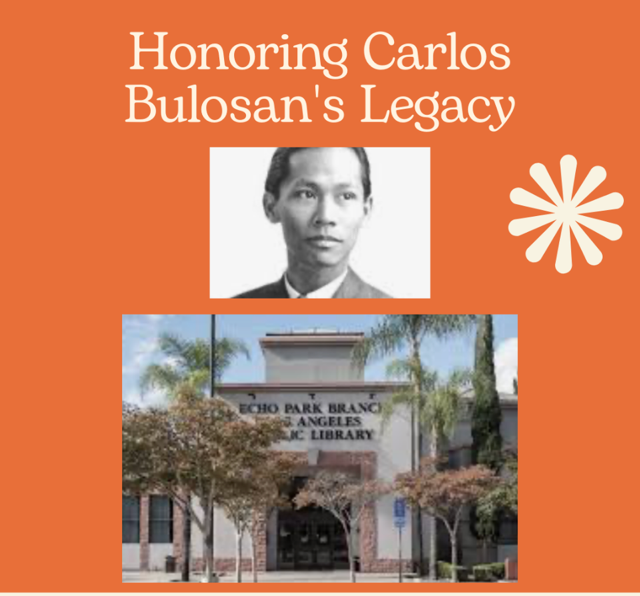
LOS ANGELES – This September, the death anniversary month of famous Filipino writer and labor union activist Carlos Bulosan, several groups are revisiting his works by way of paying him tribute for his achievements and what he had exposed and fought for, many of which have telling and timely effects on many people, including Filipinos and Asian immigrants, even during this present era.

Spearheading these groups are the Carlos Bulosan Book Club led by Commissioner Jaime Geaga and its mother organization, the Friends of Echo Park Library headed by James Castillo, the Philippine Global Media Group headed by Val Abelgas and Dan Nino, the Asian Journal Publications Inc. led by Roger Oriel, the Philippine News Today and Philippine Post, the Manila-based Komisyon sa Wikang Filipino (KWF) headed by Chairperson Atty. Maritess Barrios-Taran and Filipinos in the United States from Pangasinan, Bulosan’s home province.
Highlight of one of the tributes is the reading of the first Filipino translation of Bulosan’s famous poem, “I Want the Wide American Earth,” – “Gusto Ko ang Malawak na Lupaing America” – as part of the launching last September 20 of the book “California: A Philippine Territory Almost and Other Stories,” by veteran journalist, author and professor Alfredo G. Gabot.
Venue of the first event on September 20 was the Echo Park Library, a branch of the Los Angeles Public Library system, located on Temple street at the Filipinotown in Los Angeles. Another event is scheduled at the Milpitas Library and another in San Diego. The Los Angeles Library was the source of books and periodicals which Bulosan read and which inspired and sharpened his writing prowess while he was confined for two years in the nearby Los Angeles General Hospital from 1936 to 1938.

“I Want the Wide American Earth” was translated into Filipino by journalist-author- educator Jose Lad. Santos, former Chairman of the Komisyon sa Wikang Filipino (KWF) and former Commissioner of the National Commission for Culture and the Arts (NCCA).
A copy of the hand-written Filipino version of the poem titled “Gusto Ko ang Malawak na Lupaing Amerika” was presented to Commissioner Geaga and the Echo Park Library. Both Filipino and English versions of the poem are featured in the book launched at the library.
Also presented to the Carlos Bulosan Book Club will be copies of the Ilocano translation of Bulosan’s historic book, “America is in the Heart.” The Ilocano version, “Adda Iti Pusok Ti Amerika,” was the work of Pangasinan writer Manuel Diaz and serialized in the Bannawag magazine. The Ilocano translation’s publication into book was spearheaded by the Sub-Commission on Cultural Dissemination (SCD) of the National Commission for Culture and the Arts (NCCA) and launched with then President Gloria Macapagal Arroyo at the Binalonan Airport, a commercial airport owned by the family of current Pangasinan Governor Ramon Guico III and Rep. Ramon Guico Jr. in Binalonan, the hometown of Bulosan and the late First Lady Dr. Evangelina Macaraeg Macapagal, wife of the late President Diosdado Macapagal and mother of former President Macapagal-Arroyo.

“I Want the Wide American Earth” became the centrepiece and theme of the Asian American and Pacific Islanders (AAPI) Heritage Month celebration under US President Barack Obama in May 2013 through the efforts of the White House Initiative on Asian Americans and Pacific Islanders and the Smithsonian Asian Pacific American Center. Obama issued a Presidential Proclamation highlighting the importance of the month in reflecting upon the history and contributions of AAPIs.
In his message during the celebration, President Obama said: “Each May, our Nation comes together to recount the ways Asian Americans and Pacific Islanders (AAPIs) helped forge our country. We remember a time 170 years ago, when Japanese immigrants first set foot on American shores and opened a path for millions more. We remember 1869, when Chinese workers laid the final ties of the transcontinental railroad after years of backbreaking labor. And we remember Asian Americans and Pacific Islanders who have made our country bigger and brighter again and again, from Native Hawaiians to the generations of striving immigrants who shaped our history — reaching and sweating and scraping to give their children something more. Their story is the American story, and this month, we honor them all.”
Unknown to many, “I Want the Wide American Earth” was one of the last major works of Carlos Bulosan before his passing in Seattle, Washington due to lingering illness on September 11, 1956. Bulosan composed the poem in defense of courageous and pioneering Filipino labor union leaders, Chris Mensalvas, Ernesto Mangaoang, Ponce Torres, Joe Prudencio and Casomiro Bueno Absilor, some of them his provincemates in Pangasinan. The union leaders had been branded as communists and were being deported for years at the height of McCarthyism in the US. Bulosan produced and sold signed and numbered copies of the poem to boost the defense fund of the union leaders.
Bulosan also wrote a stirring piece, “An Open Letter to the Filipino People,” in the newspaper Philippines Mail on March 31, 1950 issue in defense of the union leaders. “…The deportation proceedings against the five members of Local 7, FTA, should be halted by all those who want to live in freedom and see an America where the individual is not in constant fear of his life and security,” he wrote. “It should be stopped before our constitutional rights are destroyed by an ever expanding machinery of our government, now bent on spying (into) the deepest recesses of our private lives…”

At that time, Bulosan was elected Publicity Director of the Local 37 of the International Longshoremen’s and Warehousemen’s Union (ILWU) based in Seattle. He edited the union’s 1952 Yearbook upon the invitation of the union leader and provincemate, Chris Mensalvas. The Yearbook chronicled the deportation battle of the union leaders and reflected Bulosan’s broad commitment to workers’ rights and social justice. Bulosan had to endure the long trip from Los Angeles where he had become an established writer to be able to reach Seattle to work for the union again. Bulosan’s works as publicity director helped strengthen the union and ultimately win the deportation cases.
Bulosan’s poem “I Want the Wide American Earth” captures the scope and ambition of immigrants of the American Dream. It also reflects the enduring spirit of immigrants and refugees seeking freedom and prosperity for their families.
The poem reads in part:
Before the brave, before the proud builders and workers,
I say I want the wide American earth
For all the free.
I want the wide American earth for my people.
I want my beautiful land.
I want it with my rippling strength and tenderness
Of love and light and truth
For all the free.
The poem affirms Bulosan’s strong faith in America – and calls on others to join in that faith – despite long years of hardships and difficulties he and other people, especially the minorities and immigrants, had suffered in America, enduring extreme racial discrimination, harsh workers conditions, despotic labor contractors, police brutality, among others. In one instance, he even wrote that in those days “it is a crime to be a Filipino in America.”
Bulosan chronicled his excruciating experience and that of other workers and migrants, including the Latinos, the Chinese and the Japanese, in an epic semi-autobiographical book “America is in the Heart” which was first published in 1946 (1943) in New York by Harcourt, Brace and Company and re-published in 1973 by the University of Washington Press. The university keeps the biggest collection of Bulosan’s original works, poems, short stories, essays, books, unpublished manuscripts, including letters. Thanks to modern technology, these works are now available in digital form on a dedicated UW website.
For years now, “America is in the Heart” has been a reference book in Asian American Studies and American Ethnic and Minority Studies in colleges and universities, especially in California, Washington and Oregon, three states which played prominently in Carlos Bulosan’s colorful life. Bulosan also worked in the canneries of Alaska and combed the farms of Colorado, Idaho and Arizona during their harvesting seasons.
According to reviews, Bulosan reveals in the final pages of the book that because he loved America no one could ever destroy his faith in his new country. He argued that despite the suffering and abuses he had experienced, America was an unfinished “ideal in which everyone must invest (…) time and energy, (…) this outlook leaves us with a feeling of hope for the future instead of bitter defeat.”

While in Los Angeles, Bulosan’s works found print in the popular magazines and national publications, especially in the 1940s, considered his most productive years. These mainstream publications include The New Yorker, Harper’s Bazaar, Town & Country, The Saturday Review of Literature, The New Republic, Mademoiselle, Scholastic, as well as the Leftist journal New Masses. On March 6, 1943, The Saturday Evening Post published his famous “Freedom from Want,” based on U.S. President Franklin Delano Roosevelt’s “Four Freedoms.” The essay put him in the league of distinguished writers of those times — Booth Tarkington, Will Durant and Stephen Vincent Benet who wrote the essays on the three other freedoms. Bulosan’s essay presented the perspective of a Filipino immigrant in the United States, addressing the struggle for equality and recognition. He highlighted that freedom from want is not just about material possessions, but also about dignity and the ability to participate fully in society.
In the essay, Bulosan affirmed that the meaning of freedom was “that all men, whatever their color, race, religion or estate, should be given equal opportunity to serve themselves and each other according to their needs and abilities.” Yet he went on to link strongly the spiritual and material dimensions of liberty:
“So long as the fruit of our labor is denied us, so long will want manifest itself in a world of slaves. It is only when we have plenty to eat—plenty of everything—that we begin to understand what freedom means. To us, freedom is not an intangible thing. When we have enough to eat, then we are healthy enough to enjoy what we eat. Then we have the time and ability to read and think and discuss things. Then we are not merely living but also becoming a creative part of life. It is only then that we become a growing part of democracy.”
Bulosan also wrote:
“But our march to freedom is not complete unless want is annihilated. The America we hope to see is not merely a physical but also a spiritual and an intellectual world. We are the mirror of what America is. If America wants us to be living and free, then we must be living and free. If we fail, then America fails.
“What do we want? We want complete security and peace. We want to share the promises and fruits of American life. We want to be free from fear and hunger.
“If you want to know what we are — we are marching!”
In an article “Letter to a Philippine Woman,” which ran in The New Republic in November 1943, Bulosan underlined his inclusive vision of life in America:
“It is but fair to say that America is not a land of one race or one class of men. We are all America that have toiled and suffered and known oppression and defeat, from the first Indian that died in Manhattan to the last Filipino that bled to death in the foxholes of Bataan…America is also the nameless foreigner, the homeless refugee, the hungry boy begging for a job and the black body hanging from a tree.
America is the illiterate immigrant who is ashamed that the world of books and intellectual opportunities is closed to him. We are all that nameless foreigner, that homeless refugee, that hungry boy, that illiterate immigrant and that lynched black boy. All of us from the first Adams to the last Bulosan, native born or immigrant, educated or illiterate—We are America!”
Bulosan sailed to America in 1930 at 17 in pursuit of the American Dream. The Philippines was an American territory or colony at that time, so he carried a passport (the size of a bond paper then) that of a United States national, along with thousands of Filipinos who arrived in the country since 1898. To his surprise, he was not treated as a US national along with thousands of other Filipinos who sailed to the US, mostly in Hawaii, to work, study and pursue the American Dream as impressed on most of them by the American teachers in the Philippines or the Thomasites.