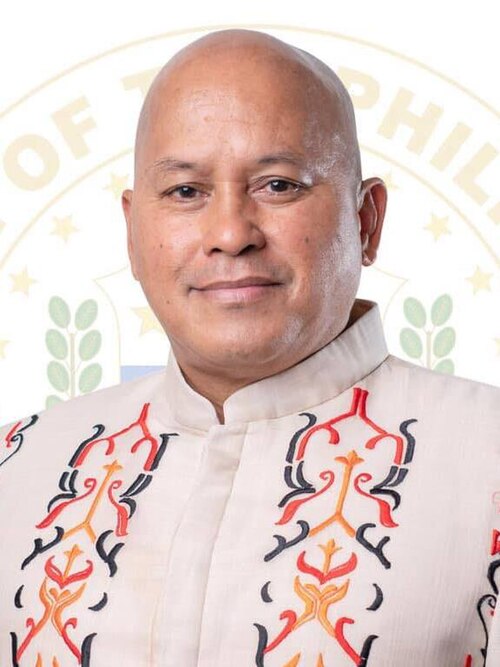







RETURN TO THE SENATE. Senator Ronald “Bato” dela Rosa confers with fellow lawmakers during the Senate session on Monday, May 11, 2026, in Pasay City, marking his return to the chamber amid ongoing legal and political developments linked to the International Criminal Court’s investigation into the Duterte administration’s anti-drug campaign. The session also resulted in the election of Senator Alan Peter Cayetano as Senate president. (PNA photo by Avito Dalan)
Lawmakers cite institutional authority and due process concerns as questions persist over possible ICC-related arrest efforts
MANILA — The Philippine Senate on Monday, May 11, placed Senator Ronald “Bato” dela Rosa under protective custody after lawmakers reported that agents of the National Bureau of Investigation attempted to intercept the senator inside the Senate complex amid continuing uncertainty over a possible arrest linked to the International Criminal Court’s investigation into the Duterte administration’s anti-drug campaign.
The motion was introduced during plenary by Senator Rodante Marcoleta and approved by newly elected Senate President Alan Peter Cayetano after no senator objected on the floor.
The decision followed the presentation of closed-circuit television footage during the session that senators said showed dela Rosa being pursued through Senate corridors and stairwells by individuals identified as NBI personnel. Lawmakers questioned the presence and actions of the agents inside the legislative compound while the Senate was in session.
Senators later cited several NBI personnel in contempt over the incident, according to statements made during the proceedings.
As of Monday evening, the NBI had not publicly released a detailed explanation regarding the reported operation or clarified whether its personnel were acting under a formal arrest directive.
The development marked dela Rosa’s first appearance at the Senate in months following persistent reports that he could face legal action connected to the ICC investigation into alleged crimes against humanity during former President Rodrigo Duterte’s anti-drug campaign.
Dela Rosa, who served as chief of the Philippine National Police from 2016 to 2018, has repeatedly denied wrongdoing and has maintained that police operations conducted during the anti-drug campaign complied with Philippine law.
During Monday’s proceedings, senators said the protective custody arrangement was intended to preserve the institutional prerogatives of the Senate while allowing dela Rosa to pursue available legal remedies.
The senator’s legal team also sought relief before the Supreme Court, requesting judicial intervention regarding any possible enforcement of an alleged ICC warrant and questioning the legal basis for cooperation with the international tribunal following the Philippines’ withdrawal from the Rome Statute in 2019.
Former Senator Antonio Trillanes IV separately stated that he had furnished Senate officials with what he described as a copy of an ICC warrant connected to dela Rosa. However, no Philippine court had publicly authenticated such a document to date, and the ICC had not issued a contemporaneous public confirmation regarding a warrant against the senator.
The ICC investigation centers on allegations tied to thousands of deaths recorded during anti-drug operations under the Duterte administration and earlier anti-crime campaigns in Davao City. International human rights organizations and ICC prosecutors have alleged that some killings may have constituted crimes against humanity. Duterte and former senior police officials have consistently denied authorizing unlawful killings or operating a state policy targeting civilians.
The issue gained renewed attention after Duterte himself was transferred to The Hague earlier this year to face ICC proceedings tied to the anti-drug campaign.
Legal experts and Philippine officials continue to debate whether the ICC retains enforceable jurisdiction over former Philippine officials despite the country’s withdrawal from the Rome Statute. ICC prosecutors have maintained that the court retains jurisdiction over alleged crimes committed while the Philippines remained a state party to the treaty.
Interior Secretary Jonvic Remulla separately confirmed that Philippine authorities were conducting domestic investigations related to alleged extrajudicial killings, although officials have described those inquiries as distinct from ICC proceedings.