






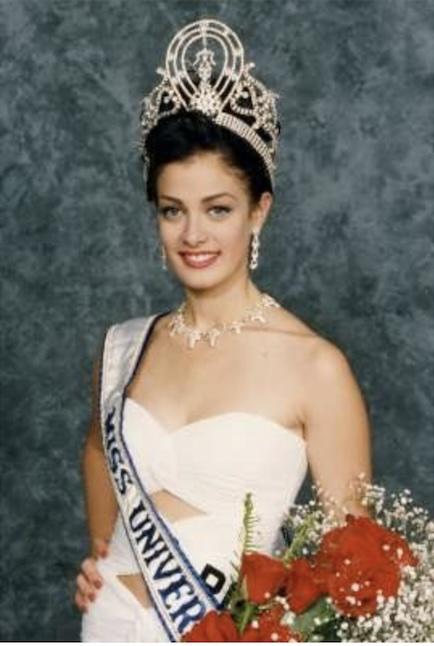
Dayanara Torres of Puerto Rico was crowned Miss Universe 1993 in Mexico City. At just 18 years old, she became the third Puerto Rican to win the international title. (Photo Credit: Courtesy of Miss Universe Organization / Archival Press Handout)
When Dayanara Torres was crowned Miss Universe 1993 in Mexico City at just 18 years old, she became a global symbol of grace, beauty, and promise. But her most lasting impact would emerge decades later—not on a runway, but in a doctor’s office, and then across communities who had long been left out of the cancer conversation.
In 2019, Torres was diagnosed with stage 3 metastatic melanoma, an aggressive form of skin cancer that had silently developed behind her knee and spread to her lymph nodes. She underwent surgery and nearly a year of immunotherapy, completing her treatment in early 2020.
“When it happened to me, I was in complete shock,” Torres told SurvivorNet in a later interview. “I had no idea what was going on in my body.”
Melanoma is the deadliest form of skin cancer. It begins in the melanocytes—cells that produce melanin, the pigment that gives skin its color. Although less common than other skin cancers, melanoma spreads quickly and can be life-threatening if not caught early. It can appear anywhere on the body, even in areas not typically exposed to sunlight. For many, including Torres, it arrives without symptoms or warning.
Her decision to share that shock publicly had ripple effects far beyond her own healing. Dermatologists across the U.S. began reporting a measurable uptick in skin exams among Hispanic patients, many of whom cited Torres’s story as their reason for finally getting checked. The phenomenon became known in advocacy circles as the “Dayanara Effect.”
A Voice for #GetNaked

In October 2020, the Melanoma Research Foundation (MRF) announced Torres as the newest spokesperson and featured model for its bold and award-winning #GetNaked campaign, launched to promote early detection through self-checks and full-body exams.
“While melanoma can affect anybody, early detection is the key to saving lives,” Torres said in the MRF’s official release. “One of my missions is for every single person to know the risks and how to detect it early on.”
MRF CEO Kyleigh LiPira praised Torres for helping dismantle long-standing misconceptions:
“Her voice helps dispel the dangerous myth that melanoma only affects older people or those with fair skin. Melanoma does not discriminate by age, race, or gender—everyone is at risk.”
Through raw interviews, public speaking, and a striking series of black-and-white campaign images, Torres helped reshape how skin cancer is perceived across racial and cultural lines.
Dayanara in the Philippines
For many Filipinos, Dayanara Torres isn’t just a former Miss Universe—she’s part of local pop culture history.
After her reign ended in 1994, Torres traveled to Manila as part of her pageant duties. What began as a short visit evolved into a four-year stay that would define her connection to the Philippines. Embraced by fans and producers alike, Torres accepted acting and hosting roles that made her a familiar face in Filipino homes.
She became a regular co-host on ABS-CBN’s top-rated Sunday variety show ASAP and starred in a string of Filipino films. Among them was the 1995 box office hit Basta’t Kasama Kita, opposite leading man Aga Muhlach. Their on-screen chemistry spilled into real life, and the two became one of the era’s most talked-about couples.
“The Philippines has always been my second home,” Torres wrote in a 2016 Instagram post.
Though their relationship ended, Torres’s bond with the country remained strong. She spoke some Tagalog, engaged with Filipino fans directly, and earned respect for her willingness to embrace the culture fully. To this day, she is warmly remembered as one of the most beloved foreign celebrities to make the Philippines her home.
A Life Reimagined
In 2000, Torres married singer Marc Anthony. The couple had two sons—Cristian, born in 2001, and Ryan, born in 2003—before divorcing in 2004.
Now based in Los Angeles, Torres has rebuilt a full life as an actress, model, author, and advocate. She continues to raise awareness about melanoma through bilingual campaigns, brand partnerships, and speaking engagements. Though she has kept her personal life private in recent years, her energy remains focused on healing—not just for herself, but for the communities she’s committed to reaching.
Legacy Beyond the Crown
Dayanara Torres’s legacy reaches far beyond the Miss Universe crown. Her openness about cancer, her cultural influence in the Philippines, and her role in reshaping public health conversations reflect a woman who has transcended her pageant origins.
“It’s not just about me,” she said. “It’s about reaching people who think they’re not at risk. Because I was one of them, too.”
Today, her quiet strength and continued visibility serve as a lifeline for those who need it most—proof that advocacy, when rooted in experience, can change lives.