




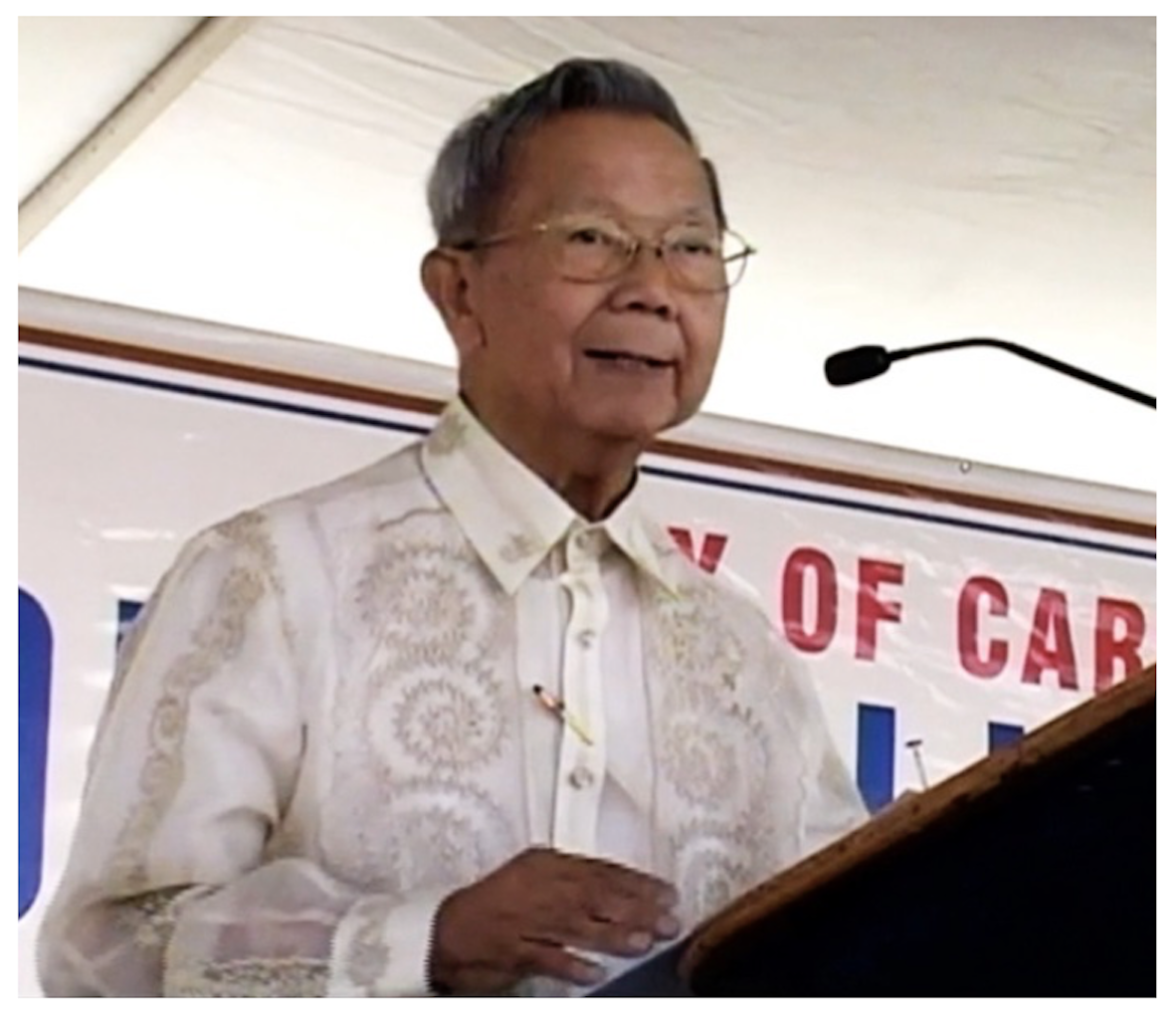
The late Jose Y. Lauchengco is shown delivering remarks during Larry Itliong Day in Carson, California, on Oct. 24, 2015. Image from the Lauchengco family archive, courtesy of Birthe Lauchengco.
How Jose Y. Lauchengco Jr. turned a dress-code dispute into a statement of Filipino dignity
LOS ANGELES — For the late Atty. Jose Y. Lauchengco Jr., the Barong Tagalog was not merely attire. It was formal dress, national identity, and a visible assertion of dignity in a country where Filipino presence often had to justify itself before being accepted.
The Barong Tagalog, the Philippines’ national dress for men, traces its origins to pre-Hispanic garments woven from lightweight fibers such as piña and jusi. During the Spanish colonial period, it became a symbol of Filipino identity, worn untucked and often hand-embroidered to reflect status and craftsmanship. By the 20th century, leaders such as President Manuel Quezon elevated the barong as formal attire, a practice reinforced by Malacañang’s 1975 declaration of Barong Filipino Week, which promoted its use as a symbol of national pride.
Lauchengco’s story most often begins in Orange County in 1975, when a dress code became a test of recognition. He mounted a formal challenge against a socially exclusive restaurant that had refused to treat the Barong Tagalog as equivalent to Western formalwear. The dispute concluded with an apology and a revised policy acknowledging the barong as proper formal attire, a small but enduring affirmation of Filipino identity.
The episode has remained a touchstone in the Filipino American community, not because of legal precedent, but because it raised a larger question: whether cultural dress carried from one country could be received in another without diminished standing. Lauchengco’s answer, in action, was yes.
Born in Manila on Dec. 6, 1936, he came to the United States at age 14 and attended Brown Military Academy in San Diego, graduating as valedictorian in 1955. He later studied political science at the University of the Philippines, where he was an entrance scholar, ROTC Corps Commander, and later a regular officer in the Philippine Army Rangers.
Those experiences shaped a sensibility that carried into his legal career: an awareness of how institutions define inclusion, assign status, and draw invisible lines around belonging.
He returned to Los Angeles for graduate and professional studies, earning a master’s degree in business administration from the University of Southern California in 1964 and a law degree from Loyola University of Los Angeles in 1971. He was admitted to the State Bar of California in January 1972.
Over four decades, Lauchengco built a practice in criminal defense and civil litigation, representing clients in matters ranging from serious criminal charges to complex disputes involving securities, torts, wrongful death, insurance, libel, and negligence.
The barong dispute was more than a question of clothing; it raised the deeper issue of how institutions define what is considered formal and whose standards are treated as the norm.
In American formal settings, Western suits have long been treated as the baseline. Other garments, even when formal within their own cultural systems, are often interpreted as deviation. Lauchengco challenged that hierarchy, asserting that Filipino formalwear did not require external validation.
In the Philippines, the barong had already been embedded in official ceremonies and public ritual. Lauchengco’s challenge extended that recognition into an American context where Filipino immigrants were still negotiating visibility.
Lauchengco’s legal career later intersected with another defining moment in Philippine history. In 1986, he was counsel in litigation connected to the Philippine government’s effort to recover assets linked to Ferdinand and Imelda Marcos in Los Angeles, part of post-authoritarian recovery efforts led by the Presidential Commission on Good Government.
Beyond litigation, he remained active in Filipino American legal life. He taught trial advocacy through the Philippine American Bar Association (PABA), served on its board of directors, and mentored younger lawyers. He also served on public and professional bodies in Los Angeles, including judicial and human rights commissions.
In 2021, PABA featured the late Lauchengco during Filipino American History Month, recognizing his place among Filipino American lawyers who helped shape the profession in Southern California.
Today, the Barong Tagalog continues to be widely visible – in Independence Day celebrations, weddings, oath-taking ceremonies, awards nights, and public gatherings. What once required explanation now moves freely through public space.
His defense of the barong remains a resonant chapter in Filipino American history. It was about claiming a place in public life without leaving one’s heritage at the door. In defending the barong, Jose Y. Lauchengco Jr., who died on March 27, 2017, affirmed that Filipino identity deserves recognition not only within the community, but in the formal institutions of American society.
Editor’s Note: Asian Journal revisits the story of the late Atty. Jose Y. Lauchengco Jr., whose defense of the Barong Tagalog in California became a lasting expression of Filipino dignity. This legacy feature reflects on a moment when cultural identity, legal advocacy and national pride converged at the doorway of American public life.