







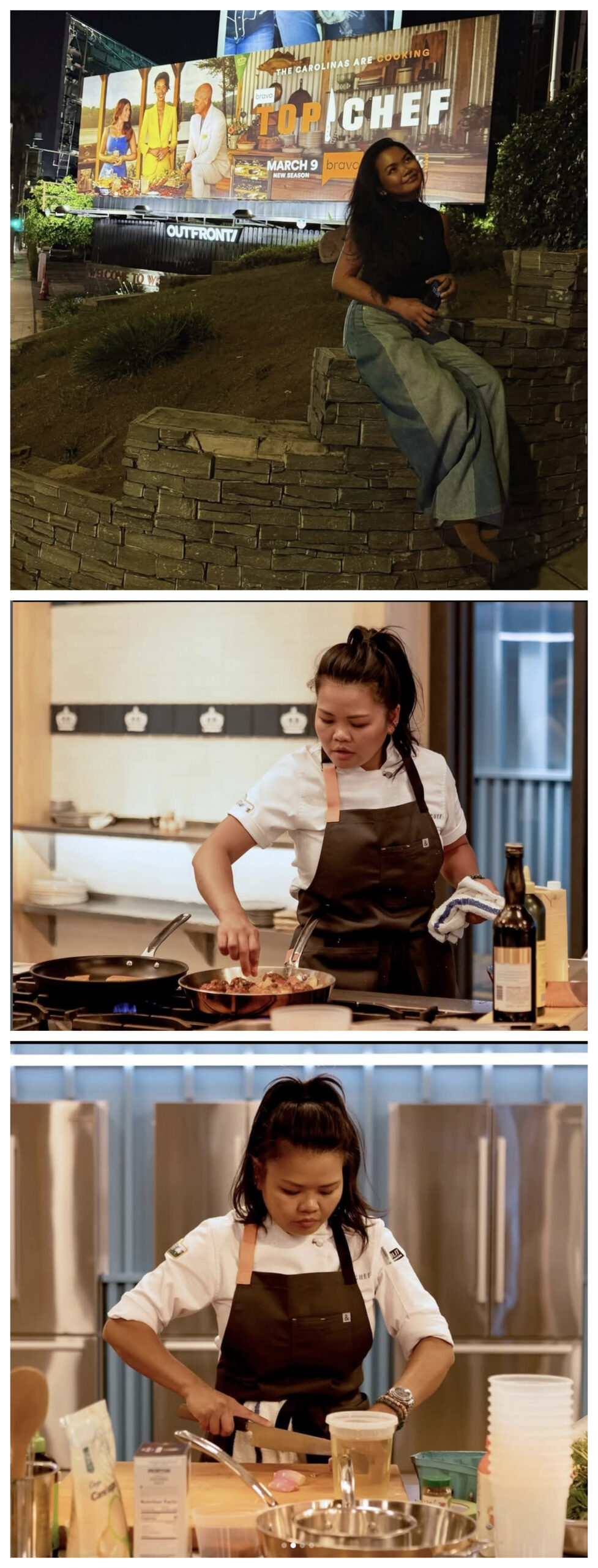
Rhoda Magbitang, executive chef of CanoeHouse in Hawai‘i and winner of Top Chef Season 23, is shown with a promotional billboard for Top Chef: Carolinas and during competition scenes in the Bravo kitchen. Magbitang won the season after returning through Last Chance Kitchen and presenting a finale menu rooted in Filipino flavors. – Photo courtesy of Rhoda Magbitang (@rockyrhodakill).
The CanoeHouse executive chef turned Filipino comfort dishes into a finale menu that completed one of the season’s most notable comebacks.
CHARLESTON, S.C. — Rhoda Magbitang, executive chef of CanoeHouse in Waimea, Hawai‘i, won Season 23 of Bravo’s Top Chef, ending a season that moved through the Carolinas and tested chefs on regional ingredients, speed, discipline and point of view.
Magbitang defeated Sherry Cardoso and Laurence Louie in the finale, which aired June 8. The season, titled Top Chef: Carolinas, brought together 15 chefs for the show’s familiar rhythm of Quickfire and Elimination challenges, with the winner receiving the $250,000 grand prize and the title of Top Chef.
Her path to the finale was hardly straightforward. Magbitang started strong, winning early elimination challenges and quickly establishing herself as one of the chefs to watch. Then, in Episode 5, she was sent home.
The loss did not end her season. Through Last Chance Kitchen, the show’s parallel competition for eliminated chefs, Magbitang cooked her way back into the main contest. By the time she reached the finale, her story had become one of recovery as much as momentum: a chef forced to regroup, sharpen her cooking and return with clearer purpose.
Born in Antipolo, Philippines, and now based in Hawai‘i, Magbitang brought to the competition a cooking style shaped by Filipino food, Pacific ingredients and fine-dining technique. Before joining CanoeHouse, she trained at Le Cordon Bleu and worked in Los Angeles kitchens, building the technical foundation that would later support her more personal cooking on the show.
The final challenge asked each chef to prepare a four-course progressive meal that reflected the people, places and experiences that shaped them. Magbitang answered with a menu rooted in Filipino family cooking.
She served sweet potato with uni, lugaw, grilled eggplant omelet with pork belly, and kaldereta with short rib. The dishes were familiar in spirit but carefully composed for the competition: lugaw, the rice porridge often associated with comfort and care; tortang talong, the grilled eggplant omelet common in Filipino homes; and kaldereta, a rich braise often served at gatherings and celebrations.
Magbitang chose not to close with a traditional dessert. Instead, she ended with kaldereta, a dish she linked to her father. It was a quiet but telling decision. Rather than using the finale to distance herself from home cooking, she leaned into it and asked the judges to meet the food on its own terms.
That choice gave the meal its force. The menu did not present Filipino cuisine as a flourish or a theme. It treated it as structure: the source of flavor, memory and technique. In a competition where chefs are often pushed to declare who they are through food, Magbitang’s answer was direct.
Her win also brought attention to the culinary world she represents. She is the first Top Chef winner from Hawai‘i, and her finale placed Filipino dishes in one of American food television’s most visible settings. For many viewers, the victory offered a rare mainstream moment for food long understood in Filipino households as layered, demanding and deeply expressive.
The season itself was built around place, with the Carolinas providing much of the backdrop and pantry. Against that setting, Magbitang’s finale added another geography: the Philippines of her childhood, the Hawai‘i where she now cooks professionally, and the restaurant kitchens that shaped her technique.
By the end, the judges were not simply weighing a comeback. They were weighing a meal that connected personal history with control and refinement. Magbitang’s final menu made its case without excess: Filipino food, handled with confidence and precision, belonged at the center of the finale.