





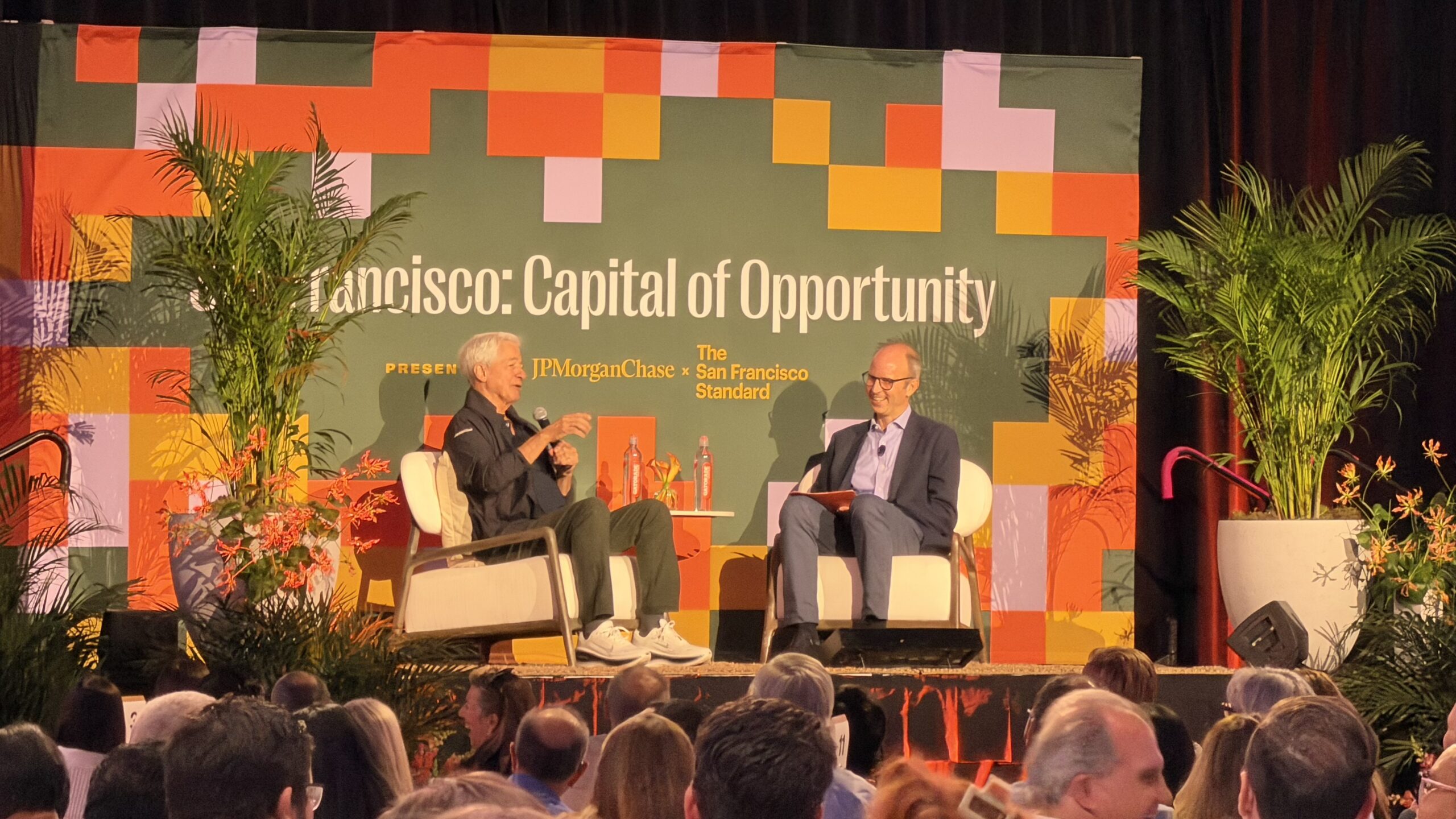
JPMorganChase Chairman and CEO Jamie Dimon speaks during a fireside chat at “San Francisco: Capital of Opportunity” at Chase Center in San Francisco on Monday, Aug. 3, 2026. The discussion covered housing affordability, artificial intelligence, workforce development and business-government cooperation.
Jamie Dimon outlines policy priorities on housing, artificial intelligence and workforce development during a San Francisco forum
SAN FRANCISCO – Jamie Dimon called for closer cooperation between business and government on housing, education, public safety and job training Monday, arguing that economic growth should be matched by policies that widen access to opportunity.
The JPMorganChase chairman and chief executive spoke at Chase Center during the opening stop of the bank’s 16th annual bus tour. Asian Journal was one of the media organizations attending “San Francisco: Capital of Opportunity,” where Dimon joined Kevin Delaney, editor-in-chief of The San Francisco Standard, for a fireside chat on the economy, technology and public policy.
Noah Wintroub, Global Chair, J.P. Morgan, was among the bank’s senior executives at the event. As JPMorganChase’s top Bay Area executive, Wintroub discussed the firm’s regional presence and its plans to increase housing investment through the American Dream Initiative. He said additional private capital could support housing production if accompanied by public policies that reduce development barriers and expand supply.
The tour brings Dimon and other senior executives to branches, operations centers and local events across the country to meet employees, customers, business owners, public officials and community organizations. It also allows the bank to review regional operations and assess where it could expand services or direct capital.
This year’s discussions parallel the six focus areas of the JPMorganChase American Dream Initiative: business growth and entrepreneurship; housing access and affordability; financial health and wealth creation; careers and skills; health care; and support for local institutions such as schools, hospitals, nonprofit organizations and local governments.
Dimon described what economists call a K-shaped economy, in which different groups move in opposite directions. Higher-income households, investors and growing industries may continue to gain wealth and opportunity, while lower-income families and struggling businesses face rising costs, stagnant wages or fewer jobs.
He attributed much of that divide to weaknesses in housing, education and workforce policy under both major political parties, while saying companies could contribute financing, expertise and partnerships.
“You don’t fix problems when you deny them,” Dimon said. He listed lower crime, better schools and more housing as priorities.
Housing occupied much of the discussion and provided the policy context for JPMorganChase’s announcement that it intends to deploy more than $750 billion in housing capital through 2035.
Dimon said high-cost cities need more housing to retain teachers, nurses and other workers. He characterized affordability primarily as a supply problem and argued that governments should reduce barriers to construction.
JPMorganChase said it will support faster permitting, updated zoning and building codes, expanded tax incentives and public-private partnerships. The bank will also chair the U.S. Chamber of Commerce’s Housing Advisory Council.
The bank aims to help finance the construction or preservation of 1 million affordable housing units and assist 500,000 customers in purchasing homes, including 200,000 first-time buyers. It also plans to increase mortgage lending by more than 40 percent and hire 850 home-lending advisers.
The $750 billion is a capital-deployment target, not a charitable fund or pool of direct payments. JPMorganChase said it includes mortgages, construction and development loans, equity investments and grants.
The bank defines units counted toward the target as serving households earning less than 120 percent of area median income. The goals remain subject to interest rates, construction costs, market demand and government approvals.
The broader initiative also seeks to support 10 million small businesses and provide nearly $80 billion in small-business lending over 10 years.
Delaney also questioned Dimon about artificial intelligence and concerns that its expansion could displace workers and widen inequality.
Dimon said some AI investments would probably lose value as the market develops, but rejected the view that the technology itself is merely speculative. He called for shorter certification programs through community colleges to prepare workers for fields such as cybersecurity and construction, and said AI requires appropriately designed regulation.
Dimon also criticized a proposed California wealth tax, saying it could discourage investment and prompt wealthy residents to leave the state. His comments represented one side of an active policy debate.
Several Bay Area announcements illustrated how the national program could be applied locally. JPMorganChase is providing nearly $200 million in financing for a 342-unit residential building at the Power Station redevelopment in San Francisco’s Dogpatch neighborhood. It is also considering an equity investment of up to $15 million in Fifth Space’s Essential Housing Fund and announced $6 million in grants to California housing organizations.
Dimon praised San Fracisco Mayor Daniel Lurie’s leadership, saying the mayor was “doing all the right stuff” and that San Francisco had “definitely turned” from the conditions that followed the pandemic. He presented the city’s recent progress as an example of what focused, competent leadership can accomplish when public officials establish priorities and act on them. Dimon cited falling crime, improved street conditions and efforts to permit more housing, while acknowledging that affordability and economic inequality remain significant challenges.
Near the end of the conversation, Delaney asked Dimon about recurring speculation that he could seek the presidency and about his plans after JPMorganChase.
Dimon said he was not preparing a presidential campaign and indicated that family considerations and his current responsibilities made a run unlikely. He said he was more interested in potentially establishing a policy-focused media or educational organization that could research and promote proposals on education, homelessness, taxation and other national issues.
He did not announce plans to buy an existing media company or provide details about the ownership, funding or timing of such an organization.
The forum linked JPMorganChase’s financial commitments to Dimon’s broader argument that private capital, government policy and workforce preparation should operate together.