







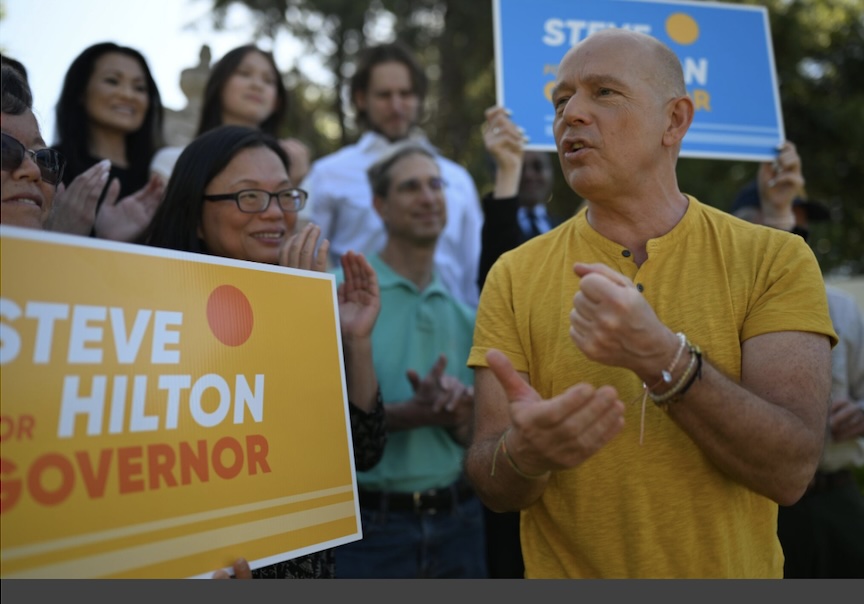
Photo courtesy of American Community Media (ACoM)
The Republican candidate and former adviser to British Prime Minister David Cameron told ethnic and community media reporters that California needs lower taxes, stronger law enforcement and a sharper focus on costs facing working families.
Steve Hilton, a Republican candidate for California governor, framed his campaign as a test of whether voters are ready to move away from Democratic control of state government, telling ethnic and community media reporters that California’s affordability crisis, housing costs, public safety concerns and immigration tensions require “a change of direction.”
Hilton appeared in American Community Media’s (ACOM) California gubernatorial candidate interview series, which gives ethnic and community media journalists an opportunity to question candidates on issues affecting immigrant, working-class and minority communities. The conversation covered immigration enforcement, farm labor, health care, taxes, diversity programs, wildfire prevention, insurance costs and hate crimes.
Hilton enters the race with an unusual political background for a California gubernatorial candidate. Born in England, he served as a senior adviser to former British Prime Minister David Cameron before becoming a political commentator, entrepreneur and founder of Golden Together, a policy organization focused on California governance and reform. California’s official certified list of candidates identifies Hilton as a Republican candidate for governor with the ballot designation “Small Business Owner.”
His campaign platform centers on what he calls restoring the “California Dream,” with proposals to reduce taxes, cut regulations on business, increase homeownership and improve student performance in math and English. His campaign website summarizes the vision as “Great jobs, great homes, great kids,” and lists priorities that include reducing taxes for workers, easing regulations on business, expanding housing affordability and improving schools.
Recent polling has placed Hilton in the top tier of California’s 2026 governor’s race, either leading or competing for one of the two November runoff spots in the state’s crowded top-two primary. In a fragmented field, surveys have shown him running closely with former U.S. Health and Human Services Secretary Xavier Becerra and billionaire activist Tom Steyer.
California’s primary system adds to the volatility. For voter-nominated offices, all candidates appear on the same primary ballot, and the two highest vote-getters advance to the general election regardless of party preference.
In the ACOM interview, Hilton opened with a personal account that linked his immigrant background to his campaign message.
“I love this beautiful state of ours,” Hilton said. “California is the most amazing place in the world as far as I’m concerned. I’m a proud immigrant and new American citizen.”
Hilton said his parents were Hungarian refugees from communism and that he was born in England before moving to California in 2012 with his wife and two sons. “Since moving here, I’ve taught at Stanford University, started a business, had a whole new career in the media,” he said. “I’ve lived the California dream.”
That experience, he said, shaped the reason for his candidacy. “The simple reason I’m running is that that dream, of course, is just not there for most people,” Hilton said. He argued that California has been shaped by 16 years of one-party Democratic control and what he described as “an experiment” in progressive governance. “If you look at the facts, it’s not a very good model to follow,” he said.
Hilton cited poverty, unemployment, cost of living, gas prices, electric bills, housing costs and homeownership as evidence for his argument that the state needs a different direction. He also pointed to national rankings on opportunity and business climate, saying California should be “the home of opportunity” and “the home of entrepreneurs and innovation.” Those claims were presented by Hilton as part of his campaign case.
“So in all these things, I think it’s very clear we need a change of direction and a bit of balance in our system,” Hilton said. “It’s not healthy to have one party controlling everything for so long.”
Hilton’s campaign uses the term “Califordable” to describe its affordability agenda. In the ACOM interview, he advanced the same theme, calling for “a positive, practical change plan” to make California more affordable through proposals such as “$3 gas,” cutting electric bills in half, making the first $100,000 of income tax-free and expanding access to homes families can afford to buy. He said his goal is to make California again “the best place once again to start and raise a family, to start and run a business.”
On immigration, Hilton drew a sharp distinction between legal and illegal immigration and said the next governor should not obstruct federal immigration law. “Immigration policy, of course, is not a responsibility of the governor,” he said. “It is a responsibility of the federal government.” He said his administration would avoid confrontation with federal authorities and ensure that “all the laws must be peacefully enforced.”
Asked about undocumented farmworkers and the potential impact of enforcement on California agriculture, Hilton rejected the characterization that he was “against immigrants,” saying, “We are pro-immigration, but it has to be legal immigration.” He said he had spent time in the Central Valley speaking with farmers and workers, and argued that a labor system dependent on unauthorized workers was unhealthy for both employees and employers.
Hilton also pointed to unemployment, labor-force participation and automation as part of his answer to concerns about agricultural labor shortages. He argued that California should not rely on unauthorized labor while many working-age adults remain outside the workforce, and said technological changes in agriculture could reduce dependence on lower-paid manual jobs.
On health care, Hilton said he would revisit programs that provide benefits to people without legal status, arguing that California taxpayers should not be asked to subsidize health care for “citizens of other countries” beyond what federal law requires. He also linked pressure on hospitals and schools to what he described as “uncontrolled immigration,” while citing labor regulations and operating costs as factors affecting distressed hospitals.
Affordability was the most developed part of Hilton’s policy presentation. Asked for the first three actions he would take to lower costs for working- and middle-class Californians, he began with taxes. “The most quick and direct way we can lower costs is through what the government charges,” Hilton said. “Number one is my tax plan to eliminate state income tax under $100,000. So your first 100 grand tax-free.”
He also proposed eliminating California’s $800 annual minimum franchise tax for small businesses and matching federal policy on not taxing tips. Hilton said tips remain subject to California state tax and that ending the tax would help service workers. He also proposed reducing annual vehicle registration to a flat $71 fee, arguing that California charges more than many other states.
On diversity, equity and inclusion programs, Hilton did not offer a blanket answer but said taxpayer funds should be reviewed by program and purpose. He said the state budget had grown substantially over the past decade while outcomes had worsened, and argued that schools should focus on academic instruction. “The focus of our spending must be, in the schools, for example, on academic instruction,” Hilton said, citing reading and math as priorities, particularly for Latino and Black students.
Asked about wildfires and insurance costs, Hilton said California should place greater emphasis on prevention, including clearing excess vegetation, maintaining defensible space and managing overgrown forests and brush, while distinguishing between Northern California forest conditions and Southern California ignition risks.
On insurance, Hilton said California’s regulatory framework had discouraged insurers from writing policies in the state. He credited Insurance Commissioner Ricardo Lara with changing rules to allow companies to account for future risk and reinsurance costs, but said the approval process for rate changes remained too slow and bureaucratic.
Public safety and hate crimes also drew extended discussion. Asked how he would address hate speech from politicians and hate crimes, Hilton said his policy on hate crimes begins with stronger enforcement against crime generally. “We need to deter crime and prosecute crime very strongly,” he said. He also called for both punishment and rehabilitation, saying prevention depends in part on reducing repeat offenses.
Pressed specifically on hate crimes, Hilton said they “must not be tolerated” and singled out attacks against Asian and Jewish communities as areas where California had not been tough enough. “I think we’ve seen too lax an attitude, particularly with regard to hate crime against Asian people and hate crime against Jewish people,” he said.
At the close of the interview, Hilton was asked whether he would support congressional immigration reform to legalize workers who have lived in the United States for years and have families. He declined to take a detailed position, saying immigration reform is a national issue and that he is running for governor. “I really want to focus on my responsibilities, which is to make sure that all the laws in our state are peacefully enforced,” he said.
Hilton returned in his final answer to the immigrant story he used at the start of the interview, saying he wanted to restore “that ladder of opportunity” for immigrant families while preserving a distinction between legal and illegal immigration.
For Hilton, the exchange offered a concise presentation of the argument at the center of his campaign: that California’s affordability crisis is inseparable from questions of immigration enforcement, public safety, education, wildfire prevention and the cost of basic services. He cast the state as a place still defined by opportunity but constrained, in his view, by a governing model that he says no longer delivers it for working families, small businesses and immigrant communities.




It would be great if Steve Hilton would eliminate property taxes for senior citizens of this state of ca the whole lottery program was started to donate money to the schools of ca nobody speaks about that. Any more!!I wonder why.also these back fees that ca dmv apply to your registration is off that charts and rediclous that should be eliminated.