








By Janet Susan R. Nepales
In the romantic fantasy-comedy world of husband-and-wife writer-directors Alex Huston Fischer and Eleanor Wilson, you can find love and live happily ever after with a partner made of wicker.
Based on Ursula Wills’ short story “The Wicker Husband,” “Wicker” tells the story of a single Fisherwoman (Olivia Colman) who decides to end her loneliness by asking the Basket Weaver (Peter Dinklage) to make her a Wicker Husband (Alexander Skarsgård).
Everything seems rosy in their relationship until the villagers, especially women such as the Tailor’s Wife (Elizabeth Debicki), become jealous of their loving and happy marriage.
In our exclusive interview with Skarsgård and Colman, the actors reveal what drew them to the project, the challenges they encountered while making the film and what makes the Wicker Husband the “perfect” husband, among other topics.
We also spoke with them during a panel discussion following the screening, where they shared further insights into the film.
What made you sign up for this project?
Olivia: I loved it because I hadn’t read anything like it before. It was original and different and full of heart and humor. It’s so exciting when something different comes into your inbox. Ideally, I’d love to play someone slightly different each time. That’s not very easy to do. I’d never played her before, and I loved her. I really loved the script. It’s quite simple for me.
Alexander: Yeah, same here. It was an extraordinary script. I came off a couple of projects in a row where, like “Pillion” (2025), “The Northman” (2022) and “Succession” (2021–2023), I played slightly misunderstood characters, slightly darker, some might say morally corrupt characters, maybe. So, it was interesting to take on a character who had such purity, and that intrigued me.
I noticed that the Wicker Husband was the most sincere among all the husbands in the village. That is probably why all the women in the village were gravitating toward him. What do you think is the secret of his charm?
Alexander: His attentiveness. He pays attention to his partner. In that scene where he’s hanging out with the other husbands, the dudes at a bar are talking about the old ball and chains back home and complaining about their partners. It’s a fun contrast because there’s obviously a lot of comedy in that, but also a lot of truth. It’s quite rare for someone to hang out with his buddies and say, like, “I love my wife. She’s amazing.”

If you had the chance to create your own partner out of any material, what material would you use, and what three qualities should your partner possess?
Alexander: Corduroy. As for the qualities, she definitely needs to have a sense of humor. I find that very, very important. I like that the Wicker Husband is quite funny.
Olivia: Corduroy would be nice to cuddle up to. Possibly too soft in some respects. The Wicker Husband’s qualities are perfect. Lovely company. We’re sort of working side by side. He listens. We chat, and he is funny.
Alex, what was your reaction when you first wore the prosthetics and makeup? How did they enhance your performance? And Olivia, what was your reaction when you began filming scenes with the Wicker Husband?
Alexander: Panic and claustrophobia were my immediate reactions because it was glued to my face. It was a bit… But honestly, it was very exciting putting it on for the first time because it was made by Wētā Workshop in New Zealand. They had a team working on it for 18 months, a team of, I believe, between 30 and 40 artists. So, I had only seen images and had conversations with them and, obviously, with Al and El, our directors.
But a few days before we started shooting, seeing it was a very memorable moment because, again, they’re such incredible artists. Then, stepping into it was kind of a shock, but really exciting because I felt like this character had existed in my head for a year, and finally, it felt real. Olivia was actually there that day at the studio where we were doing all the prep.
That was a very memorable moment as well, putting it on and finding the character because, again, that informed the physicality, too, the rigidity of the suit. But then, stepping out of the makeup trailer and seeing Olivia for the first time, I was like, “Meeting your husband. Hi.”
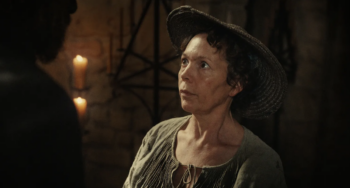
Olivia: The difference between having the real thing and having a balaclava with dots on it that you wouldn’t be able to touch properly was so amazing. And what Wētā Workshop did, Sarah and Joe, who came over and applied it every day, it was so beautiful to have the real Wicker Husband to touch.
Also, because he’s incredibly humble, all credit to Alex because getting the love, the nuance, the humor and all of that through basically a basket is incredible, and not many people could have done it.
Olivia, your character is someone whose desires are not necessarily understood or validated by the people around her. How did you find the fine line between her loneliness and her agency without allowing either one to define the other?
Olivia: Well, I didn’t consider her to be lonely, actually. Her agency appealed to me, and she’s the only one with her own job and the only one with her own money. She was perfectly at ease with herself, more so than probably anyone else in the village.
They didn’t understand it because she bucked the trend, and we found out little bits through economical little lines. So, the Wicker Husband says, “They taught you well,” about her parents, which is just enough for you to know that they loved her and that she had experienced love in her childhood. So, it was all there.
But I think one too many jibes meant she ordered herself a husband, not out of loneliness, but to tell them all to shut up. Then she just wasn’t expecting this incredibly beautiful creature who was so loving and kind. I love how the village unravels when she’s suddenly got what they want.
You mentioned the nuance in the movie. That’s what I loved most about it. We’ve known Olivia for the comedy she’s done in the UK, particularly early in her career. How did you develop these two characters to make sure the film was romantic, poetic and funny without turning into a farce? Was it difficult to find that balance? Could each of you address that?
Alexander: No, it actually wasn’t. It was an extraordinary script. It was so nuanced and so balanced. It made me laugh out loud, but there were also moments when, had it not been for the stoic suit, I probably would have cried.
It was so emotional. Olivia and I have talked quite a bit about finding that balance, making sure that you don’t dip too far into the farcical moments. There can be farcical moments, but you don’t want them to overpower the emotional beats or dip into melodrama.
We didn’t know each other, but when we met, it was very clear that we saw the movie in the same way, the script in the same way, tonally, and how we wanted to do this.
It was also very clear as we were shooting when there would be moments that lent themselves to comedy and when we could really lean in that direction, or when we had to pull back a bit to make sure we didn’t lose the audience.
Olivia: But I believe comedy is really good when it’s played realistically, and drama is good when it’s played with realism as well.
I could tell you a joke now and then tell you about something very sad. Humans do all of these things in a moment. In the saddest moments of my life, I’ve often found myself laughing hysterically because you can’t help it.
As long as it’s all played with integrity, realism and honesty, then they can both sit quite happily together.

Janet Susan R. Nepales is an award-winning journalist and the first Filipina voting member and Associate of the Golden Globe Awards. She has been a member since 2008 and is the first Filipina to be elected to the Advisory Board. She is the author of the coffee table book “FASHION. Filipino. Hollywood. The World” and the co-author of the first FWN book “DISRUPT: Filipina Women: Proud. Loud. Leading Without A Doubt.” A graduate of UST (AB Journalism, cum laude), she is based in Los Angeles and is a Hollywood entertainment journalist and TV correspondent.


Solid write-up. Been following this subject casually for a while and this is one of the better breakdowns I’ve seen. Will be checking back for more.