







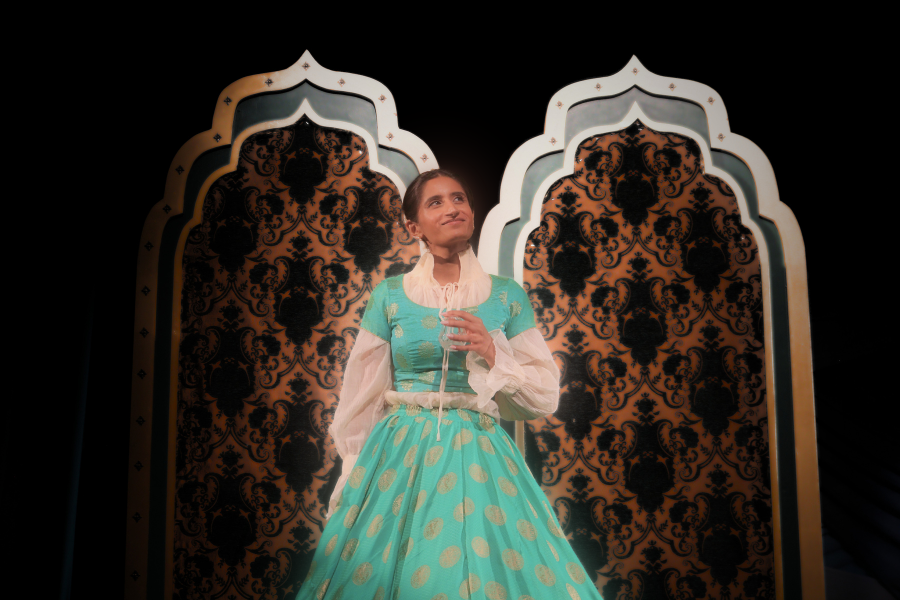
Arasha, actor in Jaclyn Backhaus’ play WIVES, at East West Players, co-produced with Hypokrit Live Arts. Photo by Daniel Antonio Vallejo.
By Janet Susan R. Nepales
At a time when marginalized voices are changing the national conversation, Jaclyn Backhaus’ play Wives, featuring a South Asian American cast, is both relevant and funny.
“This play offers its actors the opportunity to time travel, to play many characters, and to ultimately ask the question of what it means to be able to be fully seen for who they are, rather than who society supposes them to be,” says playwright Backhaus, who grew up in Phoenix, Arizona, and was raised by two botanists. “It is a play about how women might support each other in a world run by tyrant men, a play about how community is built by sharing abundance in the face of scarcity.”

Backhaus, a prominent playwright and screenwriter known for her dynamic storytelling and innovative works, is a core member of The Kilroys, an organization advocating for gender parity in theater.
The comedy whisks audiences from 16th-century France to 1920s India and 1960s Idaho, offering witty and moving glimpses of history’s so-called great men through the eyes of the women at their sides.
In 2026, its themes of visibility, solidarity and rewriting the narrative resonate strongly, particularly as South Asian American women have become increasingly visible in national and local Los Angeles politics.
According to director and Hypokrit Live Arts Artistic Director Arpita Mukherjee, “Jaclyn Backhaus’ ‘Wives’ is the audacious and irreverent storytelling event the world needs right now. The play will have you not only questioning how history was written but daring you to imagine a new form entirely. Insanely theatrical and side-splittingly funny, this is the kind of craveable drama that will keep you coming back for more.”
Wives had its world premiere Off-Broadway at Playwrights Horizons in September 2019. Presented by East West Players as the opening production of its 61st mainstage season, the Southern California premiere runs through Nov. 1 at the David Henry Hwang Theater.

The play features Rachna Khatau (Disney’s Bizaardvark), E.M. Davis (Cyrano de Bergerac at Pasadena Playhouse), Arasha (Smosh on YouTube) and Parvesh Cheena (The CW’s Crazy Ex-Girlfriend).
In exclusive email interviews, Arasha and Cheena talked about how they became involved with the play, what drew them to the production, their characters, working with director Arpita Mukherjee, the challenges they have encountered and what they hope audiences will take away from the play.
How did you get involved with Wives? What made you join the production?
Arasha: I had the privilege of working with Arpita on a project that premiered in Los Angeles in May 2025, so I was honored when she asked me to read for a role in another South Asian comedy she would be directing. She sent me the script, and I fell in love with the material. I was laughing throughout all four acts, and I could already envision myself as part of the production. I could see myself on this stage. I became obsessed with booking this job, and my anxiety took over.
After the audition, I was boarding a plane when Arpita texted me about getting on a phone call. I irrationally assumed it was to let me down, and I ended up mourning the project for the entire three-hour flight. But once I landed, I called Arpita, and she simply shocked me back into reality. She immediately said, “Hey! I just wanted to call and offer you the role.”
Parvesh: I had the privilege of working with Arpita this summer on a workshop of a new Madhuri Shekar play in NYC for PAC/NYC. Arpita and I had worked together ever so briefly on another workshop years ago. She has also directed friends like Danny Pudi in his one-man show and even Arasha in a How I Met Your Masi sketch show. I missed that opportunity as well, so when the chance to finally work with her came up, I jumped. And after reading Jaclyn’s play, it was a no-brainer. I like plays that are meant for the theater. I like theatricality and magical realism.
Please tell us more about your character.
Arasha: Wife 3 can be described as the point of view of the playwright herself. Taking the form of many different characters, she learns the most from the beginning of our story until the very last moment. She begins as Diane, the mistress who offers a twist on the typical tale. Next, she’s Martha Gellhorn, a respected correspondent but an underestimated wife. Then she’s Maharani, the first lady of Jaipur, fearless and feisty. Finally, she’s Swarn/Me, who learns that the answers she’s searching for are mythical, perhaps better left unanswered. Wife 3 transforms her gift of discovery into an acceptance of uncertainty.
Parvesh: I play four men in Wives: a French king, a celebrated American author, an Indian prince of Jaipur and, my favorite, a grandfather magically brought into the present by his granddaughter. All are fun to play, but the grandfather has a special place for me as a performer.
How is it working with director Arpita Mukherjee?
Arasha: Arpita is my sister, my mother and now my wife. I feel safe pitching bad ideas in the room, and there isn’t always a space for that in other environments. She welcomes experimentation and does not fear disaster. Her approach to rehearsal is one of experimentation and self-discovery.

In both projects I’ve worked on with her, I’ve watched her collect the puzzle pieces of the show through the people in the room and their ideas. Then it’s her vision that creates the whole picture. Arpita is not afraid to hear other opinions, but she also doesn’t fear rejecting them with her cold, cold heart. She’s somehow incredibly chill and strikingly brutal, in a fierce way. She has proven to be an impressive and respected South Asian director in this industry, helping to construct honest and bold representations of us.
Parvesh: Oof, as I so clearly stated before, it’s really tough and rough with Arpita. Heh. It’s a good match. I like a blend of play and exploration, along with the final finishing touches and solidification of the work. Arpita navigates all of this splendidly.

What challenges have you encountered so far, and how are you handling them?
Arasha: There is a LOT going on in this play: thematically, historically, physically and transitionally. Between the four acts, we have different settings, different tones and entirely different characters. To help tell these stories, movement and text work closely together during the monologues. It has been a beast to learn and keep track of all the choreography while remaining focused on connecting with and vocalizing the words.

Luckily, I have three strong players on stage with me to help create that harmony. We work together, and we move together.
Parvesh: I often forget which panels on stage I have to move. Luckily, all my castmates and our talented backstage crew help this befuddled old man out.
What do you hope audiences will take away after watching the play?
Arasha: The messaging in this play holds a lot of weight for our community. We are talking about themes that challenge historical beliefs and gender practices throughout time. Women weren’t labeled as much more than wives, often collected in handfuls by men. They were never the main characters, but usually the sidekicks. I hope our show draws attention to those sidekicks. In fact, this is a spotlight on those characters. This is our take on those stories because they exist, too.
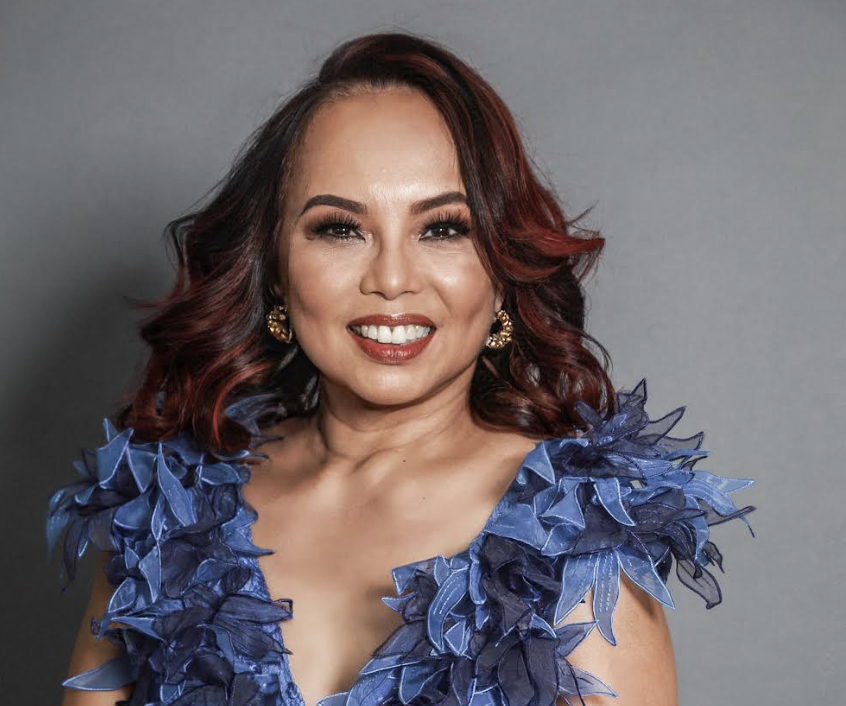
Janet Susan R. Nepales is an award-winning journalist and the first Filipina voting member and Associate of the Golden Globe Awards. She has been a member since 2008 and is the first Filipina to be elected to the Advisory Board. She is the author of the coffee table book “FASHION. Filipino. Hollywood. The World” and the co-author of the first FWN book “DISRUPT: Filipina Women: Proud. Loud. Leading Without A Doubt.” A graduate of UST (AB Journalism, cum laude), she is based in Los Angeles and is a Hollywood entertainment journalist and TV correspondent.


