




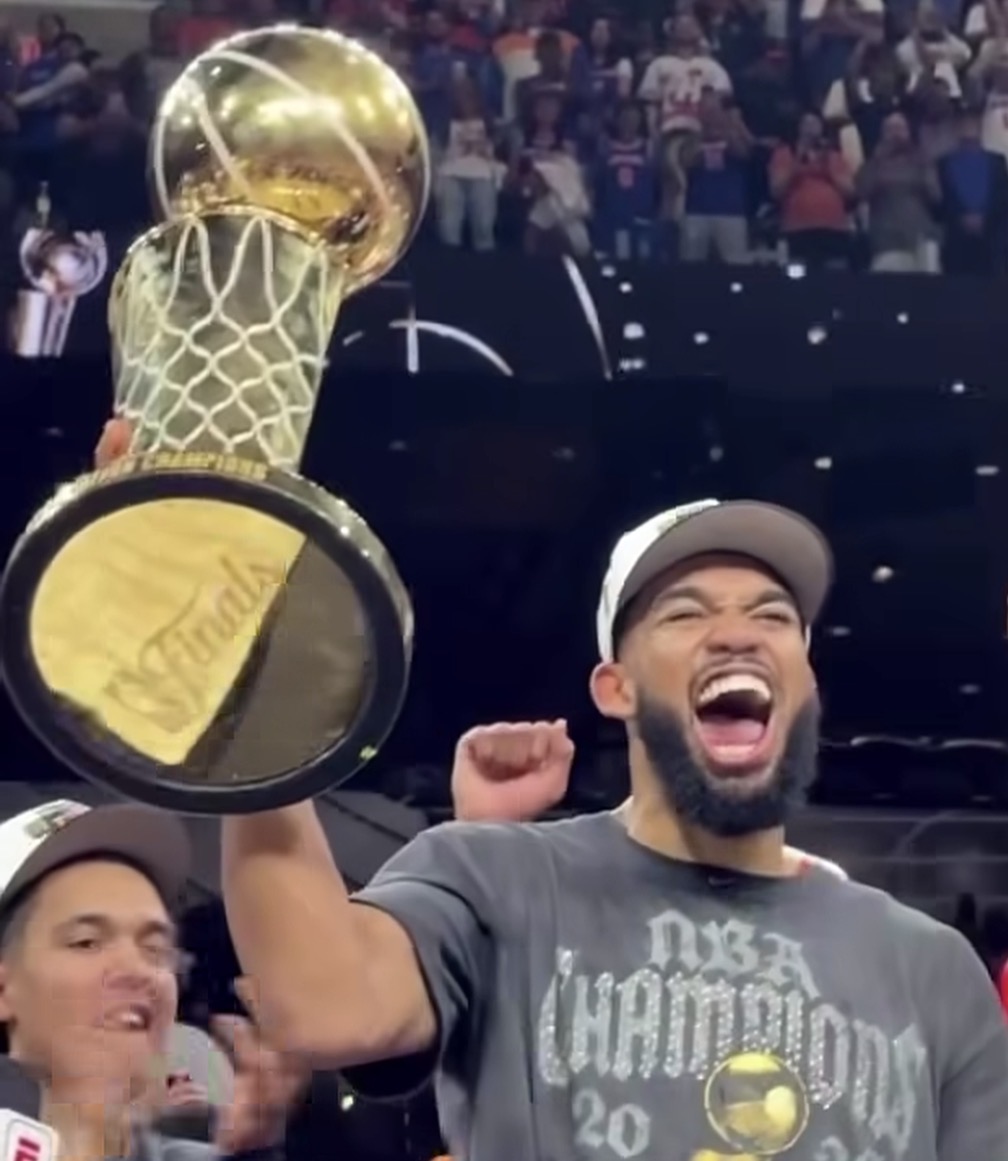
Karl-Anthony Towns with the Larry O’Brien Championship Trophy after the New York Knicks completed their NBA championship run. – Photo from the New York Knicks
SAN ANTONIO — The New York Knicks’ long wait ended the way their championship run had been defined: from behind, under pressure and with Jalen Brunson taking command when the game mattered most.
The Knicks defeated the San Antonio Spurs, 94-90, in Game 5 of the NBA Finals on June 13, clinching the series 4-1 and securing the franchise’s first NBA championship since 1973. It was New York’s third NBA title and the completion of a postseason built on resilience, late-game precision and a star guard who kept meeting the moment.
The franchise’s roots reach back to the beginning of professional basketball’s modern era. Founded in 1946 by Madison Square Garden executive Ned Irish, the Knicks were originally known as the New York Knickerbockers, one of the Basketball Association of America’s original teams before the BAA became a forerunner of today’s NBA. The name, later shortened to Knicks, draws from old New York’s Dutch colonial heritage and became one of the most enduring identities in American basketball.
Brunson delivered the performance that sealed both the championship and his place in franchise history. The Knicks guard scored 45 points, including a series of decisive baskets in the fourth quarter, and was named NBA Finals Most Valuable Player. His total set a Knicks record for points in an NBA Finals game, surpassing a mark previously held by Willis Reed.

The victory was anything but routine.
Throughout the Finals, New York repeatedly found itself trailing before rallying behind its defense, composure and late-game execution. The Knicks erased double-digit deficits in all four of their victories, including a 29-point comeback in Game 4, the largest comeback in NBA Finals history.
Game 5 followed the same pattern.
San Antonio appeared poised to extend the series behind rookie guard Dylan Harper, whose postseason rise reinforced why the Spurs are viewed as one of the league’s most promising young teams. The 20-year-old scored nine consecutive Spurs points during a third-quarter surge and finished with 25 points, helping San Antonio build a 15-point lead deep into the period.
Behind Harper’s shot-making and Victor Wembanyama’s presence around the rim, the Spurs seemed positioned to force the series back to New York. Wembanyama finished with 19 points, 14 rebounds and five blocks, giving San Antonio the kind of interior force few teams can match.
The Knicks did not break.
New York cut the deficit to seven entering the fourth quarter, then turned the game into a test of half-court execution. As the pressure rose, Brunson controlled the closing minutes, attacking mismatches, creating offense and delivering the baskets that carried the Knicks across the finish line.
For the Knicks, the championship restored one of the NBA’s defining franchises to the center of the basketball world.It recalled the era of Willis Reed and Walt Frazier, when Madison Square Garden was the home of championship basketball in New York, while giving a new generation of fans its own team to remember.
The title also carried special significance for Filipino basketball fans around the world.
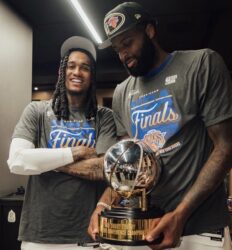
Jordan Clarkson became the first player of Filipino descent to be part of an NBA championship team. Clarkson, whose mother is Filipino American and who has represented the Philippines in international competition, added the league’s highest team honor to a career that already includes an NBA Sixth Man of the Year Award and a prominent role in the growth of Philippine basketball’s global profile.
With Clarkson on the Knicks and Harper on the Spurs, the series assured that, for the first time, an NBA championship team would include a player of Filipino heritage. Harper, whose Filipino ancestry comes through his mother’s side of the family, gave San Antonio a young Filipino-connected presence in the title series. Clarkson’s Knicks ultimately secured the championship, making the milestone part of New York’s season and a historic moment for Filipino representation.
Clarkson became the first player of Filipino descent to be part of a team that won the Larry O’Brien Championship Trophy, the NBA’s title trophy awarded to the Finals winner. Named for Larry O’Brien, the league commissioner from 1975 to 1984, the trophy honors a period that helped shape the modern NBA, including the NBA-ABA merger, the introduction of the three-point shot and expanded national television exposure. For Filipino fans, Clarkson’s place on that championship roster carried lasting significance: it placed a player of Filipino descent inside the NBA’s title record.
The moment also connects Clarkson to a longer Filipino-American basketball history that includes Raymond Townsend, widely recognized as the first Filipino-American player in NBA history after being drafted by Golden State in 1978. Nearly five decades later, Clarkson’s championship represents another landmark in the growing visibility of Filipino athletes in professional basketball.
The night ended New York’s long championship wait and secured Brunson’s place in Knicks history with a Finals MVP performance worthy of the moment. It also gave Filipino basketball a defining milestone. Clarkson became the first player of Filipino descent to be part of an NBA championship team, adding his name to the league’s roster of title winners and to the broader history of Filipino representation in the sport.