





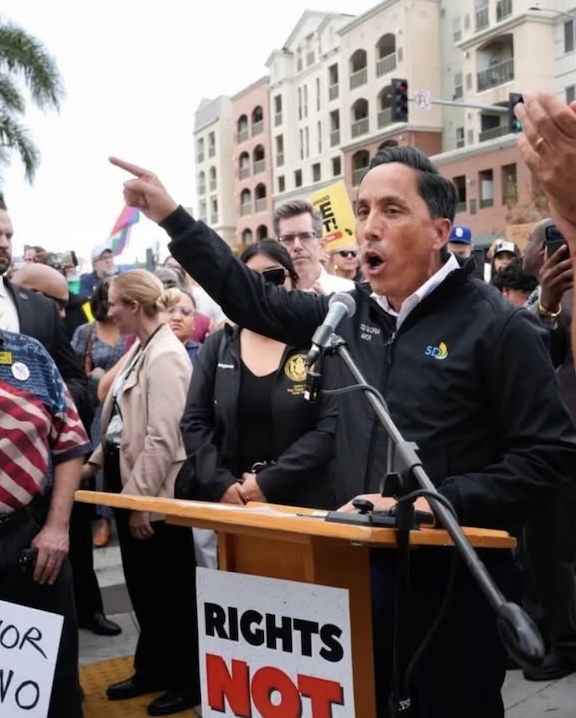
Mayor Todd Gloria file photo from his social media account
President says his comments concerned higher gasoline prices and the danger of a nuclear-armed Iran, not support for attacks on American cities
SAN DIEGO — President Donald Trump said Thursday that his remarks about possible Iranian attacks on San Diego and Los Angeles had been misinterpreted, responding to criticism that prompted Filipino American Mayor Todd Gloria and California lawmakers to demand an apology.
The controversy began Monday, October 5, during a campaign rally in Grand Island, Nebraska, where Trump discussed the war with Iran and the higher gasoline prices associated with the conflict.
Arguing that the economic costs were justified by the need to prevent Iran from acquiring nuclear weapons, Trump described rising prices as a relatively small sacrifice for national security.
He then referred to the possibility of attacks on American cities, saying, “Let them take out Los Angeles. Let them take out San Diego.”
The remarks drew objections from California officials who interpreted the wording as suggesting that attacks on the two cities could be considered acceptable. The White House rejected that interpretation.
Gloria issued a statement Tuesday emphasizing San Diego’s significance to American national defense and the president’s responsibility to protect all communities.
“President Trump should retract these remarks and apologize to the people of San Diego,” Gloria said.
The mayor pointed to San Diego’s military installations, servicemembers, shipbuilders and research institutions, saying the city’s nearly 1.4 million residents should not be treated as expendable in discussions of national security.
Gloria, San Diego’s 37th mayor, also serves as president of the United States Conference of Mayors for 2026–2027.
White House Communications Director Steven Cheung disputed the interpretation that Trump had advocated attacks. Cheung said the president was describing the danger American cities could have faced if Iran acquired nuclear weapons and the administration had not acted to prevent it.
California Gov. Gavin Newsom criticized the remarks and directed the State Threat Assessment Center to monitor the situation in case foreign actors interpreted the president’s words as an invitation to target California.
Los Angeles Mayor Karen Bass also objected to the comments. Jim Desmond, a Republican congressional candidate, San Diego County supervisor and Navy veteran, similarly expressed disagreement, emphasizing the federal government’s responsibility to defend American communities.
The United States Conference of Mayors issued a separate statement through its chief executive and executive director, Tom Cochran, criticizing the president’s initial wording and calling on elected officials of all political affiliations to reaffirm their responsibility to protect American cities.
On Wednesday, October 7, California’s Democratic congressional delegation, including U.S. Sens. Alex Padilla and Adam Schiff, called for an apology. The lawmakers said Trump’s remarks appeared to invite an attack on the cities, an allegation disputed by the administration.
Trump returned to the subject Wednesday during a campaign rally in San Antonio, Texas, where he described the devastating consequences of missile strikes against San Diego or Los Angeles.
“We’re not going to let that happen. We protect our cities. We protect our country,” Trump said.
In a social media statement Thursday, October 8, Trump said he had been comparing the temporary economic burden of higher gasoline prices with the far greater consequences of an attack on major American cities. He rejected suggestions that he wanted Iran to strike San Diego or Los Angeles and said he loved both cities.
The president’s hypothetical account of an Iranian missile attack was not an established assessment of Iran’s current military capability. In its March 2026 threat assessment, the U.S. intelligence community said Iran had developed space-launch technology that could support a militarily viable intercontinental ballistic missile by 2035 if Tehran pursued that capability. The assessment did not establish that Iran possessed an operational missile capable of striking California.