





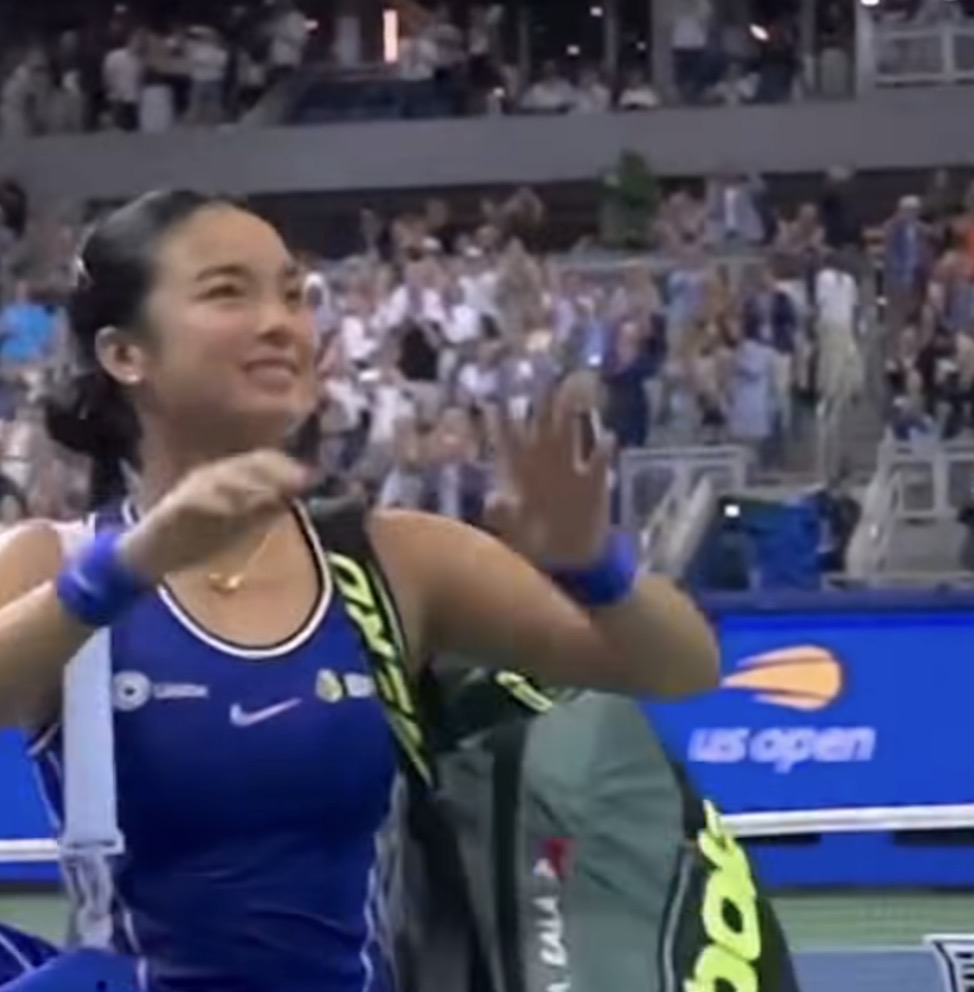
Her US Open run ended in the third round, but the larger measure of Alex Eala’s season lies in the distance traveled: from No. 140 at Miami 17 months ago to a WTA champion, Grand Slam seed and world No. 18.
NEW YORK — Long before Alexandra “Alex” Eala walked onto Arthur Ashe Stadium as one of the world’s Top 20 tennis players, there was a little girl in the Philippines heading to practice after school with her grandfather and older brother.
At Wimbledon this summer, after one of the biggest victories of her career, Eala remembered that child: the ruffled socks, the light-up shoes, the chubby cheeks, and the daily trips to the court.
The memory has particular resonance now.

On Saturday night at the US Open, Eala stood on the largest tennis stadium in the world as the No. 17 seed, facing another young Top 20 player, American Iva Jovic, for a place in the fourth round. Jovic prevailed 7-5, 3-6, 7-5 in a match that stretched deep into a deciding set.
Eala’s run in New York was over.
But the setting itself offered perspective.
Seventeen months earlier, when she entered the 2025 Miami Open on a wild card, Eala was ranked No. 140. As of the start of this US Open, she was at a career-high No. 18.
The 122 places between those two numbers only begin to describe what has happened.

A journey that began with family
Eala’s path into professional tennis started as a family affair.
She has said her grandfather coached her for the first decade of her tennis life, from about age 3½ until 13, while she trained every day with her brother. Her parents accompanied her as competition expanded from Asia to Europe and the United States.
A major turn came in 2018, when Eala won the prestigious Les Petits As junior tournament in France. The Rafa Nadal Academy subsequently contacted the family, and Eala moved to Spain at 13 to continue her development.
Leaving home so young placed much of her adolescence inside the demanding rhythms of elite tennis: training, travel, tournaments and school, often thousands of miles from the Philippines.
The results came gradually.
In 2022, at 17, Eala won the US Open girls’ singles championship, becoming the first Filipina to win a junior Grand Slam singles title. She said afterward that the achievement belonged not only to her, but also to Philippine tennis and to younger players who might see another possibility for themselves.
The junior title established her potential. The professional tour required another climb entirely.

Miami changes the trajectory
That climb accelerated dramatically in March 2025.
Eala arrived at the Miami Open ranked No. 140 and playing on a wild card. Over the course of the tournament, she defeated three Grand Slam champions: Jelena Ostapenko, reigning Australian Open champion Madison Keys and Iga Swiatek.
Against Swiatek, then ranked No. 2, Eala won 6-2, 7-5 to reach her first WTA 1000 semifinal.
Jessica Pegula ended the run in three sets, but Miami fundamentally changed Eala’s position on tour. She climbed 65 places to No. 75 and became the first Filipina to enter the WTA Top 100.
What followed mattered because it demonstrated that Miami was not simply one extraordinary week.
On grass at Eastbourne three months later, Eala came through qualifying and reached her first WTA Tour final. By late June, her ranking had risen to No. 56.
At the 2025 US Open, she rallied from 5-1 down in the deciding set to defeat No. 14 seed Clara Tauson, becoming the first player representing the Philippines to win a Grand Slam singles main-draw match in the Open Era.
Weeks later, Eala won the Guadalajara WTA 125, her first title at that level.
She finished 2025 ranked No. 50, a rise of 108 places from her year-end No. 158 ranking in 2024.
The player who had begun the year outside the Top 100 was ending it inside the Top 50.

A higher level brings higher expectations
The progression continued in 2026.
A semifinal in Auckland and quarterfinal appearances in Abu Dhabi and Dubai helped push Eala to No. 29 by March, her first move into the Top 30.
Her most significant stretch came during the grass season.
Eala won the WTA 125 tournament in Birmingham and reached the semifinals of the WTA 500 event in Berlin before arriving at Wimbledon as the No. 29 seed.
Then, on Centre Court, she met Swiatek again.
This time Swiatek was the defending Wimbledon champion.
Eala won 7-6(9), 6-2, advancing to the fourth round and becoming the first player from the Philippines to reach the second week of a singles Grand Slam in the Open Era.
It was after that victory that Eala looked backward, briefly, to the child who had started all of this.
She recalled going to practice every day with her grandfather and brother, and said that for the little girl she had been, the achievement meant “everything.”
Then she turned immediately toward the next match.
The moment captured something important about her ascent.
Milestones that carry historic significance for Philippine tennis are, for Eala, increasingly followed by the professional athlete’s next question: What comes after this?
Washington provides an answer
A few weeks later, the answer came in Washington.
At the WTA 500 Mubadala DC Open, Eala defeated Zheng Qinwen, Leylah Fernandez, Elina Svitolina and Naomi Osaka to reach the final.
Waiting there was Pegula, the same opponent who had stopped her in the Miami semifinals 16 months earlier.
This time, Eala completed the tournament.
She came from behind to defeat Pegula 4-6, 6-4, 6-0, winning the final nine games after the rain-delayed championship match resumed. It was Eala’s first WTA Tour singles title and the first won by a player representing the Philippines.
The route to the championship underscored its quality. She beat the tournament’s top three seeds, Svitolina, Osaka and Pegula, in succession.
The title moved her from No. 28 to No. 20, making her the first Filipina to enter the WTA Top 20.
By Aug. 24, she had reached No. 18, another career high.

Returning to New York from a different place
That made this year’s US Open a very different tournament from the one Eala had entered 12 months earlier.
In 2025, her first main-draw victory in New York was itself a national milestone.
In 2026, she arrived seeded.
She defeated American qualifier Mary Stoiana 6-1, 6-2 in the first round, then beat Ukraine’s Oleksandra Oliynykova 6-1, 6-4 to reach the third round without dropping a set.
Around her, another measure of the journey was visible.
Filipino supporters filled sections of the grounds with flags, signs and chants, part of a following that has grown alongside her ranking.
Eala has spoken about what that following means in the context of her own childhood. Growing up in the Philippines, opportunities to see elite professional tennis locally were limited. Young players often had to look elsewhere for them.
Now she is the player Filipino children can watch.
She has described exposure to top-level tennis as something that can “plant a dream.”
Her career has become an example of that progression in real time.

What Arthur Ashe revealed
Saturday’s third-round match did not take Eala into the second week of another Grand Slam.
It revealed something else.
At Miami in March 2025, the question was whether a 19-year-old ranked No. 140 could compete with the best players in the world.
On Arthur Ashe 17 months later, that question no longer needed asking.
Eala had arrived as No. 18 in the world, a WTA champion and a Grand Slam seed, playing a marquee match against another member of the sport’s emerging elite.
Between those two nights came a first Top 100 ranking, a first WTA final, a first Grand Slam main-draw victory, two WTA 125 titles, a Wimbledon fourth round and a first WTA Tour championship.
The more revealing change, however, may be in what is now expected of her.
A third-round appearance at a Grand Slam once would have represented another unprecedented step. Today, it can feel like unfinished business.
That is not evidence that Eala has fallen short. It is evidence of how quickly the horizon around her has moved.
Seventeen months ago, she arrived in Miami hoping to prove she could belong at this level.
On Arthur Ashe, belonging was no longer the question.
How far she can go from here is.