







U.S. Deputy Assistant Secretary of State David Bedard oversees the Office of Europe and Asia Programs in the Bureau of International Narcotics and Law Enforcement Affairs, the State Department’s counter-crime arm.
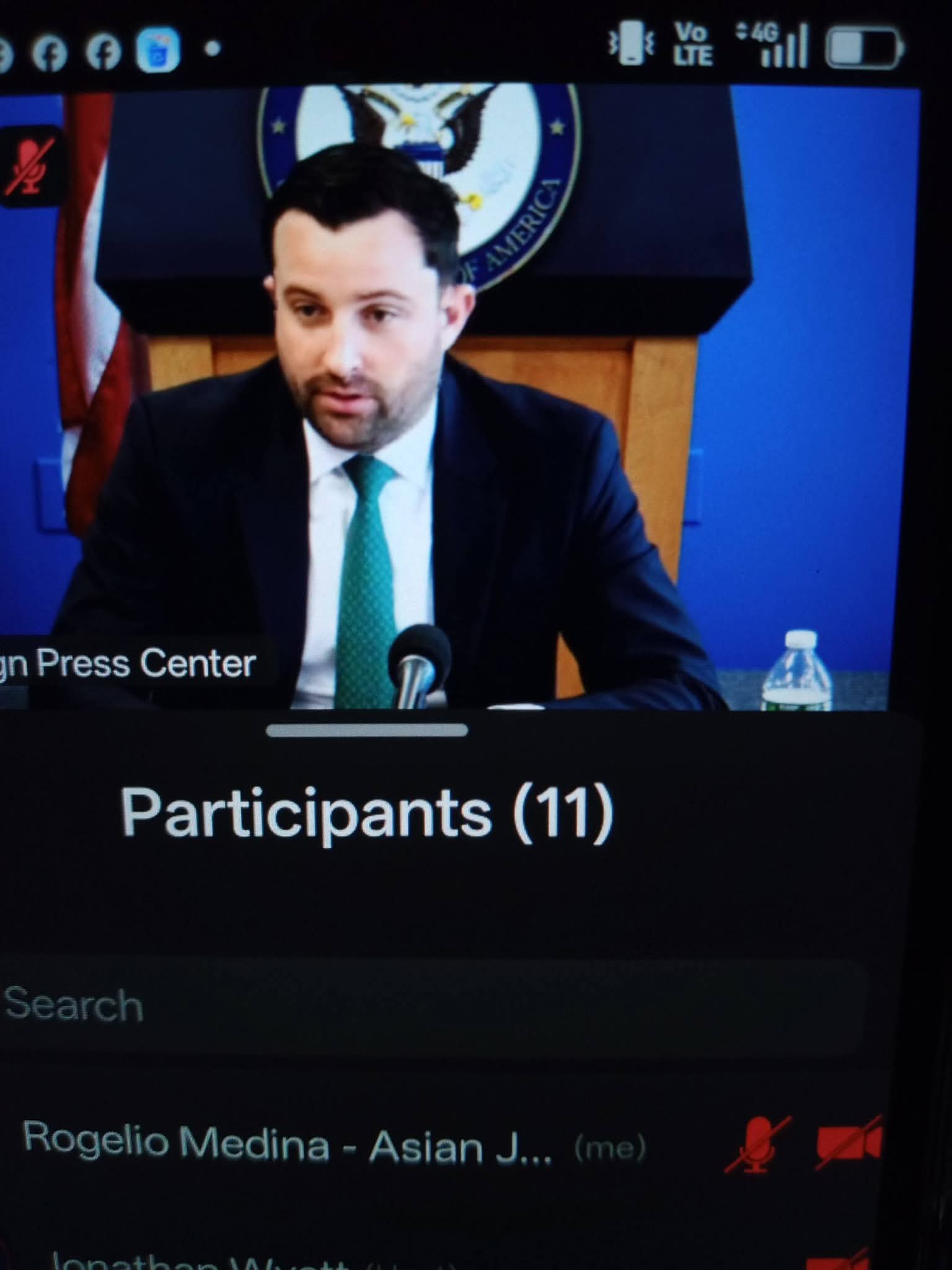
During a briefing at New York City’s Foreign Press Center, Bedard discussed a U.S.-sponsored resolution adopted by the United Nations Commission on Crime Prevention and Criminal Justice to prevent and combat transnational child sextortion.
“We keep Americans safe by countering crime and illegal drugs abroad through security assistance, diplomatic pressure, visa restrictions and rewards programs,” he said.
Bedard was in New York for a conference on child exploitation hosted by the Tim Tebow Foundation. He described transnational sextortion as one of the fastest-growing threats to children.
Sextortion uses explicit images to blackmail a victim. Although the crime is not new, Bedard said financially motivated schemes targeting children across borders have expanded.
In a common case, an offender creates a false online identity, posing as a young woman on social media or a gaming platform, and approaches a teenage boy. After gaining the child’s trust, the offender persuades him to share an explicit image, then threatens to distribute it unless money is paid.
“The psychological pressure is instant and crushing,” Bedard said, noting that children have died by suicide within hours of contact.
Since 2021, more than 40 American teenagers have died by suicide after being sextorted, he said. Thousands more have been victimized, while reports from partners suggest the global toll is higher.
Bedard said perpetrators view the crime as profitable, scalable and difficult to punish. Many schemes are run by small or loosely affiliated groups that exchange scripts and tactics online. Criminals use artificial intelligence to create deepfakes, exploit social media and gaming platforms, communicate through encrypted applications and launder proceeds through cryptocurrency.
Nearly half of sextortion schemes targeting Americans originate in Nigeria and Côte d’Ivoire, Bedard said. The Philippines ranks a distant third, followed by India, according to data he cited.
In 2025, the National Center for Missing and Exploited Children received more than 50,000 sextortion reports through its CyberTipline. Bedard said the cases were referred to law enforcement, not estimates.
He warned that sextortion may lead to other forms of exploitation, including child sex trafficking, because offenders can use similar grooming methods to control young victims.
In June 2026, the United States secured adoption in Vienna of what Bedard described as the first U.N. resolution devoted specifically to preventing and combating transnational sextortion of children.
He cited President Donald Trump’s March 2026 executive order directing federal agencies to prioritize prosecutions involving cyber-enabled fraud, including sextortion schemes targeting American families.
Although boys are the targets in many financially motivated cases, Bedard said girls are also victimized.
He said cooperation with Philippine authorities and partners should be measured by its ability to prevent abuse globally and save young lives.
“If we’re able to save one child from sextortion and one child from taking their own life, I consider that a success,” Bedard said.
The Young Ones Are Rediscovering the Creative Market
The Philippines is expanding participation in the creative economy through CREATEPhilippines, the government’s platform for creative industries.
The sector draws on Filipino talent, culture and innovation to produce goods and services protected by intellectual property. It includes advertising, animation, fashion and graphic design, film, music, publishing, performing arts, crafts, culinary arts, gaming and software.


Young Filipinos drive this growth by turning ideas and imagination into marketable work, from woven textiles and independent films to digital games and animation.
In July 2026, CREATEPhilippines will stage the Philippine GameDev Expo, or PGDX, in Manila. The event aims to showcase homegrown talent and connect local game developers with international industry participants.
In September, CREATEPhilippines and the Cultural Center of the Philippines will hold the Manila International Performing Arts Market to promote Filipino performing artists and creative enterprises.
Through such programs, the younger generation is helping strengthen an industry with economic and cultural value.

* * *
The opinions, beliefs and viewpoints expressed by the author do not necessarily reflect the opinions, beliefs and viewpoints of the Asian Journal, its management, editorial board and staff.
* * *

Associate Professor III Rogelio Constantino Medina is an award-winning Filipino international journalist, columnist and academic. He is well regarded for his extensive contributions to Philippine media and major international news publications. His career spans several decades and covers a wide range of fields, including news, business, travel, lifestyle, science, sports and health. He has written for major international publications such as the Far Eastern Economic Review in Hong Kong, The Japan Times in Tokyo and Gulf News in Dubai. Notably, he made history as the first Filipino journalist to interview Japan’s first astronaut, Dr. Mamoru Mohri. He is also credentialed with the U.S. Department of State’s Foreign Press Centers in New York City and Washington, D.C.