





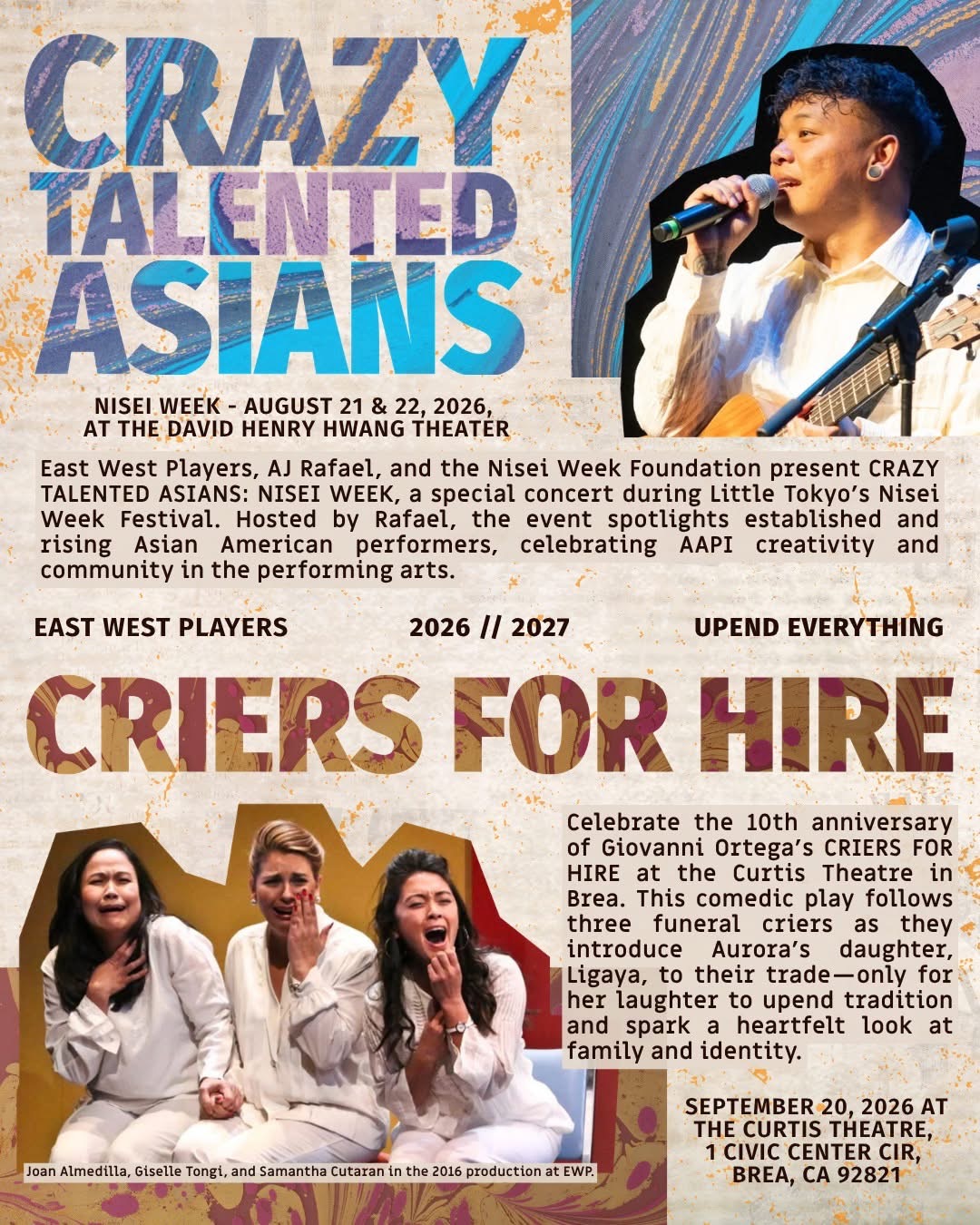
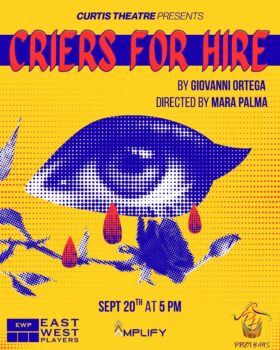
Criers for Hire Flyer at Curtis Theatre
Don’t look now, but the beloved comedy hit “Criers for Hire,” commissioned by East West Players Theatre in 2016, is back! This time with a new director and a new cast.
Playwright Giovanni Ortega told us in an exclusive interview what changes he made in the 2026 iteration. He revealed, “We’re making some changes with just some of the character behaviors. I don’t want to give it away, but some of the relationships are slightly different. I feel like some of the characters have more grit.”
Directed by Mara Palma and to be shown at the Curtis Theatre on September 20 at 5:00 p.m., the revised iteration of “Criers for Hire” features Joy Regullano (Ligaya), Sandy Velasco (Baby), Bianca Ibarra (Henny), Evie Abat (Meding), and Pablo Cuen (Narciso).
The comedy is about Aurora, Remedios, and Eugenia, who are three of the most sought-after professional funeral criers in Brea. They are eager to welcome Aurora’s teenage daughter, Ligaya (nicknamed Gaya), from the Philippines into their world and teach her their somber trade. However, they soon realize that Gaya has the opposite effect on people, making them laugh instead of cry. What ensues is a hilarious and heartwarming story of cultural identity, generational conflict, and finding home in a new country.
This special presentation is part of AMPLIFY—an initiative to address inequality in performing arts programming that provides a platform and outlet for performing artists of all kinds, while expanding the inclusivity and outreach of the Curtis Theatre to a diverse artistic community.
We were able to talk to Ortega, Regullano, Velasco, and Ibarra in exclusive virtual interviews, and they talked to us about why it was important for them to be a part of this project.
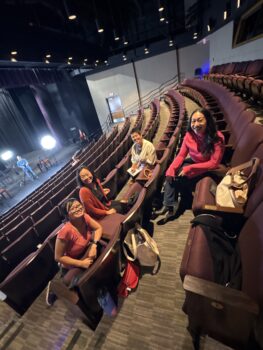
Giovanni Ortega (Playwright)
This is the 10th anniversary of “Criers for Hire.” How different is this 2026 version from the 2016 version? What changes did you make?
We’re making some changes to just some of the character behaviors. I think I don’t want to give it away, but some of the relationships are slightly different. I feel like some of the characters have more grit. They already have grit. These are based on my Titas and my mom’s story. But I think the journey of Ligaya coming here is still the same time period, so early ’90s. She’s a little older. So, I think in the original play she was about 14. We’re aging her up a little bit—16. I see. Filipino relationships are so interesting. There’s something different from a 14-year-old to a 16-year-old, I feel.
And Narciso’s trajectory is slightly different as well. In the original production, he was Colombian. In this production, he’s Mexican. In my work in the last ten years after “Criers” was published, I really found so many similarities between Mexican and Filipino cultures. Acapulco and Manila galleons that went back and forth. We are very similar in behavior and culture and religion. So, Ligaya and Narciso actually find that friendship, but the mom doesn’t really know. So, she doesn’t really have that knowledge. So, the transformation is more evident for Ligaya.
Why do you think people relate a lot to this play?
It’s so funny, right? It doesn’t give it away in the beginning. Like, there’s a character that’s TNT, and I’m like, wow, we’re actually still talking about it.
It’s not mentioned in this play specifically, but I was looking at another play of mine from the same time. And I bring out ICE, and I’m like, wow. I think as immigrants or children of immigrants, we’re very aware of it. But in the States now, everyone’s really aware of it. Like, we’ve always known, we’ve always known the stories, but now you cannot hide from it anymore.
So that’s one thing that I think is really interesting, is that people will watch this and say, wow, did you just write this? I’m like, no, I wrote it ten years ago. And by the way, Jessica Hagedorn wrote stories about it 40 years ago. You know, Carlos Bulosan wrote stories about it 60 years ago. The story keeps coming back for some reason.
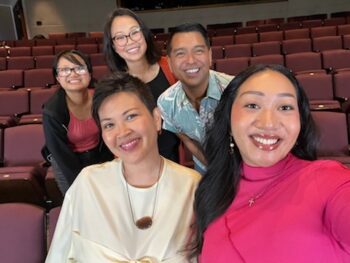
How did you choose the actors who are portraying their characters here in this play? Can you talk more about them and why they are perfect for their roles?
Joy was actually the very first person who did a public reading with East West Players. And Tim Dang directed that. The very first reading, and Sandy also. Sandy was also the original Baby. And funnily enough, when I met Joy, she was just, like, post-college. She just finished college. And I think in the last ten years she’s grown. This is so funny because she’s grown to understand Ligaya as a teenager now, which is really interesting.
Also, because Joy is Filipino American and was born and raised here, I feel like maybe the understanding wasn’t there back then, but now, as she has written so many plays, and I’ve worked with Joy so many times in the last ten years, it’s like, wow, let’s go back to this. You’re perfect. I think you’re really Ligaya, with a name like Joy.
And then Sandy is just the same thing. I wasn’t really involved with the casting before, and I don’t remember if Sandy auditioned for the actual production that Jon Lawrence Rivera directed. This time around, being a mother herself, it changes her completely. I was talking to her, and she has a six-year-old kid.
She is learning from her daughter as well. And it’s really interesting how time really changes us as artists and as humans. I was just reading the play, and Evie’s comic timing is just on point. And Bianca is someone I just recently started working with. And funnily enough, I was in Singapore, and I was doing some work there. And the cartoon that she voices, Gabby, is huge. It’s so huge over there. But Bianca’s another one of those folks who I just started working with last year, and I was like, wow, you’re so Pinay, but so American, and she’s from Texas.
So just that sensibility of being Filipino American, not Filipino enough, not American enough, really understands that. These women are so funny. All four of them are just hilarious. I can’t wait for them to be in the same room to work together.
Why is this play such a passion project for you?
When Tim Dang commissioned me to write about it, I really wanted to honor—oh my God, I’m going to get emotional—I really wanted to honor my Lola. Her name is Baby. She had just recently died during that time. And I was like, oh, this is a really great way to honor her and her sister and the matriarch of the sisters, Lola. So, it’s really the three of them getting together. Henny, Baby. And I think that’s the reason why it keeps on coming back. I wanted to bring it back because, again, politically speaking, we have a right to be here.
They’re also doing a shorter version of the play during the Filipino American Theater Festival in Chicago a week later.
And just the relationships of being nice are so inspiring to me. I was raised by women. Also, they are the first people who really understood me and welcomed me as a gay person. And I think that’s why Ligaya, I really created her to be a female character because I was—I would understand her more as a writer if that was the way we wrote it. But yeah, that’s really the reason why I love this play so much. And at the end, I honor the women, my Lola and my Titas.
This Lola, on my mother’s side, Lola Baby, was actually the one who raised me in the Philippines.
Then I moved to the States when I was 12. My mom came in for the weekend to watch the play. At the end of the play, she looks at me and she’s like, “Hindi naman nangyari ’yan, eh.” (It really didn’t happen like that.) I was like, of course it didn’t happen that way because it’s fictionalized slightly.
But yeah, the mom in the play is close to my mom to a T.
How is it working with director Mara Palma?
She is very sweet and very caring. One of the conversations we had was, I just want you to really create a very loving environment, a very nurturing environment. And that was, like, such a given. That wasn’t a problem at all.
Have you ever experienced the real criers for hire in the Philippines? And how was that experience?
No. I haven’t. Ruben Uy, the actor, talked about it because he’s Chinoy (Chinese Filipino), and he mentioned something to that extent. But I don’t know if you know, but my mom’s dad is Chinoy.
And so that was part of the reason I delved into this; I was delving into my Chinoy identity. My Lolo didn’t raise my mom. He left when she was eight. But funnily enough, and this is another play, so when my mom was here for three days to watch “Criers,” I wanted to be very specific, dramaturgically and historically speaking; we need to do the research when we’re telling stories. So, I really wanted to research Chinese criers. And then, at the same time, I started looking for my Lolo. And I found him; I found my Lolo, and he responded to me the weekend my mom was here to watch “Criers.”
They haven’t seen each other in 55 years. We’re eating at Izakaya in Little Tokyo. And I was like, Mom, I think someone from your dad’s family on Facebook is trying to reach out. She’s like, I don’t want—I don’t want to talk to him. But then, to make a long story short, we find out that he’s in Torrance.
The following day, we went to the nursing home. I walk in, I find him, and he’s like, “Gio.” And then my mom walks really slowly; she sees him, and she goes, “Daddy.” She turned into this ten-year-old girl.
That I’ve never—I’ve never experienced in my life. And I didn’t have that relationship with my Lolo, but they did. So, they rekindled their relationship until he died during the pandemic.
So now that he’s passed on, he’s like the Chinese Filipino watching over this play.
What do you think audiences will get after watching this play?
I want to make sure that for Filipinos, they’ll get it. For immigrant families, children of immigrants, they’ll get it. I really want to make sure that people who are not from immigrant families understand that family is family, right? This is the story of a mother and daughter who didn’t know each other and had to know each other within a span of a year. But also, just the strong will of women who come together.
We are so layered as a people, as Filipinos. There are so many layers for us. We’re not just monoliths. I think that’s one thing that I want people to learn, and just for people to laugh, and Ligaya really does that. You hear at the end what her Lola said, and that’s why we realize why she doesn’t cry.
Congratulations also because “Criers for Hire and Other Plays” will be published by the Philippine American Writers and Artists in October 2026.
Yes. Thank you.
Joy Regullano (Ligaya), Sandy Velasco (Baby), Bianca Ibarra (Henny)
What inspired you to join this play? Were you familiar with it before?
Joy: Yeah. Gio had asked me to be in a reading of this play, like, years ago before it was in development, before it had its East West Players run. I loved it then. He asked me to be in the reading this time. I was so thrilled to be back in that world because I loved it then. I still love it now. I love working with Gio. He’s talented. So yeah, just grateful to be a part of it.
Sandy: Yes. I actually did my first public stage reading in 2015 with East West. I think we performed at the Japanese American National Museum.
Bianca: No. So, I worked with Gio before on some projects. We did a play reading back in January. That’s when we met. It was also, like, an all-Filipino cast and crew kind of a thing. Then we did another reading in May.
Then he contacted me to do this. I liked it, of course, because I love Gio. He’s always so welcoming. Ever since I first met him, which was on a project with all Filipinos, it already felt like family. He immediately felt like family as well. So, when he contacted me to do this, I was like, I will do whatever you want me to do.
Can you tell us more about your character?
Joy: She is a recent immigrant from the Philippines. I think inspired by Gio’s life. And still a kid, when she goes to school, she doesn’t fit in very well. They make fun of her accent. They think she sounds like a duck. She sounds like a duck, kind of like that. But she loves new wave music. It’s a little bit about her, and she’s very joyful, as her name might suggest.
Sandy: I’m playing Baby or Aurora. I’m the mom of Ligaya. So, I am an immigrant who came to the U.S. to pursue the American dream of providing a better life for my family, which is my daughter, Ligaya, who’s 14.
Bianca: She is named Eugenia, or her nickname is Henny. She’s Filipino American just like me. She has a history degree. And she’s one of the three professional criers for hire. But her main thing is that she wants to find love, but she’s always with the wrong guy.
When you want love so much, you want to find it with any person you’re with. Henny is very much like that. But she’s also the more dramatic one in the group; I think the two other ladies are very professional with their cries. But Henny is very dramatic and over the top, which honestly is very much like me. My parents call me OA, or overly dramatic.
What do you know about criers for hire in the Philippines? Have you ever experienced them at a funeral? And what was your reaction?
Joy: I haven’t, no. I’ve not been to a funeral in the Philippines. But learning about it, I remember we talked about it when I was in the developmental reading, and yeah, I was surprised to hear about it. But it makes sense that Filipinos would be very good at this because I think Filipinos can be very dramatic, or so.
Sandy: I never heard of them before I did this play. But I’m not surprised to have somebody because maybe the Filipinos or even the Chinese community has a very shame-based culture. So, it’s funny that even in the afterlife, you have to show face to make sure that people are mourning your death. So it’s very fascinating, but I never heard of them until I did this play.
Bianca: No. Well, when I saw the play titled “Criers for Hire,” I was like, what is that? I didn’t know what that was. When I read the script, I was like, oh, this is a real thing. When I saw the premise, I was like, oh, Gio just came up with this. But I read the whole thing, and I was like, oh, wow, this is real. So, this is my first time hearing about criers for hire.
In real life, do you cry easily? What makes you cry?
Joy: I do actually cry at movies. I cried at “Curious George.” Sometimes, I cry at trailers. What makes me cry? I guess stuff about parents. I have a very soft spot for parents, and animal stuff makes me cry too. Of course, like the big life stuff, like marriages, deaths, grieving, even happy things.
Sandy: Yes, I’m a mom now. I have a daughter. And I think having my six-year-old daughter made me more emotional. I literally watch her when I realize any milestone in her life. If she says something for the first time, she walks for the first time. Even now that she’s going to be in kindergarten or first grade, I’m crying all the time, and she goes, oh, no, no. She’s starting again. I’m just crying all the time now.
Bianca: It’s hard for me not to cry. Like, I’m a very emotional person. If I’m happy, I cry. If I’m sad, I cry. If somebody’s crying in front of me, it’s very hard for me not to cry. Filipinos are so emotional. It’s very easy for me to cry.
Is this your first time working with Giovanni Ortega? How is it working with him?
Joy: Oh, I actually have worked with him several times over the years. I took playwriting at East West Players a long time ago, and Gio had been assigned to direct my play back then. So, I’ve worked with him as a director on my material, but then I’ve also been an actor in his work. And I also recently took a playwriting class at East West Players. So yeah, just over the years I’ve worked with him a lot, and it’s always so great. He adds so much to anything I collaborate with him on.
Sandy: Oh, no, it’s not the first time. The first time probably was the first reading, 11 years ago. He’s great. Even now, I’m so excited to do the play again because he’s so excited. The way he talks to us, he’s just very excitable, very warm. I love working with him.
Bianca: Well, I’ve only known Gio for a few months, but I think he’s sassy. He’s very professional. I love his ideas when it comes to directing. I never would have thought of that. He just seems like a seasoned director and so professional, but also so welcoming too, which helped me a lot too, because when I did the play reading back in January, I hadn’t met anybody there before. I was also the newbie there.
Well, because I’m originally from Texas. I moved here two years ago. So, a lot of the time, like, I’m the newbie in the room. I don’t know everyone there. So, he was really nice and welcoming, and that made me feel comfortable and excited to be a part of the play reading and how.


Can you share with me your acting process? How do you prepare for a role, and how do you relax after a performance?
Joy: A good question. Doing your homework. So, reading the material, just the dramaturgy of it too. Learning about the crying or whatever the circumstances are, the time period. The dialect is going to be a big one for this one since I grew up here in the United States, but this character is an immigrant. So that’s going to be a big part of the preparation, or even just the dialect, the mouth placement, and the accents and all that stuff. Working in the shape of any monologues or any emotions, any journeys that the character goes on, just mapping my experiences onto the character’s emotional journeys and what can get me there.
How do I relax? Hanging out with the cast after is always nice, or whoever comes to the show, just chill with them, maybe a nice drink. Eat a taco from a taco truck or Korean barbecue or whatever’s out there. Or even just going to bed.
Sandy: Preparing for the role. I think I just want to obviously get to know the character, get to know the world she’s in. Then, besides learning the lines, that’s just a given. I just want to get inside her world. So right now, when I read this for the first time, I wasn’t a mom yet, and even when I read this play again, I’m relating to her even more. And now I have a daughter. So now I’m like, all the feelings of sacrifice, all the feelings of doing everything I can.
And because I’m also an immigrant, I can relate to this character so much. I’m now realizing that I relate to her so much in that there’s a lot of me that’s very American in my being a mom, like gentle parenting and really sharing your feelings. But there’s also a part of me that was like, just do it because I’m Mom. This is a dictatorship. You do it because I said so, and I know what’s best for you.
I’m always telling her all these things, like, I’m here to give you solutions, not to, like, sit down with you. But because I’m also an American, and I’m trying to raise a more balanced girl, emotionally balanced, well-balanced girl, then I invite her to share her feelings, you know? Let’s talk about it. Why do you feel this way? And so, in this process, for this character, it’s a lot about, like, tapping into who I am as a mom, what I can relate to.
And then once the project is done, it’s very sad. I get really emotional because you get so attached to the character, and you’re like—I talk about it with everybody, with my husband. I’m probably going to share this with my daughter, who I’m playing with this time. So, it gets very emotional, and I get really sad, like you say goodbye to them, to the character. But it’s very sad for me.
Bianca: Oh, good question. So, I went to acting school. I got my BFA in acting degree at Saint Edward’s in Austin, Texas, and I graduated in 2021. The first show that called for me to figure out my process like that was a show called “Good Friday,” and it dealt with very heavy and emotional themes. It talked a lot about campus shootings and victims of sexual abuse. I was 19 at the time, and then I just didn’t know how to do that, how to take the mask off when you’re dealing with such heavy themes, especially doing a show every night.
What I found was important, I gave it all on the stage. Then I really needed to have a moment to myself when I got home, nobody around, and take the mask off of that character. Also, prayer is really important for me too. So, I feel like that also helps me calm down and center myself after doing such a heavy show.
Reading the whole script helps me not put any expectations on it. Then also just allowing myself to play when I’m in the rehearsal process and learning my lines. I don’t want to teach them a certain way. Then when I get to rehearsal, I can’t do it a different way. So, allowing myself the freedom of taking chances, doing different things. Of course, sometimes the director has a different vision than you do as the actor, so being open to that as well has really helped me.
How is it working with your castmates in “Criers for Hire”? How do you bond?
Joy: Hopefully we’ll get some food together. Food is a great bonding thing for Filipinos. Filipinos love food. We love laughing together. I guess there’s always space, but maybe we won’t do that, and we want to keep it positive, of course. But in life, I think sometimes, even though sometimes it can be negative, it also has a bonding effect. Maybe we’ll just talk about the general state of America.
Sandy: I’ve worked with most of them, except the Henny character, I believe. So, Joy, I’ve worked with her for many years. She always plays my daughter because we do comedy too. So, she would always cast me as her mom, but in a joking way. Because I look so young, and it’s this idea that Asians don’t look old. So, over the years, I portrayed her mom at least two, three, four times already. So, it’s nice to, like, do it again. Then Evie, I’ve done a play with her with Jon Lawrence Rivera. We’ve done a play together, so I’m excited to get to know everybody.
Bianca: So, we haven’t met officially yet for rehearsal, but I’ve met Evie before, the same time I met Gio in the play reading back in January. But like I said, I feel like whenever I work with Filipinos, I feel immediately there’s a bond there because we can speak the same language most of the time, like we have the same humor. So, but like I said, anytime I work with Gio, it’s always a great experience. So, I’m excited.
What do you hope audiences will get after watching this play?
Joy: I hope that they’ll be moved. I hope that they’ll laugh and they’ll cry and that they’ll think about immigrants in this country just on a larger idea too, besides just identifying with Gio’s personal story. I think where we are with immigrants in this country is just being more welcoming, open and kind to people who come here, and they feel different than everyone else.
Sandy: I always hope for empathy. Empathy for the characters and for life, especially as an immigrant, with everything that’s happening right now. I always hope that people will get a little bit of an idea of what the struggle is. That’s not that easy. Also, especially for parents, right? So, the family values that it brings out, I hope that people can relate to it or learn from it.
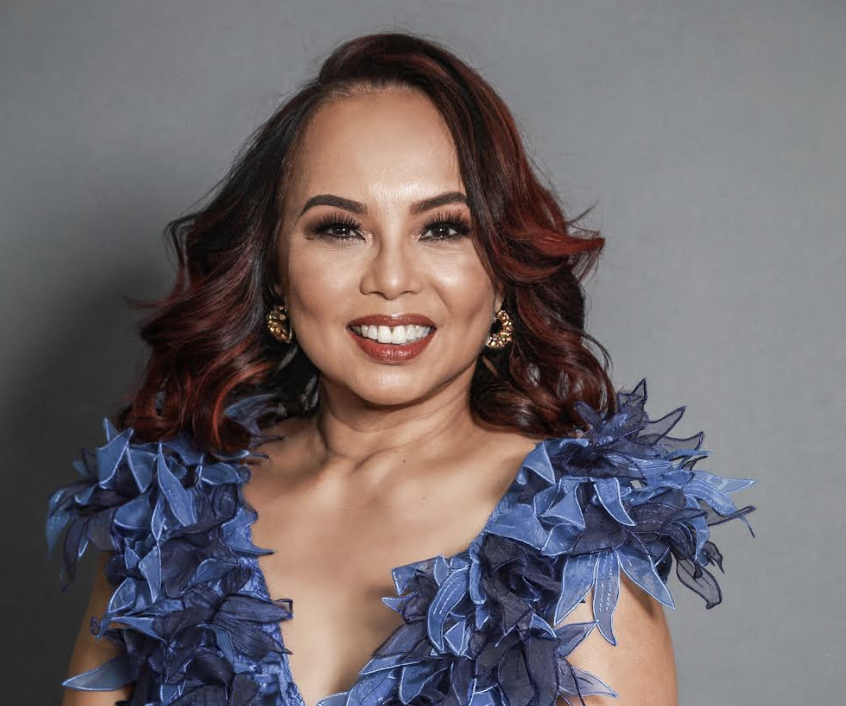
Janet Susan R. Nepales is an award-winning journalist and the first Filipina voting member and Associate of the Golden Globe Awards. She has been a member since 2008 and is the first Filipina to be elected to the Advisory Board. She is the author of the coffee table book “FASHION. Filipino. Hollywood. The World” and the co-author of the first FWN book “DISRUPT: Filipina Women: Proud. Loud. Leading Without A Doubt.” A graduate of UST (AB Journalism, cum laude), she is based in Los Angeles and is a Hollywood entertainment journalist and TV correspondent.