

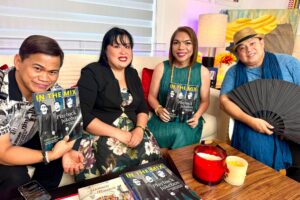

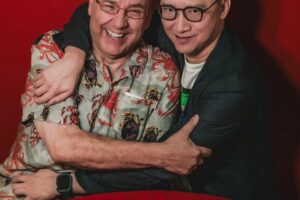


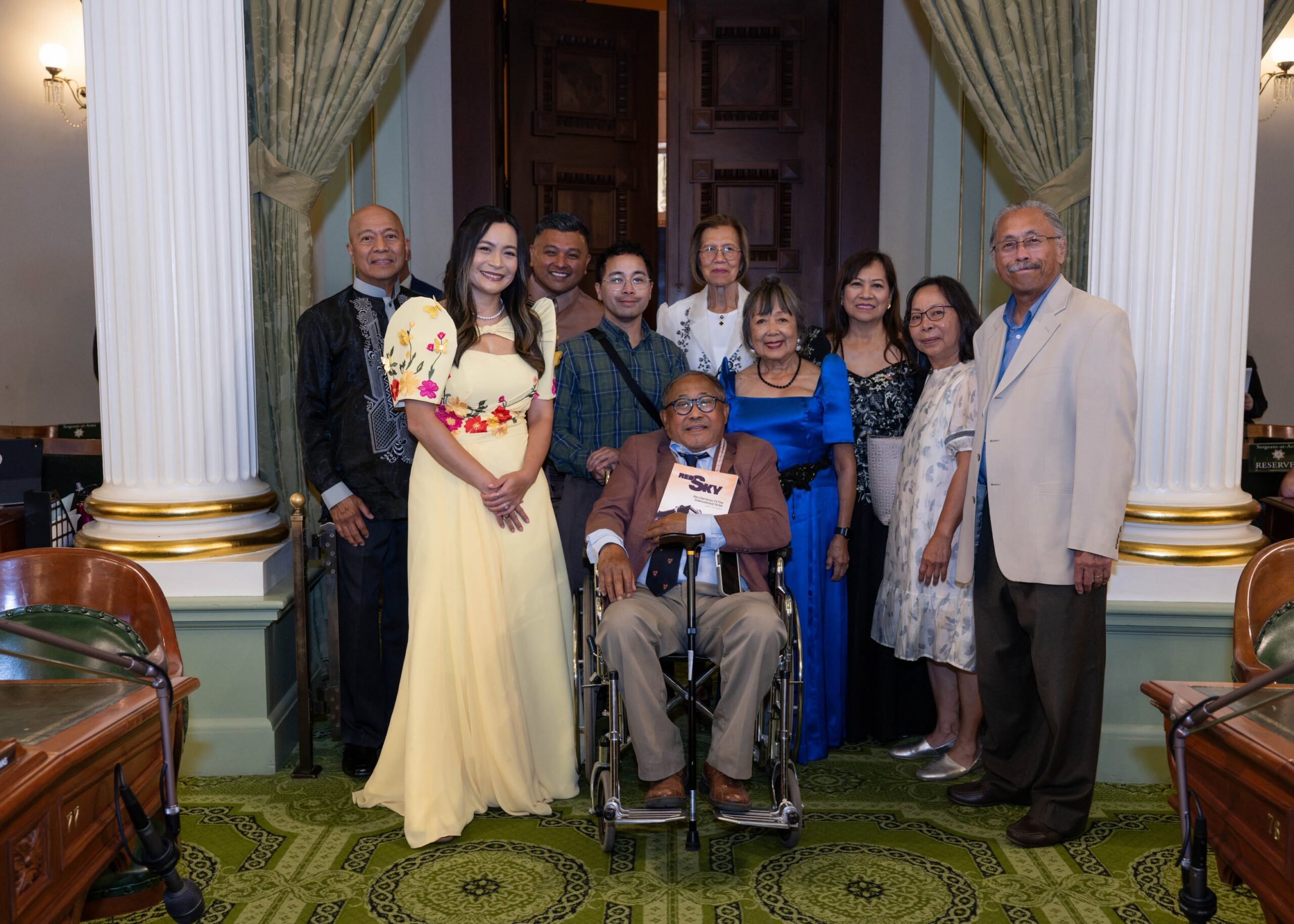
Assemblymember Jessica Caloza joins the 2026 Filipino American History Month “Champions of Change” honorees and their representatives at the California State Capitol in Sacramento on Aug. 3, 2026. Recognized were Joselyn Geaga-Rosenthal, Emil A. De Guzman, SoCal Filipinos, the Manila International Film Festival and the late technology pioneer Diosdado “Dado” Banatao, represented by his wife, Maria Banatao. – Photo courtesy of Assemblymember Jessica Caloza social media account
Assembly and Senate resolutions mark the October observance as five honorees are recognized at the Capitol
SACRAMENTO – The California Assembly and Senate adopted separate resolutions Monday recognizing October 2026 as Filipino American History Month, while a Capitol program honored five individuals and organizations for contributions to technology, literature, historical preservation, community service and film.
Assemblymember Jessica Caloza presented House Resolution 102, which the Assembly adopted by voice vote after 64 lawmakers joined as coauthors.
The Senate adopted Senate Resolution 120, introduced by state Sen. Christopher Cabaldon, on a 36-0 vote. Cabaldon introduced the measure June 18, and it was ordered to a third reading June 24.
Caloza is the first Filipina elected to the California Legislature. Cabaldon, elected in 2024 after serving for two decades as mayor of West Sacramento, is the first Filipino American to serve in the state Senate.
Caloza said the observance carried personal meaning as the daughter of Filipino immigrants. Her parents, Gigi and Jesse Caloza, joined her on the Assembly floor.
The resolutions trace Filipino American history in California to Oct. 18, 1587, when Filipino members of a Spanish galleon expedition came ashore near present-day Morro Bay, marking the first recorded Filipino presence in what is now the continental United States.
Caloza also cited Filipino American contributions to agriculture, health care, education, the military, business, public service, sports and the arts.
Her remarks highlighted labor leaders Larry Itliong and Philip Vera Cruz, who helped organize more than 1,500 workers during the 1965 Delano grape strike. The Agricultural Workers Organizing Committee later joined with the National Farm Workers Association led by César Chávez and Dolores Huerta, helping form the United Farm Workers.
She also recalled the struggle to save San Francisco’s International Hotel, where mostly elderly Filipino and Chinese tenants resisted eviction for nearly a decade. Police removed the remaining tenants on Aug. 4, 1977, after breaking through a large barricade of supporters.
Caloza further recognized the Third World Liberation Front movements. The 1968-69 strike at San Francisco State led to the nation’s first College of Ethnic Studies, while a related campaign at the University of California, Berkeley, helped establish its Department of Ethnic Studies.
The Capitol observance included “Champions of Change” recognitions for technology entrepreneur Diosdado “Dado” Banatao, honored posthumously; Los Angeles community advocate Joselyn Geaga-Rosenthal; International Hotel activist Emil A. De Guzman; the nonprofit SoCal Filipinos; and the Manila International Film Festival.
The honorees were not named in the texts of HR 102 or SR 120 but were recognized during the accompanying program.
Banatao, who died in December 2025 at 79, was an engineer, semiconductor entrepreneur and investor credited by Berkeley Engineering with developing the personal-computer chipset and graphics-acceleration architecture. He also supported engineering education and scientific research. His wife, Maria Banatao, attended the ceremony.
Geaga-Rosenthal has held leadership roles with the Friends of the Echo Park Library and supported programs connected to the Philippine Heritage Collection and Carlos Bulosan Book Club. The collection preserves books and materials on Philippine and Filipino American history and culture, while the book club promotes Filipino American literature.
De Guzman served as president of the International Hotel Tenants Association during the campaign against the tenants’ eviction. He later worked through the Manilatown Heritage Foundation to preserve the history of the I-Hotel struggle and the cultural legacy of the neighborhood.
Founded in June 2020, SoCal Filipinos grew from an online network into a nonprofit serving Filipino communities across Southern California. Its activities include cultural programs, support for emerging businesses and scholarships. Founder Jason Lustina represented the organization at the Capitol.
The Manila International Film Festival promotes Philippine cinema in Hollywood through screenings, filmmaker discussions and industry events. Its third annual edition is scheduled for Sept. 3 to 6 at the TCL Chinese Theatre, followed by an awards gala at the Beverly Hilton.
Caloza also cited contemporary Filipino and Filipino American figures, including California Attorney General Rob Bonta, Cabinet Secretary Nani Coloretti, performer Lea Salonga and tennis player Alex Eala.