





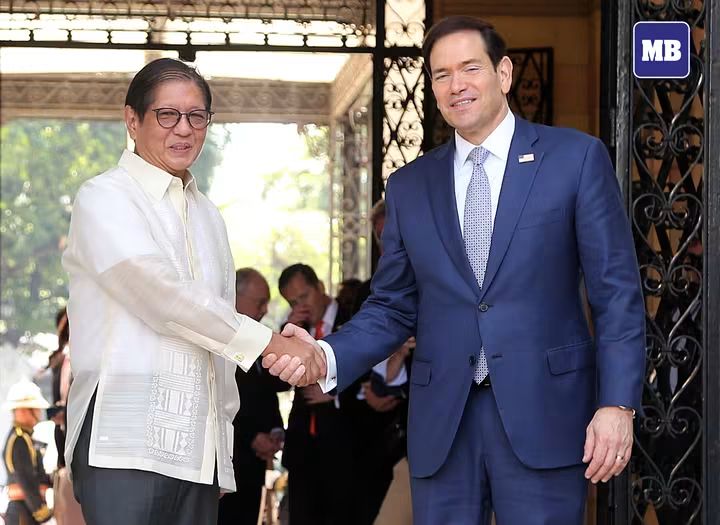
Secretary of State Marco Rubio was recently in Manila, Philippines, to engage with ASEAN and regional leaders, advance the U.S. vision for a Free and Open Indo-Pacific, reaffirm U.S. commitment to ASEAN centrality, and strengthen the U.S.-Philippine alliance.
The U.S.-ASEAN Comprehensive Strategic Partnership has helped Southeast Asia grow while creating opportunities for Americans and U.S. businesses. Recognizing the region’s strategic importance, the U.S. is investing more than $2.5 billion in security cooperation, infrastructure, technology, energy security and efforts against transnational crime.
U.S.-ASEAN AI Spark
Working with Congress, the United States plans to make Southeast Asia a focus for American AI exports. Through the Pax Silica initiative, AI SPARK, the U.S. will provide financial and technical support to governments interested in deploying the U.S. AI stack for public-sector applications.
The U.S. also plans to provide $10 million to strengthen and modernize the Philippines’ critical information and communications technology infrastructure.
Bolstering Energy Security
The Millennium Challenge Corp. Board approved a $60 million Threshold Program grant to the Philippines to support energy-sector investment, strengthen institutions and expand American commercial opportunities.
The U.S. also plans to provide $4 million to advance mining projects toward investment and offtake and identify investment-scale opportunities.
Investing in Infrastructure
The U.S. is investing $1.5 billion to establish a platform supporting energy-security infrastructure across the Indo-Pacific, the single largest project investment in the International Development Finance Corporation’s history.
It also plans to work with Congress to provide more than $100 million for strategic infrastructure and other investments in the Philippines, focused on Subic Bay in the Luzon Economic Corridor.
Combating Crime and Strengthening Law Enforcement
The U.S. plans to provide $2.5 million for ASEAN programs targeting scams, cybercrime, drug trafficking and money laundering. It is also providing $9 million to expand a Philippine Coast Guard pier in Palawan to strengthen maritime law enforcement and sustain South China Sea operations.
U.S.-Philippine Commercial Ties
The United States welcomed Philippine Airlines’ intent to purchase up to 20 Boeing 787 aircraft powered by GE Aerospace GEnx engines, reflecting deepening commercial ties.
Strengthening Security Cooperation
The U.S. will allocate $100 million in military grant assistance to the Philippines for fiscal year 2026, a $60 million increase over historical annual funding levels, to enhance its ability to defend its sovereignty and deter conflict.
It also plans to provide $19 million this year for investigations, prosecutions, information sharing, training and equipment supporting Philippine counterterrorism efforts.
The U.S. is funding a $6.5 million contract providing the Philippines access to the Rhombus AI Concierge platform for national-security analytics and predictive analysis. Another $3 million will support cyber-related training.
Improving Global Health Security
The U.S. and Philippine governments signed a five-year Strategic Objective Agreement containing a jointly funded plan of up to $685 million to improve capacity to detect, treat and prevent HIV and tuberculosis and strengthen global health security.
35th Annual Fairfield Tomato & Vine Festival
Downtown Fairfield, California, comes alive with music, food and summer activities during the 35th Annual Fairfield Tomato & Vine Festival on Aug. 15-16, from 11 a.m. to 5 p.m. at 600 Texas Street.

The free, family-friendly event features tomatoes to sample and purchase, local food vendors, craft beer and wine gardens, a tomato-canning demonstration, children’s activities and a classic car show on both days.
Live music fills the County Green. Saturday features Mobility, Ideateam and Dirty Cello. Sunday features F.A.T Betty, Michelle Lambert and Ginger Molasses.
The celebration each year highlights Fairfield’s agricultural roots, diverse community and downtown. Admission is free. For information, contact Juanita Johnson at 707-428-7628 or jjohnson@fairfield.ca.gov, or visit www.fairfield.ca.gov/tomato.
Vince Tañada’s Rizal 3000 Grand Opening
Despite the suspension of classes due to continuous heavy rain, the recent grand opening of Vince Tañada’s futuristic play Rizal 3000 drew an enthusiastic audience at St. Scholastica’s College Manila.

At the entrance, I saw esteemed director Anton Juan; PX and Ssheng Ilano, whom I thank for inviting me; my dear friend Christina Aliada with her daughter, Princess Lee Cansino; and Gerald Magallanes.
Seated in the balcony during the darkened performance, I continued taking notes with the light from my mobile phone. Catherine Daymoto, leader of the Elia Ilano fan club, helped identify performers whose faces I could not clearly recognize. I was familiar with the voices of Vince Tañada, Johnrey Rivas, Elia Ilano, Joseph Tañada, OJ Arci, Peter Parker Tañada, JP Lopez, Chris Lim, Adelle Ibarrientos-Lim and Vean Cancino.

Lance Cabradilla, Gabriel Bautista, Christina Aliada and Rogelio Constantino Medina; (seated) Peter Parker Tañada.
* * *
The opinions, beliefs and viewpoints expressed by the author do not necessarily reflect the opinions, beliefs and viewpoints of the Asian Journal, its management, editorial board and staff.

Associate Professor III Rogelio Constantino Medina is an award-winning Filipino international journalist, columnist and academic. He is well regarded for his extensive contributions to Philippine media and major international news publications. His career spans several decades and covers a wide range of fields, including news, business, travel, lifestyle, science, sports and health. He has written for major international publications such as the Far Eastern Economic Review in Hong Kong, The Japan Times in Tokyo and Gulf News in Dubai. Notably, he made history as the first Filipino journalist to interview Japan’s first astronaut, Dr. Mamoru Mohri. He is also credentialed with the U.S. Department of State’s Foreign Press Centers in New York City and Washington, D.C.